Finding the optimal Nash equilibrium in a discrete Rosenthal congestion game using the Quantum Alternating Operator Ansatz
This paper establishes the tractability of finding the optimal Nash equilibrium, as well as the optimal social solution, to a discrete congestion game using a gate-model quantum computer. The game is of the type originally posited by Rosenthal in the 1970’s. To find the optimal Nash equilibrium, we formulate an optimization problem encoding based on potential functions and path selection constraints, and solve it using the Quantum Alternating Operator Ansatz. We compare this formulation to its predecessor, the Quantum Approximate Optimization Algorithm. We implement our solution on an idealized simulator of a gate-model quantum computer, and demonstrate tractability on a small two-player game. This work provides the basis for future endeavors to apply quantum approximate optimization to quantum machine learning problems, such as the efficient training of generative adversarial networks using potential functions.
💡 Research Summary
This paper presents a pioneering investigation into solving a classic game theory problem—finding the optimal Nash equilibrium in a discrete Rosenthal congestion game—using variational quantum algorithms. The work establishes a proof-of-concept for applying quantum computing to complex optimization problems inherent in game theory and machine learning.
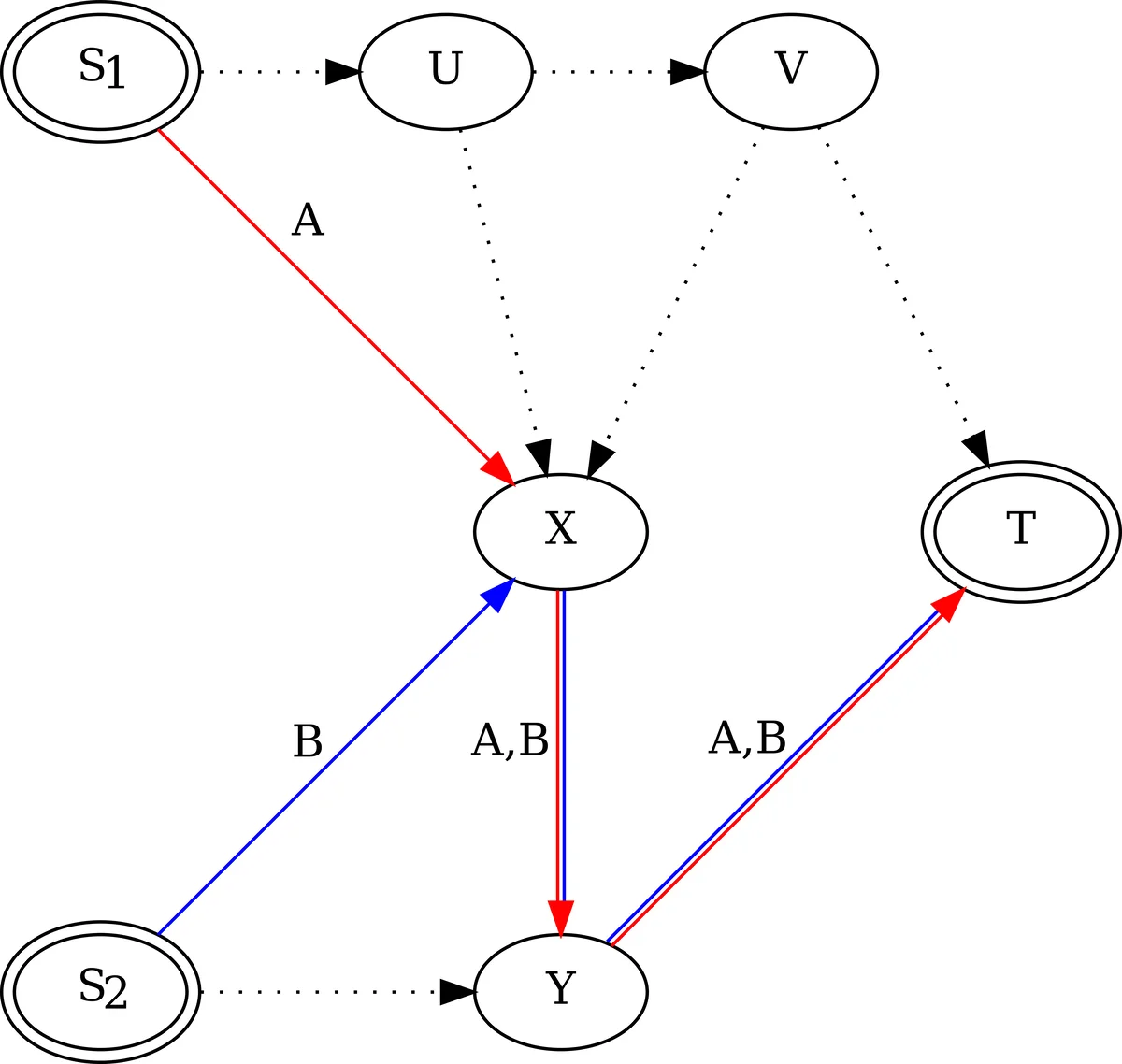
The core problem addressed is an asymmetric network congestion game with two players. Each player must choose a single path from their origin to destination across a shared network of resources (e.g., roads). The delay on each resource increases linearly with the number of players using it. The objectives are to find both the optimal social solution (the path combination minimizing total delay for all players) and the optimal Nash equilibrium (the path combination representing the best stable outcome where no player can unilaterally improve their delay). The authors formulate these objectives by leveraging Rosenthal’s potential function, which inherently encodes the equilibrium conditions of the game.
To solve this optimization problem on a gate-model quantum computer, the authors employ and compare two variants of the Quantum Approximate Optimization Algorithm (QAOA). The first is the standard QAOA, which treats the “one-path-per-player” constraint as a soft constraint by adding a penalty term to the Ising-model cost function. The mixing operator in this approach explores the entire solution space. The second approach is the Quantum Alternating Operator Ansatz, which enforces the constraint as a hard constraint. This is achieved by designing a specialized “parity mixer” as the mixing operator, which restricts the quantum state evolution strictly to the subspace of valid solutions (where each player’s selected path is represented by a one-hot encoded block of qubits).
The paper details the mathematical formulation for encoding the game’s strategies, utility functions, and constraints into polynomial cost functions compatible with QAOA. It provides explicit equations for the cost Hamiltonians corresponding to both the game’s potential function and the penalty terms for soft constraints.
The proposed methods are implemented and tested on an idealized simulator of a quantum computer for a small, tractable two-player game instance. This experimental validation demonstrates the feasibility of the approach. The authors discuss that the hard-constraint method, using the alternating operator ansatz, holds promise for more efficient search by avoiding invalid solutions, though a full-scale performance advantage remains to be proven on larger, real quantum hardware.
The broader significance of this work lies in its potential application to quantum machine learning, particularly the training of Generative Adversarial Networks (GANs). Training a GAN is framed as a two-player game, and failure to converge to a good Nash equilibrium leads to issues like mode collapse. By providing a method to find optimal Nash equilibria in a canonical game, this research lays the groundwork for future quantum-assisted algorithms that could directly optimize the training dynamics of GANs and other adversarial machine learning models, with potential impacts in finance (for synthetic data generation, fraud detection, and risk modeling) and beyond.
Comments & Academic Discussion
Loading comments...
Leave a Comment