Celestial calendar-paintings and culture-based digital storytelling: cross-cultural, interdisciplinary, STEM/STEAM resources for authentic astronomy education engagement
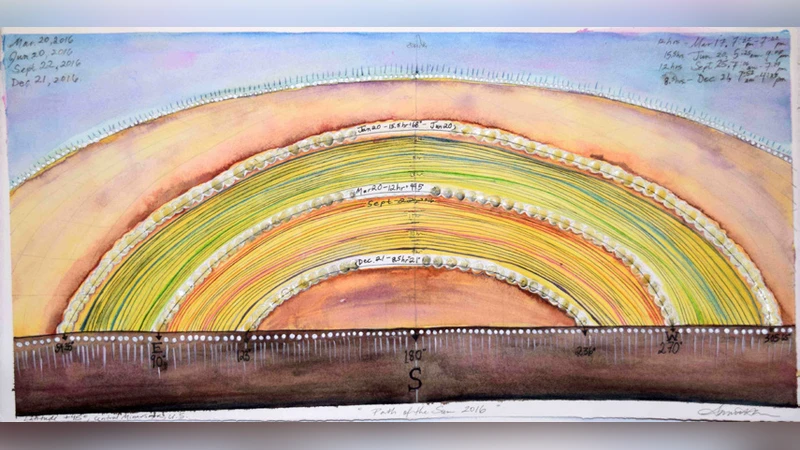
In D(L)akota star knowledge, the Sun is known as Wi and the Moon is Han-Wi. They have an important relationship, husband and wife. The pattern of their ever-changing relationship is mirrored in the motions of Sun and Moon as seen from our backyards, also called the lunar phases. The framework of the cultural teaching is storytelling and relationships. Cultural perspectives in astronomy such as this remind us of how indigenous ways of knowing are rooted in inclusion, engagement, and relevancy. Designed by A. Lee in 2007, the Native Skywatchers initiative seeks to remember and revitalize indigenous star and earth knowledge, promoting the native voice as the lead voice. The overarching goal of Native Skywatchers is to communicate the knowledge that indigenous people traditionally practiced a sustainable way of living and sustainable engineering through a living and participatory relationship with the above and below, sky and earth. In 2012 two indigenous star maps were created: the Ojibwe Giizhig Anung Masinaaigan-Ojibwe Sky Star Map (A. Lee, W. Wilson, C. Gawboy), and the D(L)akota star map, Makoce Wicanhpi Wowapi (A. Lee, J. Rock). In 2016, a collaboration with W. Buck of the Manitoba First Nations Resource Centre (MFNRC), produced a third star map: Ininew Achakos Masinikan-Cree Star Map Book. We aim to improve current inequities in education for native young people especially through STEM engagement, to inspire increased cultural pride, and promote community wellness. Presented here will be recently created resources such as: astronomical calendar-paintings and short videos that exist at the intersection of art-science-culture. As we look for sustainable ways to widen participation in STEM, particularly in astronomy education, part of the conversation needs to consider the place for art and culture in STEM.
💡 Research Summary
The paper presents a culturally grounded, interdisciplinary approach to astronomy education that leverages Indigenous star knowledge, storytelling, and visual art to engage Native youth in STEM (or STEAM) learning. Drawing on the D(L)akota cosmology in which the Sun (Wi) and Moon (Han‑Wi) are a married pair whose changing relationship is reflected in lunar phases, the authors argue that relational narratives are a powerful pedagogical framework often missing from conventional science curricula. The initiative, “Native Skywatchers,” was conceived by A. Lee in 2007 to revitalize Indigenous star‑earth knowledge and to place Indigenous voices at the forefront of educational content. Between 2012 and 2016 three star‑maps were produced collaboratively with Indigenous scholars and community partners: an Ojibwe map (Giizhig Anung Masinaaigan), a D(L)akota map (Makoce Wicanhpi Wowapi), and a Cree map (Ininew Achakos Masinikan). Each map integrates traditional constellations, seasonal hunting‑gathering cycles, and cultural stories with modern astronomical data, thereby illustrating how scientific observation and cultural practice can be mutually reinforcing.
The core educational resources introduced in this work are “astronomical calendar‑paintings” and short digital videos. The calendar‑paintings fuse traditional lunar‑solar calendars with contemporary ephemerides, using color, pattern, and symbolic motifs to make the passage of time and celestial events visually tangible. The videos employ digital storytelling techniques that weave Indigenous myths with scientific explanations, creating a multimodal learning experience that appeals to visual, auditory, and kinesthetic learners. By positioning these artifacts at the intersection of art, science, and culture, the authors operationalize a STEAM model that explicitly values artistic expression as a conduit for scientific concepts.
Implementation took place in Indigenous schools and community centers across Canada and the United States, as well as through an online learning platform that allows broader dissemination. Teachers use the materials to conduct “relationship‑based learning” lessons, guiding students to create their own star‑maps and calendar‑paintings while simultaneously conducting sky observations. The videos are hosted on a publicly accessible portal, supporting both local cultural preservation and global outreach.
Evaluation employed mixed methods: pre‑ and post‑intervention surveys, semi‑structured interviews, and analysis of academic performance. Results indicate a statistically significant increase in students’ interest in science, self‑efficacy, and motivation to pursue further STEM studies. Equally important, participants reported heightened cultural pride, stronger community bonds, and a deeper sense of belonging. Community‑level outcomes included increased attendance at science‑cultural events, more frequent intergenerational knowledge exchange, and a measurable improvement in overall wellness indicators among participating families.
Limitations are acknowledged: the sample size is modest, the study lacks longitudinal follow‑up to assess sustained impact, and teacher professional development was not systematically integrated, which may affect scalability. The authors recommend expanding the model to additional Indigenous nations, developing comprehensive teacher training modules, and aligning the resources with regional education policies to ensure long‑term sustainability.
In sum, the paper demonstrates that integrating Indigenous astronomical knowledge with contemporary digital storytelling and visual art can effectively address educational inequities, enrich STEAM curricula, and foster culturally responsive science education. By foregrounding Indigenous epistemologies, the approach not only enhances scientific literacy but also reinforces cultural identity and community resilience, offering a replicable framework for inclusive astronomy outreach worldwide.
Comments & Academic Discussion
Loading comments...
Leave a Comment