Comparison and Application of non-Conforming Mesh Models for Flow in Fractured Porous Media using dual {L}agrange multipliers
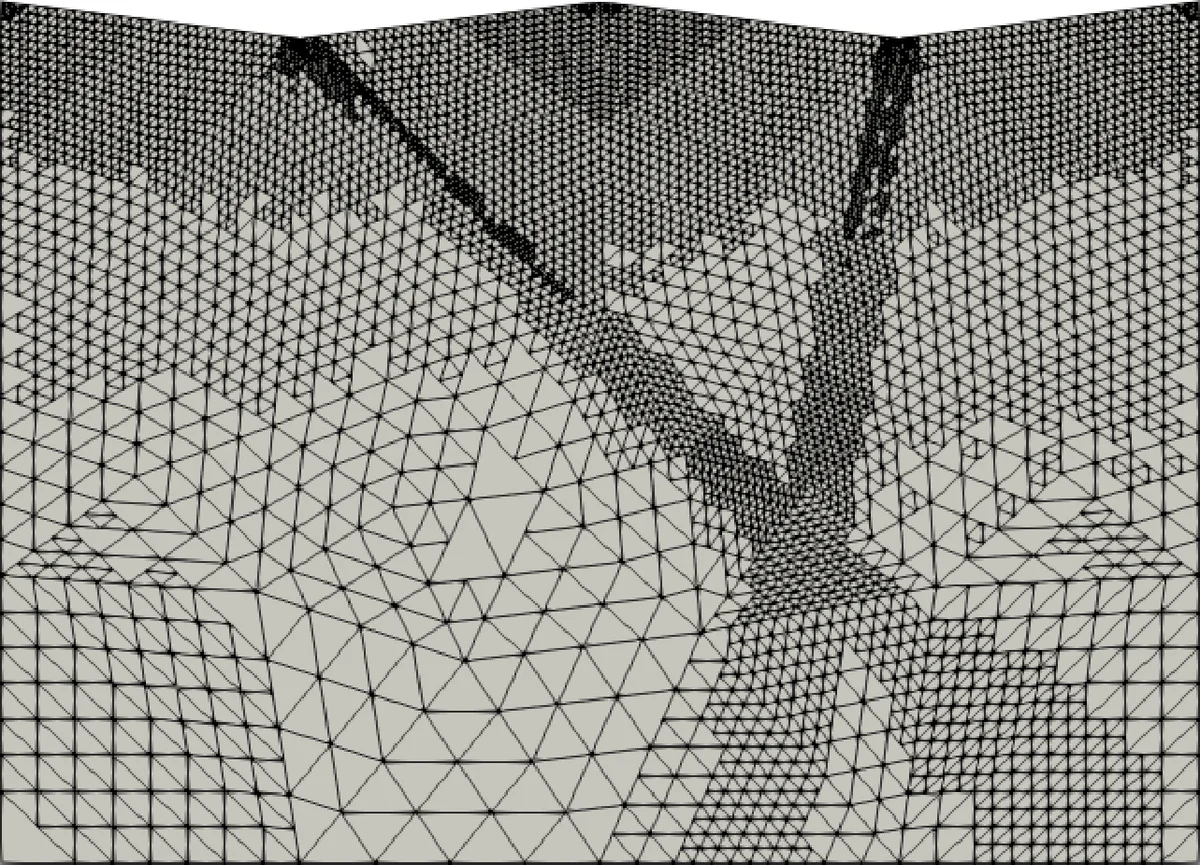
Geological settings with reservoir characteristics include fractures with different material and geometrical properties. Hence, numerical simulations in applied geophysics demands for computational frameworks which efficiently allow to integrate various fracture geometries in a porous medium matrix. This study presents a modeling approach for single-phase flow in fractured porous media and its application to different types of non-conforming mesh models. We propose a combination of the Lagrange multiplier method with variational transfer to allow for complex non-conforming geometries as well as hybrid- and equi-dimensional models and discretizations of flow through fractured porous media. The variational transfer is based on the $L^2$-projection and enables an accurate and highly efficient parallel projection of fields between non-conforming meshes (e.g.,\ between fracture and porous matrix domain). We present the different techniques as a unified mathematical framework with a practical perspective. By means of numerical examples we discuss both, performance and applicability of the particular strategies. Comparisons of finite element simulation results to widely adopted 2D benchmark cases show good agreement and the dual Lagrange multiplier spaces show good performance. In an extension to 3D fracture networks, we first provide complementary results to a recently developed benchmark case, before we explore a complex scenario which leverages the different types of fracture meshes. Complex and highly conductive fracture networks are found more suitable in combination with embedded hybrid-dimensional fractures. However, thick and blocking fractures are better approximated by equi-dimensional embedded fractures and the equi-dimensional mortar method, respectively.
💡 Research Summary
This paper presents a unified computational framework for modeling single-phase flow in fractured porous media, addressing the significant challenges associated with mesh generation for complex, intersecting fracture networks in 3D. The core innovation lies in the combination of dual Lagrange multipliers and variational transfer to couple non-conforming meshes, enabling great flexibility in geometric representation and discretization.
The framework elegantly integrates two primary non-conforming strategies: embedded discretizations and the mortar domain decomposition method. In the embedded approach, fracture domains (which can be hybrid-dimensional, i.e., represented as lower-dimensional manifolds, or equi-dimensional) are meshed independently and embedded within the matrix domain. Their meshes need not align geometrically or discretely with the matrix mesh. The mortar method is used to split the matrix domain into subdomains along fracture planes, mesh them independently, and then couple them at their interfaces. The use of dual Lagrange multiplier spaces is a critical technical choice, as it allows the condensation of the global system into a symmetric positive-definite matrix, facilitating the use of efficient solvers like the conjugate gradient method with robust preconditioners.
The variational transfer, based on L2-projection, is the mechanism that enables accurate and consistent communication of field data (like pressure) between these completely independent meshes. The authors also demonstrate how non-conforming adaptive mesh refinement can be incorporated within this framework to control error and optimize computational cost.
Numerical experiments validate the framework’s accuracy and efficiency. The results show excellent agreement with established 2D benchmarks for flow in fractured media. In 3D, the method is successfully applied to a benchmark fracture network and a more complex, realistic scenario. The comprehensive study leads to a practical conclusion: different fracture types are best modeled with different techniques within the same framework. Complex, highly conductive fracture networks are most efficiently handled with embedded hybrid-dimensional fractures. In contrast, thick fractures are more accurately resolved using embedded equi-dimensional representations, and fractures acting as flow barriers (with very low permeability) are best approximated using the equi-dimensional mortar method. This work provides a versatile and powerful toolbox for high-fidelity simulations in subsurface applications, significantly reducing the meshing burden for stochastic studies involving numerous fracture network realizations.
Comments & Academic Discussion
Loading comments...
Leave a Comment