Grid peeling and the affine curve-shortening flow
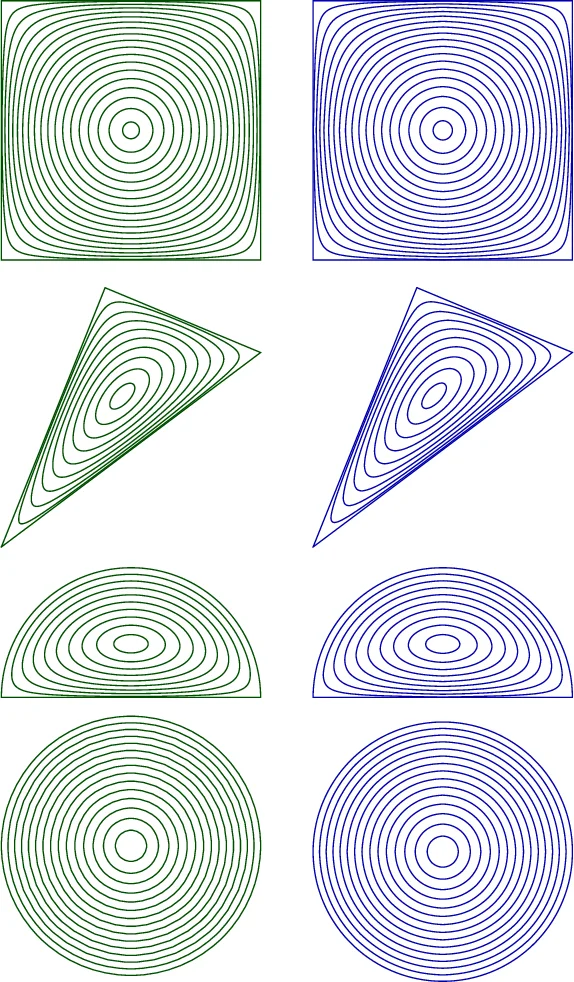
In this paper we study an experimentally-observed connection between two seemingly unrelated processes, one from computational geometry and the other from differential geometry. The first one (which we call “grid peeling”) is the convex-layer decomposition of subsets $G\subset \mathbb Z^2$ of the integer grid, previously studied for the particular case $G={1,\ldots,m}^2$ by Har-Peled and Lidick'y (2013). The second one is the affine curve-shortening flow (ACSF), first studied by Alvarez et al. (1993) and Sapiro and Tannenbaum (1993). We present empirical evidence that, in a certain well-defined sense, grid peeling behaves at the limit like ACSF on convex curves. We offer some theoretical arguments in favor of this conjecture. We also pay closer attention to the simple case where $G=\mathbb N^2$ is a quarter-infinite grid. This case corresponds to ACSF starting with an infinite L-shaped curve, which when transformed using the ACSF becomes a hyperbola for all times $t>0$. We prove that, in the grid peeling of $\mathbb N^2$, (1) the number of grid points removed up to iteration $n$ is $\Theta(n^{3/2}\log n)$; and (2) the boundary at iteration $n$ is sandwiched between two hyperbolas that are separated from each other by a constant factor.
💡 Research Summary
The paper investigates a striking connection between two seemingly unrelated processes: the discrete convex‑layer decomposition of integer‑grid point sets (often called “grid peeling”) and the continuous affine curve‑shortening flow (ACSF) applied to smooth planar curves. Grid peeling iteratively removes the vertices of the convex hull of the current point set, producing a sequence of convex layers (the “onion” decomposition). ACSF evolves a curve by moving each point in the normal direction with speed equal to the inverse cube root of the local radius of curvature; this flow is invariant under affine transformations and, for closed convex curves, drives the shape toward an ellipse, collapsing to a point in finite time.
The authors conjecture that, when a convex region R is sampled on a fine uniform grid of spacing 1/n, the boundary of the c·n⁴⁄³‑th convex layer of the sampled point set converges pointwise to the curve obtained by running ACSF on ∂R for a fixed time t. The constant c≈1.6 is suggested by experiments. Intuitively, known results on the number of convex‑hull vertices of lattice points inside a disk (Θ(n²⁄³)) imply that a boundary segment of length d contains Θ(d·n²⁄³·r⁻¹⁄³) vertices, where r is the local radius of curvature. Advancing this segment inward by a distance ε requires removing Θ(ε·n⁴⁄³·r¹⁄³) points, which yields an inward speed of Θ(n⁻⁴⁄³·r⁻¹⁄³). This is exactly n⁴⁄³ times slower than the ACSF speed r⁻¹⁄³, leading to the scaling factor in the conjecture.
To substantiate the conjecture, the authors conduct extensive experiments on several convex shapes (a smooth curve, a square, a triangle, a half‑disk, and a full disk). For each shape they generate grid point sets with spacings 1/n for n up to 100 000, compute the convex layers, and compare every 2 714‑th layer with a high‑precision numerical simulation of ACSF. The Hausdorff distance between the two curves decreases as n grows, and the empirically derived constant c (estimated as m_i/(t_i·n⁴⁄³) where m_i is the layer index and t_i the corresponding ACSF time) approaches 1.6 and stabilises for large n or large t. For the unit disk, the exact ACSF solution r(t)=(r(0)⁴⁄³−4t/3)³⁄⁴ is used, confirming the same behaviour.
The paper also proves rigorous asymptotic results. Theorem 2 shows that for any bounded convex region R, the total number of convex layers of G
Comments & Academic Discussion
Loading comments...
Leave a Comment