An immersed phase field fracture model for fluid-infiltrating porous media with evolving Beavers-Joseph-Saffman condition
📝 Abstract
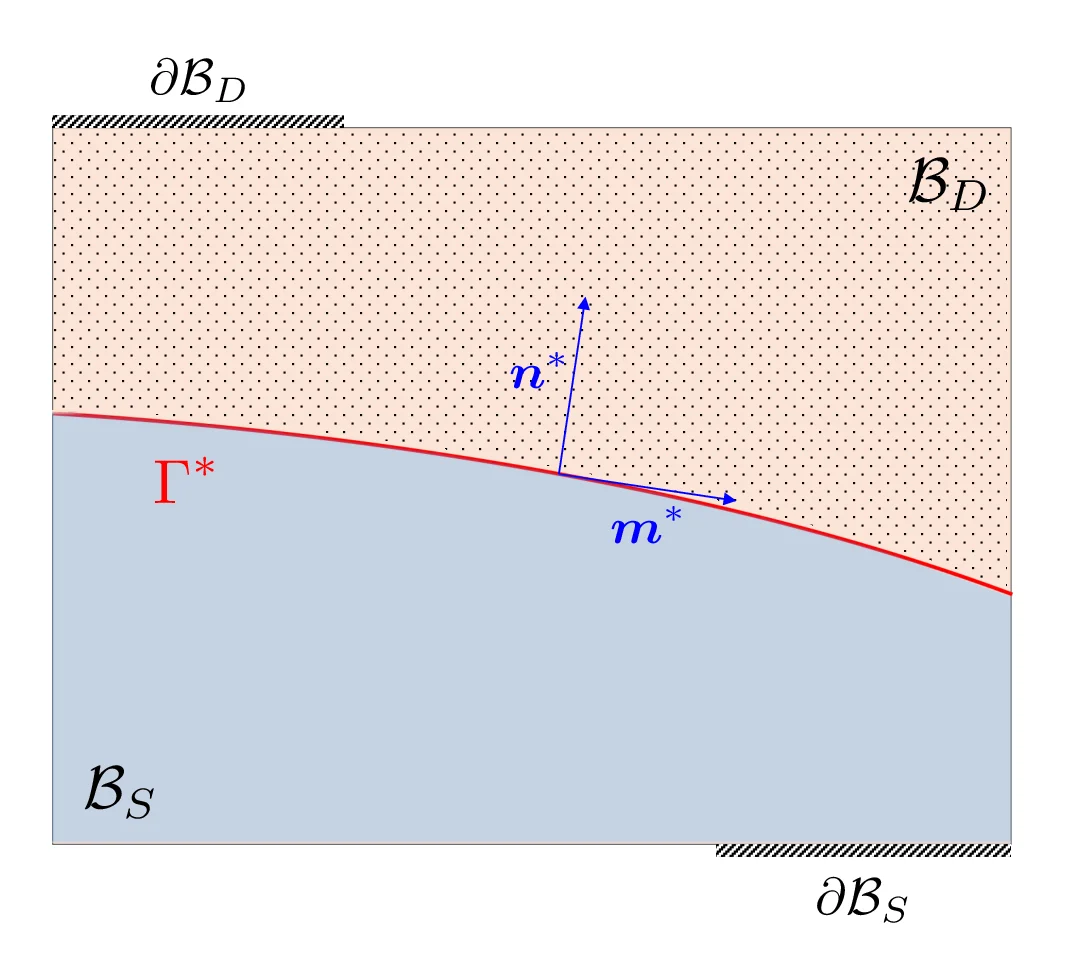
This study presents a phase field model for brittle fracture in fluid-infiltrating vuggy porous media. While the state-of-the-art in hydraulic phase field fracture considers Darcian fracture flow with enhanced permeability along the crack, in this study, the phase field not only acts as a damage variable that provides diffuse representation of cracks or cavities, but also acts as an indicator function that separates the domain into two regions where fluid flows are governed by Stokes and Darcy equations, respectively. Since the phase field and its gradient can be respectively regarded as smooth approximations of the Heaviside function and Dirac delta function, our new approach is capable of imposing interfacial transmissibility conditions without explicit interface parametrizations. In addition, the interaction between solid and fluid constituents is modeled by adopting the concept of mixture theory, where the fluid velocities in Stokes and Darcy regions are considered as relative measures compared to the solid motion. This model is particularly attractive for coupled flow analysis in geological materials with complex microstructures undergoing brittle fracture often encountered in energy geotechnics problems, since it completely eliminates the needs to generate specific enrichment function, integration scheme, or meshing algorithm tailored for complex geological features.
💡 Analysis
This study presents a phase field model for brittle fracture in fluid-infiltrating vuggy porous media. While the state-of-the-art in hydraulic phase field fracture considers Darcian fracture flow with enhanced permeability along the crack, in this study, the phase field not only acts as a damage variable that provides diffuse representation of cracks or cavities, but also acts as an indicator function that separates the domain into two regions where fluid flows are governed by Stokes and Darcy equations, respectively. Since the phase field and its gradient can be respectively regarded as smooth approximations of the Heaviside function and Dirac delta function, our new approach is capable of imposing interfacial transmissibility conditions without explicit interface parametrizations. In addition, the interaction between solid and fluid constituents is modeled by adopting the concept of mixture theory, where the fluid velocities in Stokes and Darcy regions are considered as relative measures compared to the solid motion. This model is particularly attractive for coupled flow analysis in geological materials with complex microstructures undergoing brittle fracture often encountered in energy geotechnics problems, since it completely eliminates the needs to generate specific enrichment function, integration scheme, or meshing algorithm tailored for complex geological features.
📄 Content
본 연구는 유체가 침투하는 구공극(vuggy) 다공성 매질 내부에서 발생하는 취성 파괴(brittle fracture)를 기술하기 위한 새로운 위상장(phase‑field) 모델을 제시한다. 기존의 수압 위상장 파괴 모델들은 주로 균열면을 따라 투과성이 증가한 다르시(Darcian) 흐름을 고려하는 것이 최첨단(state‑of‑the‑art) 접근법으로 받아들여져 왔으며, 이러한 모델들은 균열이 형성된 영역에서 유체 전도도가 급격히 상승한다는 가정을 기반으로 한다. 그러나 본 연구에서 제안하는 위상장 모델은 단순히 손상 변수(damage variable)로서 균열이나 공동(cavity)을 확산적으로(diffuse) 표현하는 역할을 넘어, 도메인을 두 개의 상이한 유동 영역으로 구분하는 지시 함수(indicator function)의 역할도 동시에 수행한다. 구체적으로 말하면, 위상장 값이 0에 가까운 영역은 고체가 거의 손상되지 않은 상태로 간주되어 전통적인 다르시(Darcy) 흐름 방정식에 의해 유체 흐름이 지배되고, 위상장 값이 1에 가까운 영역은 균열 혹은 공동이 거의 완전하게 형성된 상태로 간주되어 스토크스(Stokes) 방정식에 의해 점성 유체 흐름이 지배된다.
위상장 자체와 그 기울기(gradient)는 각각 헤비사이드(Heaviside) 함수와 디랙(Dirac) 델타 함수의 부드러운 근사(smooth approximation)로 해석될 수 있다. 헤비사이드 함수는 이산적인 영역 구분을 연속적인 형태로 변환하는 역할을 하며, 디랙 델타 함수는 그 경계면에서의 급격한 변화를 수학적으로 표현한다. 이러한 수학적 특성을 이용하면, 명시적인 인터페이스 매개변수화(explicit interface parametrization) 없이도 두 영역 사이의 계면 전투과성(transmissibility) 조건—예를 들어, 압력 연속성, 유속 연속성, 그리고 전단 응력 연속성—을 자연스럽게 강제할 수 있다. 즉, 위상장이 연속적인 스칼라 필드로서 존재하기 때문에, 전통적인 경계 조건을 별도의 메쉬 분할이나 인터페이스 요소 삽입 없이도 자동으로 구현할 수 있다.
또한 고체와 유체 성분 간의 상호작용을 모델링하기 위해 혼합 이론(mixture theory)의 개념을 도입하였다. 혼합 이론에 따르면, 다공성 매질 내부의 전체 운동은 고체 골격과 그 골격을 통과하는 유체 두 상의 운동을 각각 별도로 기술한 뒤, 두 상의 질량 및 모멘텀 보존 법칙을 결합하여 전체 시스템의 거동을 서술한다. 본 모델에서는 스토크스 영역과 다르시 영역 각각에서 정의된 유체 속도 field를 고체 변위 속도에 대한 상대적인(relative) 속도로 해석한다. 즉, 유체 속도 v₍f₎는 고체 속도 v₍s₎와의 차이 v₍f₎‑v₍s₎ 형태로 표현되며, 이 차이는 다공성 매질의 투과성 변화와 위상장에 의해 조절되는 손상 정도에 따라 연속적으로 변한다. 이러한 접근법은 전통적인 두 상을 독립적으로 다루는 방법에 비해, 복잡한 미세구조와 급격한 손상 진행이 동시에 일어나는 상황에서도 수치적 안정성을 유지하면서 물리적 일관성을 확보한다.
본 모델이 특히 매력적인 이유는 복잡한 미세구조를 가진 지질 재료에서 취성 파괴와 유동이 동시에 진행되는 현상을 효과적으로 포착한다는 점이다. 에너지 지반공학(energy geotechnics) 분야에서는 석유·가스 저장소, 탄소 포집·저장(CCS) 시설, 지열 에너지 추출 시스템 등에서 다공성 암석이 급격한 압력 변화와 화학적 침투에 의해 균열이 발생하고, 이 균열이 유체 흐름 경로를 급격히 재구성한다는 현상이 흔히 관찰된다. 기존의 수치 해석 방법은 이러한 복합 현상을 모사하기 위해서는 (1) 균열을 명시적으로 추적하는 강화 함수(enrichment function)를 설계하고, (2) 비정형적인 균열 경로에 맞는 특수 적분 스킴(integration scheme)을 도입하며, (3) 복잡한 지질 구조에 맞추어 메쉬를 재생성하거나 적응형 메쉬(refinement)를 수행하는 등 복잡하고 비용이 많이 드는 전처리 과정을 필요로 했다. 반면에 제안된 위상장 기반 모델은 위상장 자체가 손상과 균열을 연속적으로 표현하므로, 별도의 강화 함수나 특수 적분 기법, 그리고 복잡한 메쉬 생성 절차가 전혀 필요하지 않다. 위상장 값과 그 기울기만으로도 균열 면의 위치와 형태, 그리고 그 면을 통한 유체 전투과성을 자동으로 결정할 수 있기 때문이다.
요약하면, 본 연구에서 개발한 위상장 모델은 다음과 같은 핵심적인 특징을 가진다. 첫째, 위상장을 손상 변수와 동시에 도메인 구분 지시 함수로 활용함으로써, 스토크스 영역과 다르시 영역을 자연스럽게 구분한다. 둘째, 위상장과 그 기울기를 각각 헤비사이드 함수와 디랙 델타 함수의 부드러운 근사로 해석함으로써, 명시적인 인터페이스 매개변수화 없이도 계면 전투과성 조건을 정확히 구현한다. 셋째, 혼합 이론을 기반으로 고체와 유체의 상대 속도를 정의함으로써, 복합 매질 내에서의 상호작용을 물리적으로 일관되게 모델링한다. 넷째, 복잡한 미세구조와 급격한 취성 파괴가 동시에 일어나는 지질 재료에 적용 가능하며, 별도의 강화 함수, 특수 적분 스킴, 혹은 맞춤형 메쉬 알고리즘을 필요로 하지 않는다. 이러한 장점들은 에너지 지반공학을 비롯한 다양한 지구공학 분야에서 복합 유동‑구조 상호작용을 효율적으로 해석하고 설계하는 데 큰 도움이 될 것으로 기대된다.