The strong convergence of operator-splitting methods for the Langevin dynamics model
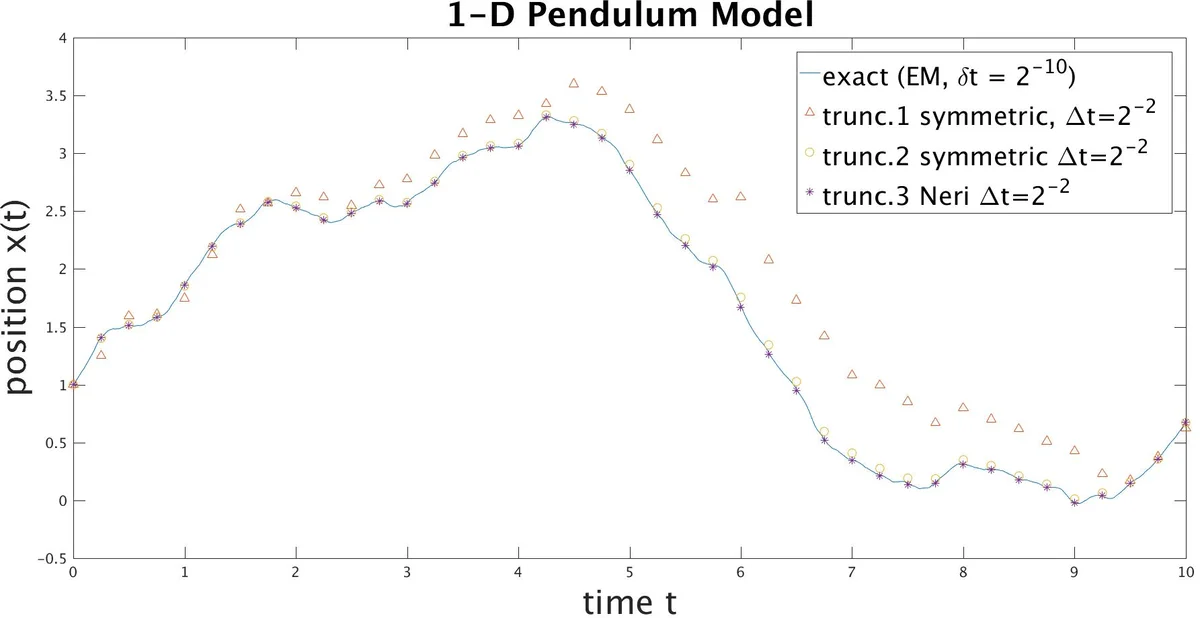
We study the strong convergence of some operator-splitting methods for the Langevin dynamics model with additive noise. It will be shown that a direct splitting of deterministic and random terms, including the symmetric splitting methods, only offers strong convergence of order 1. To improve the order of strong convergence, a new class of operator-splitting methods based on Kunita’s solution representation are proposed. We present stochastic algorithms with strong orders up to 3. Both mathematical analysis and numerical evidence are provided to verify the desired order of accuracy.
💡 Research Summary
The paper presents a comprehensive study of the strong convergence properties of operator‑splitting methods applied to the Langevin dynamics model with additive noise. The authors first formalize the Langevin system as a 2n‑dimensional Itô stochastic differential equation (SDE) describing the evolution of positions and velocities under a conservative force, linear friction, and Gaussian white noise satisfying the fluctuation‑dissipation theorem. Strong convergence is defined in the uniform‑in‑time sense: a numerical approximation YΔt converges with order γ if
\
Comments & Academic Discussion
Loading comments...
Leave a Comment