Multi-objective Eco-Routing Model Development and Evaluation for Battery Electric Vehicles
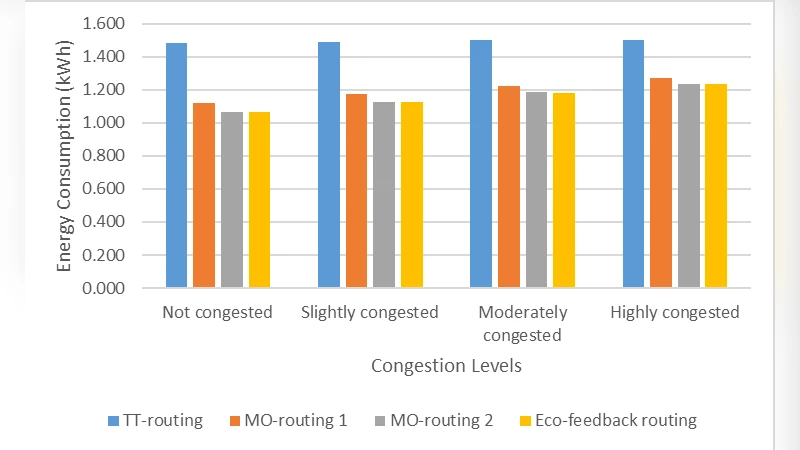
This paper develops and investigates the impacts of multi-objective Nash optimum (user equilibrium) traffic assignment on a large-scale network for battery electric vehicles (BEVs) and internal combustion engine vehicles (ICEVs) in a microscopic traffic simulation environment. Eco-routing is a technique that finds the most energy efficient route. ICEV and BEV energy consumption patterns are significantly different with regard to their sensitivity to driving cycles. Unlike ICEVs, BEVs are more energy efficient on low-speed arterial trips compared to highway trips. Different energy consumption patterns require different eco-routing strategies for ICEVs and BEVs. This study found that eco-routing could reduce energy consumption for BEVs but also significantly increases their average travel time. The simulation study found that multi-objective routing could reduce the energy consumption of BEVs by 13.5, 14.2, 12.9, and 10.7 percent, as well as the fuel consumption of ICEVs by 0.1, 4.3, 3.4, and 10.6 percent for “not congested”, “slightly congested”, “moderately congested”, and “highly congested” conditions, respectively. The study also found that multi-objective user equilibrium routing reduced the average vehicle travel time by up to 10.1% compared to the standard user equilibrium traffic assignment for the highly congested conditions, producing a solution closer to the system optimum traffic assignment. The results indicate that the multi-objective eco-routing can effectively reduce fuel/energy consumption with minimum impacts on travel times for both BEVs and ICEVs.
💡 Research Summary
This paper presents a novel multi‑objective eco‑routing framework that integrates energy (or fuel) consumption and travel time into a Nash‑equilibrium (user‑equilibrium, UE) traffic assignment for both battery electric vehicles (BEVs) and internal‑combustion‑engine vehicles (ICEVs). Recognizing that BEVs and ICEVs exhibit fundamentally different energy‑use characteristics—BEVs gain substantial efficiency on low‑speed arterial roads due to regenerative braking, whereas ICEVs are relatively more efficient on high‑speed highways—the authors develop separate consumption models calibrated on speed‑acceleration‑deceleration profiles and road‑type classifications.
The core of the methodology is a weighted cost function for each driver:
(C_i = \alpha_i , T_i + (1-\alpha_i) , E_i) (for BEVs) or (C_i = \alpha_i , T_i + (1-\alpha_i) , F_i) (for ICEVs), where (T_i) denotes travel time, (E_i) electric energy, (F_i) fuel consumption, and (\alpha_i) a user‑specified preference parameter ranging from 0 (pure energy minimization) to 1 (pure time minimization). By embedding this multi‑objective cost into the classic UE formulation, the authors solve a fixed‑point problem using an extended Frank‑Williamson algorithm that iteratively updates link costs and redistributes flow until convergence.
A large‑scale, realistic network (≈5,000 nodes, 7,000 links) is simulated in a microscopic traffic environment (VISSIM). Four congestion scenarios—“not congested”, “slightly congested”, “moderately congested”, and “highly congested”—are generated, each populated with 10,000 vehicles (50 % BEV, 50 % ICEV). Three routing strategies are compared: (1) conventional UE that minimizes travel time only, (2) the proposed multi‑objective UE, and (3) a system‑optimal (SO) assignment that minimizes the total network cost.
Key findings include:
-
Energy/Fuel Savings – The multi‑objective UE reduces BEV electricity consumption by 13.5 % (not congested), 14.2 % (slightly congested), 12.9 % (moderately congested), and 10.7 % (highly congested). ICEV fuel use drops by 0.1 %, 4.3 %, 3.4 %, and 10.6 % across the same scenarios.
-
Travel‑Time Impact – In the highly congested case, the multi‑objective UE shortens average travel time by up to 10.1 % relative to the conventional UE, bringing the solution close to the SO benchmark. In low‑congestion conditions, travel‑time penalties are negligible.
-
Congestion Interaction – Energy savings diminish as congestion intensifies because prolonged low‑speed conditions limit the regenerative‑braking advantage of BEVs. Conversely, the travel‑time benefit of the multi‑objective approach grows with congestion, as the algorithm steers some traffic onto less congested, albeit slightly longer, routes that collectively improve network performance.
-
Vehicle‑Type Specific Routing – The model naturally assigns BEVs to low‑speed arterial links where electric efficiency peaks, while ICEVs are routed more often onto higher‑speed highways where fuel efficiency is higher.
The study demonstrates that incorporating a multi‑objective cost into the UE framework can achieve substantial environmental gains without sacrificing, and in some cases even improving, operational efficiency. By explicitly modeling the divergent energy dynamics of BEVs and ICEVs, the proposed approach offers a realistic decision‑support tool for planners, fleet managers, and navigation service providers seeking to balance sustainability and user convenience.
Limitations are acknowledged: the consumption models omit battery thermal management, charging‑station availability, and real‑time electricity price signals; the preference weight (\alpha) is treated as static rather than behaviorally derived; and computational scalability to national‑level networks remains to be demonstrated. Future work will extend the framework to include charging infrastructure constraints, dynamic user‑preference estimation from telematics data, and accelerated solution algorithms for large‑scale applications.
In conclusion, the multi‑objective eco‑routing model successfully reduces fuel/energy consumption for both BEVs and ICEVs while maintaining or even improving travel times, especially under heavy congestion, thereby offering a viable pathway toward greener and more efficient urban mobility.