Hierarchical Control in Islanded DC Microgrids with Flexible Structures
Hierarchical architectures stacking primary, secondary, and tertiary layers are widely employed for the operation and control of islanded DC microgrids (DCmGs), composed of Distribution Generation Units (DGUs), loads, and power lines. However, a comp…
Authors: Pulkit Nahata, Alessio La Bella, Riccardo Scattolini
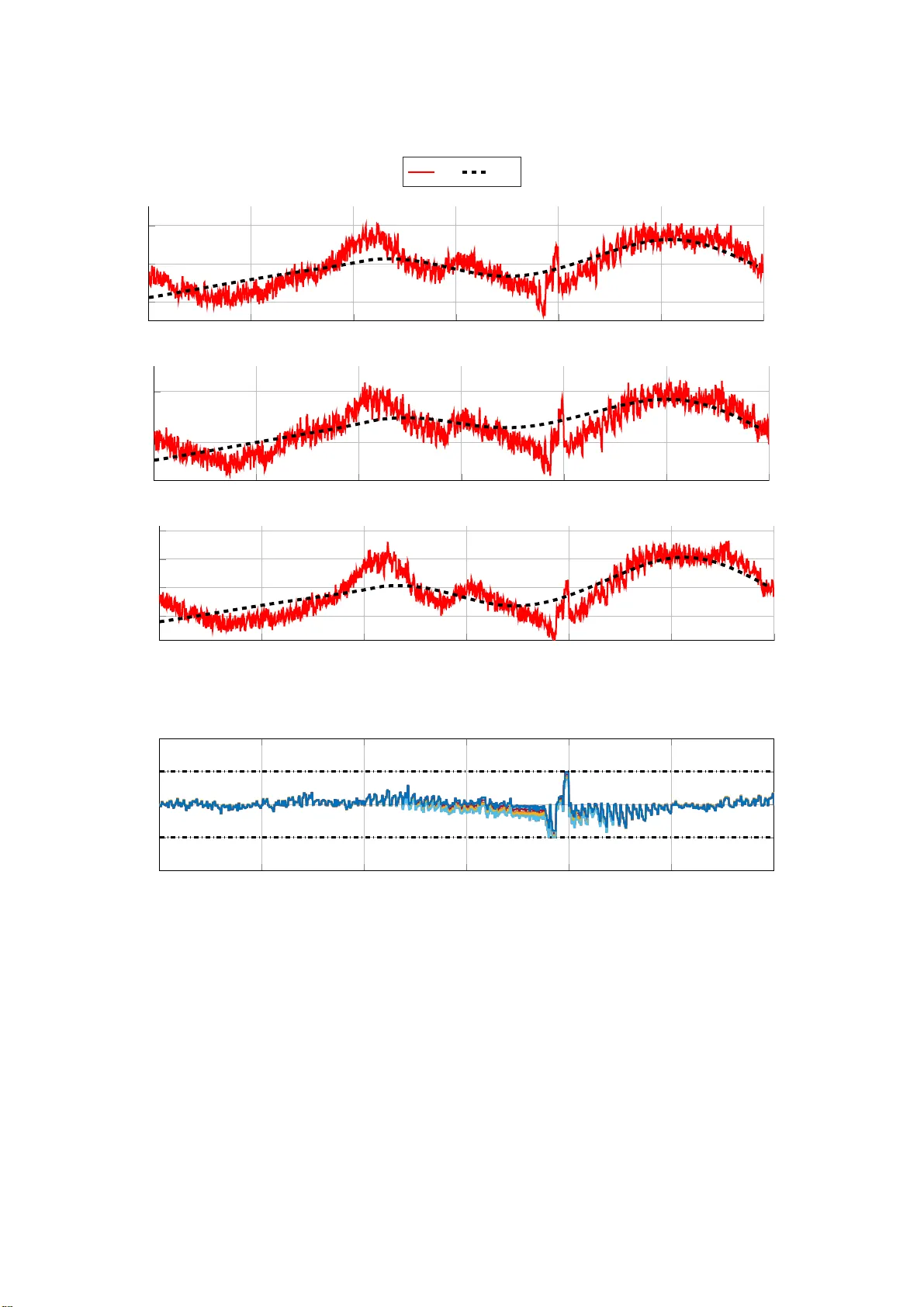
Hierarc hical Con trol in Isl anded DC Microgrids with Flexible Structure s Pulkit Nahata ∗ , 1 , Ales sio La Bella ∗ , 2 , Riccardo Scattolini 2 , and Giancarlo F errari-T recate 1 1 Aut omatic Contr ol L ab o r atory, ´ Ec ole Polyte chnique F´ ed ´ er ale de La usanne, L ausanne, Switzerland 2 Dip artimento di El ettr oni c a, Informazione e Bioinge gneria, Polite cnic o di M ilano, Italy T ec hnical Rep ort Septem b er, 2019 Abstract Hierarc hical architectures stacking primary , secondary , and tertiary la yers are widely emplo yed for the operation and control of islanded DC microgrids (DCmGs), comp osed of Distribution Generation Un its (DGU s), loads, and p ow er lines. How ev er, a comprehen- sive analysis of all the la yers pu t together is often missing. In this work, we remedy t his limitation b y setting out a top-to-b ottom hierarc hical con trol architecture. Decen tralized vol tage con trollers attac hed to DGUs fo rm our primary la yer. Go verned by an MPC –based Energy Management Sy stem (EMS), our tertiary la yer generates optimal p ow er references and decision vari ables for DGUs. In particular, decision vari ables can turn DGUs ON/OFF and select th eir op eration mo des. An in termediary secondary la yer translates EMS p ow er references into appropriate voltage signal s required by the primary lay er. More sp ecifically , to provide a voltage solution, the secondary lay er solves an optimization problem embed- ding p ow er-flow equations shown to b e alw a ys solv a ble. Since load voltages are n ot directly enforced, their uniqueness is necessa ry for DGUs to produ ce reference pow ers h anded down by the EMS. T o this aim, w e deduce a no vel un iqueness condition b ased only on lo cal load parameters. Our control framew ork, b esides being applicable for generic DCmG top olo- gies, can accommo date topological c hanges caused b y EMS command s. Its functioning is v alidated via simula tions on a modified 16-bus DC system. ∗ indicates equal con tribution. This w ork has receiv ed supp ort from the Swi ss National Science F oundat ion under the COFLEX pro j ect (gran t num ber 200021 169906) and the Researc h F und for th e Italian Electrical System in compliance with the Decree of Minister of Economic De velopmen t April 16, 2018. Elect ronic addresses: { pulkit. nahata, giancar lo.ferraritr ecate } @epfl.ch , { alessio. labella,ricc ardo.scattolini } @polimi.it 1 1 In tro duction Microgr ids (mGs) are sma ll-scale electric net works consisting of Distributed Gener a tion Units (DGUs) a nd different loa ds. Apart from their manifold adv an tages like integration of renewables, enhanced power quality , reduced transmission lo sses and capabilit y to oper ate in g rid-connected and islanded mo de s , mGs a re als o compatible with both AC and DC op er ating standa rd [1, 2, 3]. In par ticula r, DC microgrids (DCmGs), hav e ga ined tra ction in recen t times . Their rising po pularity can be a ttributed to the developmen t of efficient co nv erters, natural interface with many re newable energy so ur ces (for instance PV modules), batter ies, and many e le c tronic loads (v arious appliances, L EDs, electric vehicles, computers etc), inherently DC in nature [4, 5]. A stable and e conomic oper ation of a n islanded DC microgrid (DCmG) is a multi-ob jective problem. As such, it necessita tes a cont ro l entit y which pro per ly reg ula tes the internal voltages and efficien tly co or dina tes DGU op erations while taking int o considera tion the non-deter ministic absorption/ pro duction of loa ds and renewables. T o this aim, a hierarchical architecture spanning different cont rol stag es, time scales, and physical lay ers is often employ ed [4, 5, 6, 7]. Generally , a primary control lay er, acting at the compo nent level, is resp onsible for voltage stability , crucial in islanded DCmGs interfaced with no nlinea r loads [8]. Many resear ch studies hav e aimed at desig ning decentralized stabilizing primar y controllers, implemented at ea ch DGU with a view to tracking constant voltage referenc e s in stea dy state. F or this purp ose, differen t techn iques such as dro o p control [2, 4], plug-and-play [9, 8, 10] and sliding-mo de control [11] have bee n explor e d. Being blind voltage emulators, primary con troller s are incapable of inc o rp orating v arious opera tional and economic constraints needed to sustain a contin uous and prop er function- ing of an isla nded DCmG. High-level s up er visory con trol architectures a r e, ther efore, necessary to co ordinate primar y voltage r eferences. Co nsensus-based sup erv is ory controllers discussed in [12, 13] appropria tely tw eak pr imary voltage references to attain prop ortional load sha ring and voltage balancing. Despite presenting the ma jor adv antage of having a distributed structure, these con trollers assume loa d satisfia bilit y and uns a turated inputs at all times. Superv ising co n- trol strategies co nsidering saturated inputs for primary voltage controllers are prop osed in [14]; how ever, capability limits, oper ation mo de, and filter losses of DGUs, along with optimal p ow er dispatch a re neglected. One can ov erco me the afo r ementioned limitations b y designing an Energy Management System (EMS), which can meet sp ecified p ower and ener gy mana gement strategies while r esp ecting gener ation co nstraints and other economic ob jectives like optimal p ow er dis- patch, load sha ring, a nd battery mana g ement. Flow chart-based EMSs encompassing multiple case scena rios are discussed in [1 5, 16], whereas the use o f optimization metho ds and pr edictive algorithms to design an E MS is in vestigated in [7, 17]. In general, EMSs utilize power balance equations to pro vide optimal pow er s et-p o ints to the DGUs, esp ecia lly when based on complex optimization algorithms such as stochastic or mixed-integer techniques a s in [18, 19, 20, 21, 22, 23]. Nev ertheless , when the primary layer is voltage controlled, these EMSs cannot b e directly implemen ted in DCmGs as the optimal power references must somehow be translated into suitable v oltage set-p oints. Such a translation is not straightforward for mGs with meshed top olo gies and, effectively , requires the solution of p ower- flow equations . Mo r eov er, considering that the voltages c a n solely b e enforced by the DGUs, a unique voltage equilibrium may fail to exist at the load buses in the pres ence of nonlinear lo ads (e.g. cons ta nt p ow er loa ds ) [24]. 1.1 Main Contributions The lack of a detailed, all-r ound co ntrol scheme defining the interface b etw een, and exact roles of, m ultiple control layers motiv ated the design of a compr e hensive three-layered hierarchical 2 control a rchitecture fo r the ov era ll op era tion and control of an isla nded DCmG with flexible top ologies. A s chematic of the pro p o sed architecture is depicted in Figure 1; a detailed description of the v ariables in Figure 1 is presented in Sections 3 and 4. • T ertiary layer : An MPC-base d EMS sits at the upp ermos t lev el, and defines power r ef- erences and op eration modes for DGUs. The ob jective of this lay er is to minimize cost of pr o duction and to optimize DGU usa ge, e.g . avoiding frequent changes in op era tion mo de. The E MS a ccounts for DGU satura tion limits, type-based DGU pow er models, and load/genera tio n forecas ts. T o efficiently solv e the MPC problem, this lay er disc a rds net work and DGU filter losses—nonlinea r and non-co nvex. • S e c o ndary layer : A no vel seco ndary co nt rol scheme, acting as an in terface b etw een the primary and tertiary layers, is designed to translate E MS power references in to app osite voltage references. As DGUs a re controlled by primary voltage regulators, such an oper a- tion is necessary for the EMS p ow er references to b e effectively pro duced/a bs orb ed in the DCmG netw ork. This task is pe r formed via a sta tic optimization pr oblem sub ject to the net work DCmG pow er-flow equations embedding netw ork and DGU filter losses, as well as DGU capability limits and DCmG voltage constraint s. The seconda ry layer is executed at a faster time scale with resp ect to the EMS, e ns uring quick restora tion of the EMS p ow er references in case of changes in loa d absor ption. • Primary layer : Ea ch DGU is provided with a dec e n tralize d primary v oltage controller which, a long with other such controllers, makes the primary layer. In order to leverage the adv ances in grid-s tabilizing decen tralize d prima ry voltage control, we assume that a ll DGUs ar e eq uipp ed with primary voltage regula to rs. The str ucture a nd design of pr imary v oltage controllers a lo ng with stability certificates and pro o fs are skipped in this work. A detailed ana ly sis can be found in [9, 8, 10, 1 1] which show control design bas ed on the plug-and-play paradig m allowing DGUs to effortlessly enter/leav e the DCmG witho ut spoiling ov erall voltage stabilit y . The pro po sed hiera r chical co ntrol system is applied to a DCmG with DGUs in terfaced with nonrenewable dispatchable resources , ba tteries, and P V modules. The EMS at the ter tiary layer generates o ptimal p ow er references a nd decides the op era tion mo des o f DGUs by solving an MPC mixed-integer pro blem a t ev ery sampling instant while taking in to account fore casts a nd system parameters . The generated decision v ariables v ariables serve to turn ON/OFF dispatchable DGUs, switch the PV DGUs betw een Max im um Pow er Point T rac king (MPPT) and p ow er curtailment modes, a nd control the c harg ing/discharging of batter y DGUs. In spite of a change in topolog y that ma y tak e place due to EMS commands, the collectiv e v oltage s tability of the DCmG netw ork is ensured by decentralized plug-and-play pr imary controllers. T o per form a power-v oltage tr a nslation, the sec o ndary c o ntroller makes use of an optimization problem sub ject to DCmG p ow er-flow eq ua tions. Although these eq uations—indisp ensable to the feasibility of the seco ndary optimization pro ble m—a re no nlinear and non- conv ex, w e prove that a so lutio n to these ca n b e alwa ys co mputed. W e p oint out that the existence o f a solution to the pow er-flow equations has als o b een addr essed in [25, 26] Nev ertheless, the tools therein cannot b e used directly as, in our case , the DGU voltage references are free optimization v ariables and no t known a priori . F urthermore, a s a complement, w e also state a necessa ry condition for the solv ability of the stated optimization pro blem. W e highlight that the voltages can b e enforced only a t DGU nodes and ther efore, the unique- ness of voltages a pp ea ring at the load nodes is necessar y for the a tta inment of predefined op- erational o b jectiv es. Indeed, if the load v oltages a re different fro m thos e anticipated by the 3 T ertiar y Control (EMS) Secondary Cont rol C [ i ] C [ j ] DGU i DGU j ¯ P G,i , δ i · · · · · · ¯ P G,j , δ j V ∗ i V ∗ j D C M i c r o g r i d N e t w o r k Z I P L o a d s ¯ I L , ¯ P L S B , P o P V P f P V ¯ P f L ¯ I f L Primary Con trol Figure 1: Hier a rchical con trol scheme for DC microgrids . secondary lay er, p ermis s ible v oltag e limits may b e viola ted and DGUs ma y fail to g enerate the optimal power set-p oints provided by the EMS. In this resp ect, we provide a no vel condition for the uniqueness of load v oltag es and DGU p ower injections. The uniqueness of v oltag e s has also bee n addressed in [25], where the deduced condition depends on the generato r voltages and the top ological parameters of the overall netw ork . Here, we provide a no vel and simpler condition which relies only o n lo cal lo a d parameter s and can ea s ily b e verified. Different fro m the hier archical control approaches for islanded DCmG prese nted in [2, 15, 16, 21, 2 7, 2 8, 29, 3 0], our scheme works for an y DCmG top olog y , considers nonlinear ZIP (constant impeda nce, consta nt current, a nd co nstant pow er) loa ds, and acco mmo dates temp ora l topo logical v ariations caused b y the addition/ r emov a l of cer tain DGUs. F urthermor e, none of the foregoing contributions simu ltaneous ly ensure o ptimal management of DGUs (MPC-based E MS) and stable regulation of voltages (decen tralized primary c o ntrollers). F or ins tance, the hiera rchical control metho dologies presented in [28, 29, 30] addres s voltage reg ulation and optimization of p ow er flows, but discard ener gy management and type-based DGU power models . On the other hand, MPC-based EMSs are prop os e d in [18, 2 2, 23]; but voltage stabilit y is not a ddressed. Preliminary results of this w ork hav e b een repor ted in [31] where (i) desig n of an EMS was deferred to fut ure w ork, (ii) in terface b et ween secondary and tertia r y lay ers was not discussed, (iii) no dis tinction was made on the type of DGU; DGU dy na mics were not mo deled, and (iv) detailed proofs of main theorems a nd prop ositions were skipped. F urthermore, this article demonstrates a co ordinated op era tion of multiple control lay ers on a 1 6-no de DCmG. The structure of DCmG along with prop osed hiera rchical control sc heme is des crib ed in Section 2. The EMS-based tertiary lay er and its in terac tio n with the seconda ry control layer is detailed in Section 3. The in-depth functioning of seco ndary la yer and rela ted deriv a tions are presented in Section 4. Simu lations provided in Section 5 substan tiate theo retical results, and demonstrate the functioning a nd robustnes s of our co nt ro l a rchitecture o n a modified 16-bus DC feeder [32], in the prese nce of inaccur ate genera tion and load forecasts. Finally , conclusions are 4 drawn in Section 6. DC-DC Conv erter R ti L ti V i C ti I i P C i C tj I Lj ( V j ) V j P C j I j Load j DGU i DCmG Netw ork Figure 2: Representativ e diagram of the DCmG netw ork with DGUs and lo ads. 1.2 Preliminaries and notation Sets, ve ctors, and functions: W e let R (resp. R > 0 ) denote the set of rea l (resp. stric tly po sitive real) num ber s. Given x ∈ R n , [ x ] ∈ R n × n is the asso ciated diag onal matrix with x on the diagonal. The inequa lity x ≤ y for vectors x, y ∈ R n is comp onent-wise, i.e. x i ≤ y i , ∀ i ∈ 1 , ..., n . F or a finite set V , let |V | denote its car dinality . Given a matrix A ∈ R n × m , ( A ) i denotes the i th row. The notation A ≻ 0 , A 0, A > 0, and A ≥ 0 repre s ents a pos itive definite, p os itive semidefinite, p ositive, and nonnegative matrix, resp e ctively . Throughout, 1 n and 0 n are the n -dimensional v ectors o f unit and zer o entries, and 0 is a ma trix of all zeros of appropriate dimensions. Alge br aic gr aph t he ory : W e denote b y G ( V , E , W ) a n undirected gr aph, wher e V is the no de set a nd E = ( V × V ) is the edge set. If a n um b er l ∈ { 1 , ..., |E |} and an a rbitrary dire c tion are assigned to each edge, the incide nce matrix B ∈ R |V |×|E | has non-zero comp onents: B il = 1 if no de i is the source node of edge l , and B il = − 1 if no de j is the sink no de of edge l . The Kir choff ’s Curr ent L a w (KCL) can b e represented as x = B ξ , wher e x ∈ R |V | and ξ ∈ R |E | resp ectively repres ent the no dal injections and edge flows. Assume that the edge l ∈ { 1 , ..., |E |} is oriented from i to j , then for any vector V ∈ R |V | , ( B T V ) l = V i − V j . The Laplacian matrix L of graph G is L = B W B T , with W being the diago nal matrix of edge weigh ts. 2 DC microgrid structure and h ierarc hical con trol sc heme In this section, w e descr ib e the DCmG structure and provide an outline of the hierar chical control structure used to ensure optimal, safe, and unin terrupted o pe r ation of the netw ork. Structure of the D C micr o grid: A DCmG comprises mult iple DGUs and loads, connected to each other via se veral p ow er lines. Its electrical interconnections are mo deled a s an undirected connected g raph m G = ( V , E ), where V is the set of no des and E the set of edges (power lines). The set V is par titio ned into t wo disjoint sets: G ⊂ V is the s et of DGUs and L ⊂ V the set of loads. Figure 2 shows a representative dia g ram of the DCmG, highligh ting the internal structure of DGU s and loads. It is worth noting that ea ch DGU and load is in terfaced with the res t of the DCmG (r epresented with a clo ud in Fig ur e 2) via a Poin t of Coupling (PC), c hara cterized by a voltage V i and output cur rent I i , with i ∈ V . Distribute d gener ation units (DGUs) : A DGU consists of a DC voltage so urce, a DC-DC conv erter, and a s eries RLC filter (see Figur e 2; DGU filter capacitance is a ssumed to b e lump ed 5 with capacitance C ti ). The DC voltage source can b e of different t yp e s, s uch as dis pa tchable sources, battery storage systems a nd PV panels. As the the t yp e of DGU v oltage source deter- mines management str a tegies and system mo dels to be a dopted (see Section 3), we define G D as the set o f DGUs interfaced with dispatchable sources, G B as the set of DGUs interfaced with batteries, and G P as the set of DGUs connected to PV panels, suc h that G D ∪ G B ∪ G P = G . L o ad mo del: The term I Li ( V i ) in Figure 2 indicates the loa d’s functional dependence on the PC voltage, and takes different expres sions based on the type of load. Pro to t ypical load mo dels that ar e of interest include the following: 1. co nstant-current loads: I LI ,j = ¯ I L,j , 2. co nstant-impedance lo ads: I LZ,j ( V j ) = Y L,j V j , where Y L,j = 1 /R L,j > 0 is the conductanc e of load j , and 3. co nstant-pow er loads: I LP ,j ( V j ) = V − 1 j ¯ P L,j , (1) where ¯ P L,j > 0 is the p ow er demand of the j th load. T o refer to the thr ee load cases ab ove, the abbrevia tions I, Z, and P a re often us ed [33]. The analysis pres e n ted in this article will fo cus on the g eneral case of a parallel combination of the three lo ads, th us on the ca se of ZIP loads, which are mo deled as I L,j ( V j ) = ¯ I L,j + Y L,j V j + V − 1 j ¯ P L,j . (2) The net power a bsorb ed by the j th load is g iven as P L,j ( V j ) = ¯ I L,j V j + Y L,j V 2 j + ¯ P L,j . (3) 2.1 Hierarc hical c on t rol in DC microgrids In this work, we prop ose the hier archical control architecture depicted in Figure 1. The controller is split in to three distinct lay er s viz. pr imary , secondary , and tertiar y . The secondary and ter tiary lay ers together form the sup er v isory control lay er o f the DCmG netw o r k. All DGUs a re equipp ed with lo cal v oltage regula tors (not shown in Figur e 2) fo rming the primary c ontro l layer . The main ob jective of these con troller s is to ensure that the v oltage at each DGU’s PC tracks a r eference voltage V ∗ i provided b y the sup ervisory c ontr ol layer . Assumption 2. 1. (Stabili ty u nder primary voltage c ontr ol). In ste ady state, the pri- mary c ontr ol lers ar e assume d t o achi eve offset-fr e e voltage tr acking of c onstant voltag e r efer enc es V ∗ i , i ∈ G , and to guar ant e e the stability of the entir e DCmG net work. The a bove ass umption implicitly states that, during transients and loa d v ar iations, the primary-co ntrolled DGUs nev er saturate, meaning that they ha ve suffcient pow er at their dis - po sal to feed the entiret y of loads in the DCmG netw o rk. F or further details aprop os o f the design o f stabilizing primary controllers, the r eader is deferred to [9, 8, 10, 11] and the references therein. An EMS s its at the tertia ry level, and utilizes the foreca sts of PV gener a tion P f P V , and load power and current abs o rption terms ¯ P f L , ¯ I f L . A t each time step, it measures the nomina l PV generation P o P V , the state o f c harg e (SOC) of batteries S B and the a c tua l p ow er and current absorption of ZIP loa ds ¯ P L , ¯ I L . Solving an MPC o ptimiza tion problem, the EMS generates optimal p ow er references ¯ P G,i , i ∈ G , for the DGUs. In addition, it pro duces de c ision v a riables 6 T able 1 : O ptimization v ariables and parameters for the EMS Symbol Description P DH , P C H Charging and dis charging pow er of the battery [kW] P B Po wer output of battery DGUs [kW] P D Po wer output of dispatchable DGUs [kW] P P V Po wer output of PV DGUs [kW] P o P V Nominal p ow er pro ductio n of PV DGUs [kW] P f P V Po wer pro duction forecast of P V DGUs [kW] P o L Nominal total p ower absorption for ZIP loads [kW] ¯ I f L Current absorption forecas t for I lo a d [kV ar ] ¯ P f L Po wer abso rption forecast for P load [kW] S B State of charge (SOC) of battery S o B Nominal SOC o f battery η C H , η DH Charging and dis charging efficiency of ba ttery C B MG battery capacity [k Wh] V o Nominal netw ork voltage [V] δ B Op eration mo de of battery DGU [bo olean] δ D Op eration mo de of dispatachable DGU [b o olean] δ P V Op eration mo de of PV DGU [b o olean] V No dal voltage magnitude [V] I No dal current magnitude [A] δ i ∈ { 0 , 1 } , i ∈ G , which can either turn ON/OFF DGUs or change their op eration mode. Since the prima ry lay er oper ates only with voltage refer ences, the secondar y control lay er translates the power references in to appr opriate voltage re ferences V ∗ . The detailed structure and functioning of the secondary and tertiary control lay ers are discussed in Sections 4 and 3, resp ectively . W e highlight that differen t lay ers work at different time scales . In a typical sce nario, the primary controllers op e r ates in a r a nge v a rying from 1 0 − 6 to 10 − 3 s, the s econdary lay er ranges from 10 0 to 30 0 s, and the tertiary lay er ranges from 5 to 15 mins [21]. At each high lev el sampling time, the controller provides a reference to its cor resp onding low er lay er. 3 T ertiary cont rol la ye r: the EMS This section deta ils the functioning of the MP C - based EMS o ccup ying the topmost p osition in our pro p o sed hierar chical struc tur e. The foreca sts, par ameters, a nd decision v ariables a re describ ed in T a ble 1. As a con ven tion, all the p ow er v alues ar e defined to be pos itive if de- livered from a DGU. Mor eov er, the upper and lower b ounds of eac h v ar iable are denoted with sup e rscripts max and min , r esp ectively . 3.1 MPC-based E MS for islanded D C mGs The MPC–based EMS is resp onsible for energy management and coo rdination of r esources in the islanded DCmG. A t the core of this cont rolle r is a receding horizon optimization problem 7 which ena bles load satisfia bilit y , optimal scheduling o f dispatchable and storag e DGUs, and maximum pos sible utilization o f PV DGUs. A t a generic time instant k , the EMS solves a mixed int eger optimization pr oblem ov er a finite prediction horizo n [ k , . . . , k + N ], with N indicating the n umber of predictio n steps. As a consequence, an optimal pla n (input) on power dispatch, storage schedule, a nd ope r ational mo des of DGUs is for mulated for the en tire pr ediction ho rizon. Nev ertheless , only the first sample o f the input sequence is implemen ted, following which the horizon is shifted. A t the next sampling time, using updated information on forecasts a nd mG initial condition, the EMS s o lves a new optimization pro blem. In the ensuing discussion, we lay out the EMS optimization problem in detail. Unless s tated otherwise, the index i spans the en tire predictio n horizon except for the terminal time step N , i.e. i ∈ [0 , . . . , N − 1]. 1. D GUs : F or the purpo s e of the EMS optimization problem, the characterization of a DGU hinges on the type o f its v oltag e source. a) Stor age DGUs: A battery serves as the voltage source for these DGUs. Accounting for b o th the c harg ing and discharging efficiencies, the SOC dynamics o f a battery b ∈ G B are given as S B ,b ( k + 1 + i ) = S B ,b ( k + i ) − τ C B ,b 1 η DH ,b P DH ,b ( k + i ) + η C H,b P C H,b ( k + i ) ! , (4) with battery power output P B ,b ( k + i ) = P DH ,b ( k + i ) + P C H,b ( k + i ) . (5) Since battery DGU s can oper ate e ither in c harg ing or in disc harging mode, the following constraints are stated 0 ≤ P DH ,b ( k + i ) ≤ P max B ,b ( k + i ) δ B ,b ( k + i ) , (6) 0 ≤ P C H,b ( k + i ) ≤ − P min B ,b ( k + i ) (1 − δ B ,b ( k + i )) , (7) where δ B ,i = 1 indicates discharging mode while δ B ,i = 0 represents the c harg ing mo de. In o rder to ensure long evity of batterie s, we constrain the SOC betw een minimum a nd maximum bounds as S min B ,b ≤ S B ,b ( k + i ) ≤ S max B ,b . (8) T o avoid complete charging or discharging of batteries—not ideal for guar anteeing unin- terrupted p ow er supply to loa ds in face of a co nt ingency , w e co nstraint the terminal SO C as S B ,b ( k + N ) = S o B ,b + ∆ S B ,b , (9) where S o B ,b is the nominal SO C of ba tter y b ∈ G B , while ∆ S B ,b is a slack v aria ble intro duced to ensur e feasibility of the EMS optimization pro blem. b) Dispatc hable DGUs: E quipp ed with a dispatchable voltage source—c ommonly nonrenew- able, e.g. a fuel cell o r a DC e lectric genera to r, these DGUs can b e switc hed O N/OFF, based on need. Their o per ation mo de is gov erned by the v ar iable δ D,d , d ∈ D D , with v alues 8 1 and 0 indicating ON and OFF states, respectively . The power pro duced lies within a range defined b y lo wer and upper b ounds δ D,d ( k + i ) P min D,j ≤ P D,d ( k + i ) P D,d ( k + i ) ≤ P max D,d δ D,d ( k + i ) , d ∈ G D . (10) c) PV DGUs: The p th DGU, p ∈ G P , has tw o distinct mo des of op era tion: p ower curtailment mo de and MPPT. P V DGUs inject maximum av ailable pow er into the g rid while op erating in MP P T mo de. They o therwise curtail power—una voidable during p erio ds of p eak PV generation—to preser ve int erna l power balance of the DCmG. Since, at a given time instant, the EMS utilizes both a c tual no minal PV pro duction a nd future PV forecast, the PV power output is expressed as P P V ,p ( k ) = P o P V ,p ( k ) + ∆ P P V ,p ( k ) , (11) P P V ,p ( k + i ) = P f P V ,p ( k + i ) − ∆ P P V ,p ( k + i ) , (12) where ∆ P P V ,p expresses the amount of curtailed p ow e r . Additionally , ∆ P P V ,p fulfills ∆ P P V ,p ( k ) ≥ (1 − δ P V ,p ( k )) ǫ, (13) ∆ P P V ,p ( k ) ≤ (1 − δ P V ,p ( k )) P o P V ,p ( k ) , (14) ∆ P P V ,p ( k + i ) ≥ (1 − δ P V ,p ( k + i )) ǫ, (15) ∆ P P V ,p ( k + i ) ≤ (1 − δ P V ,p ( k + i )) P f P V ,p ( k + i ) , (16) where ǫ > 0 is a sufficiently small num be r and δ P V ,p is a decision v aria ble. The rationale behind constraints (13)-(16) is not only to limit p ow er curtailment b ound b y the no minal PV pr o duction, but a lso to allow ju st one of the op eration mo des at a time. Clearly , if δ P V ,p = 1, ∆ P P V ,p is forced to zer o mea ning tha t the MPPT mo de is ac tiv ated, whereas if δ P V ,p = 0, the curta iled power m ust b e strictly greater than zero and lo wer than the nominal PV p ow er pro duction. F or more details on logic and mixe d- in teger c o nstraints, the rea der is defer red to [34]. 2. L o ads: At t = k , the nominal pow er a bsorption of the l th ZIP loa d, l ∈ L for the first time step is computed at nominal voltage b y means of the current state of the system P o L,l ( k ) = ¯ I L,l ( k ) V o + Y L,l V o 2 + ¯ P L,l ( k ) , l ∈ L . (17) Load forecasts are used for future time steps i ∈ [1 , . . . , N − 1]. Therefor e, P o L,l ( k + i ) = ¯ I f L,l ( k + i ) V o + Y L,l V o 2 + ¯ P f L,l ( k + i ) . (18) It is worth noticing that P o L,l is just a n estimate since net p ower abs orption of ZIP lo ads depe nds on the actual DCmG voltages, see (3). 3. Power b alanc e: In a n islanded DCmG, the internal power balance must b e main tained. Hence , the following constra int is in tro duced X b ∈D B P B ,b ( k + i ) + X d ∈D D P D,d ( k + i ) + X p ∈D P P P V ,p ( k + i ) + X l ∈L P o L,l ( k + i ) = 0 , . (19) W e hig hlight that the converter a nd netw o rk losses a re neglected at the EMS level. 9 4. Cost function: O ur aim is to minimize the cos t of satisfying the electrical loads; hence the cost function is J ( k ) = + X b ∈D B (∆ S B ,b ) 2 w S,b + N − 1 X i =0 X b ∈D B ( P B ,b ( k + i )) 2 w B ,b + N − 1 X i =0 X d ∈D D ( P D,d ( k + i )) 2 w D,d + N − 1 X i =0 X p ∈D P (∆ P P V ,p ( k + i )) 2 w P V ,p + N − 1 X i =0 X p ∈D P ( δ P V ,p ( k + i ) − δ P V ,p ( k + i − 1)) 2 wδ P V ,p | {z } α + N − 1 X i =0 X b ∈D B ( δ B ,b ( k + i ) − δ B ,b ( k + i − 1 )) 2 wδ B ,b | {z } β + N − 1 X i =0 X d ∈D D ( δ D,d ( k + i ) − δ D,d ( k + i − 1 )) 2 wδ D,d | {z } γ , (20) where w S , w P V , . . . are p ositive weigh ts. In pa rticular, w S weighs the slack v ariable ∆ S B ,b , whereas w B , w D weigh the power outputs of battery a nd dispatchable DGUs, r esp ectively . W e intend to keep batteries close to their nominal SOCs, and to use power curtailmen t as the last resort. Thus, the w eights w S,B and w P V are set to much higher v alues with resp ect to others, per mitting ∆ S B ,b and ∆ P P V ,p to be nonzero only when necessa ry for preser ving feasibility . The terms α , β a nd γ are included in the cos t to av o id fr equent changes in modes of op er ation of different DGUs. A t every EMS time instant, the following o ptimization is so lved to obtain optimal p ow er set po int s ¯ P B ,i , ¯ P D,j , ¯ P P V ,p and decis ion v ar iables δ B ,i , δ D,j , δ P V ,p . J E M S ( k ) = min J ( k ) (21a) sub ject to (4) − (19) . (21b) 3.2 In teraction b et w een t ertiary and secondary la y ers The EMS produces p ow er references as well as decision v ar iables, b oth of whic h are passed down to the secondary control lay er. Given that the decision v ar iable δ D,j decides whether a dispatchable DGU gets connected to, or disco nnected from, the DCmG netw o rk, the EMS essentially determines the top olog y of the DCmG netw o rk. Mo reov er, the PV DGUs can either inject max im um p ower or undergo p ow er curta ilment, dep ending upon the v alue of δ P V ,p . While injecting maxim um p ow er , the PV DGU go verned by standar d MP PT algorithms automatically 10 alters its output voltage to inject maximum p ow er . Thus, in this mo de, the PV DGU mimics a P load injecting pow er. While e xp e r iencing a p ow er curtailment, the PV DGU oper ates as a voltage-controlled DGU and injects the requested p ow er. As s tated ea rlier, the EMS pow er references canno t b e p erceived by the primary voltage controllers. T o ca rry out a p ow er-to-voltage translatio n, the intermediary sec ondary la yer solves an o ptimization pr oblem r elying on power-flow equations (see Section 4). Since these equations are dependent on DCmG top ology and para meters, the secondary con troller, a t every EMS time instant, is requir ed to exploit the decision v a riables to acc o unt for the op eration mo de of PV DGUs and the changes in DCmG to po logy ca used caused by dispatchable DGUs. Remark 3. 1. (Conne ctivity of the DCmG network). T urn ing ON/OFF disp atchable DGUs is assume d not to imp act the c onne ctivity of the r est of the DCmG net work. In other wor ds, addition or r emoval of a di sp atchable DGUs must not split t he r emainder of the n etwork into two or mor e disjoint islande d m Gs. In c ase critic al DGUs affe cting the c onne ctivity of gr aph ar e pr esent in the network, one c an r estrict their op er ation m o des by adding additional c onstr aints to the EMS optimization pr oblem (se e Se ction 5 for an example). 4 Secondary con trol based on p o w er-flo w equations The secondar y control is designed to fac ilita te DGUs’ generating EMS p ow er refer ences, denoted as ¯ P G from now on. W e recall that the decision v a riables communicated at an EMS sampling instant define the to p o lo gy of the net work ov er the cour se of the successive EMS sampling p erio d. Remark 4. 1. Th e se c ondary layer, op er ating on a faster time s c ale in c omp arison to the EMS, utilizes a fixe d DCmG top olo gy over an EMS sampling p erio d to p erform p ower-voltage t r ansla- tion. The top olo gy is up date d when a n ew s et of de cision variables is r e c eive d. T o ge nerate pro per primary voltage refer e nc e s out of EMS voltage references , the sec ondary control lay er needs to link p ow ers and voltages. Therefore, we start by deducing the relation be- t ween powers and v oltag e s, defined by the power-flo w equations dep endent on DCmG par a meters and top o lo gy . W e let the undirected connected gra ph m ˜ G = ( ˜ V , ˜ E ) define the top olog y of the DCmG for a sp ecified EMS sa mpling p erio d. The set ˜ V is par titioned in to tw o sets: ˜ G = { 1 , . . . , n } is the s et of DGUs and ˜ L = { n + 1 , . . . , n + m } the set of loads. The set ˜ G = ˜ G D ∪ ˜ G B ∪ ˜ G G P , where ˜ G D is the set of connected dispatchable DGUs, ˜ G B the set of ba tteries, and ˜ G D P the set of voltage- controlled P V DGUs. In steady sta te, the inductances and capa citances can b e neglected. Hence, the cur rent-v oltage relation is giv en by the identit y I = B Γ B T V = Y V , where, I is the vector of PC output curr ent s, V the vector containing PC voltages (see Figure 2), Γ the diago nal matrix of line conductances, and Y ∈ R ( n + m ) × ( n + m ) the netw or k admittance matrix [3 5]. On partitioning the no des into DGUs and loa ds, one obtains the ab ov e relatio n as I G I L = B G R − 1 B T G B G R − 1 B T G B L R − 1 B T G B L R − 1 B T G V G V L := Y GG Y GL Y LG Y LL V G V L , (22) where V G = [ V 1 , . . . , V n ] T , V L = [ V n +1 , . . . , V n + m ] T , I G = [ I 1 , . . . , I n ] T , and I L = [ I n +1 , . . . , I n + m ] T . Moreov er, Y GG ∈ R n × n , Y GL ∈ R n × m , Y LG ∈ R m × n and Y LL ∈ R m × m . The subscr ipts G and L indicate the DGUs and loads, resp ectively . Throughout this work, the follo wing a ssumption is made. 11 Assumption 4.1. The PC voltage V i is strictly p ositive for al l i ∈ V . W e remark that Assumption 4.1 is not a limitation, and r ather reflects a common constraint in microg r id op eration. Notice that, in Figure 2, one end o f the lo ad is connec ted to the PC and the other to the gr ound as sumed b e at zero potential by conv ention. Since the e le ctric current flows fro m higher to low er p otential, negative PC voltages will reverse the r ole o f loads and make them pow er generators. In or de r to ens ure power balance in the netw ork , the DGUs will have to absorb this surplus p ower. This, in effect, de fea ts the fundamen tal goal of the mG, i.e. the satisfiability o f the loads b y virtue of the p ower genera ted b y the DGUs. F urther more, if V i ∈ R N , then a zero-cro ssing for the voltages may take place. At zero voltage, the p ow er consumed by the Z IP loads tends to infinity . Based on the current directio ns depicted in Figure 2 , I L,j ( V j ) = − I j , j ∈ L . Using (2), one can simplify (22) as I G = Y GG V G + Y GL V L (23a) 0 = Y LG V G + Y LL V L + Y L V L + ¯ I L + [ V L ] − 1 ¯ P L , (23b) where Y L ∈ R m × m is the diagonal matrix of load admittances. The vectors ¯ I L and ¯ P L collect consumptions of I and P loads, r e spe ctively . Note that the p ow er P G,i , i ∈ ˜ G pro duced b y an individual DGU is the sum o f pow er injected in to the netw or k and the filter losses. Equiv alently , P G = [ V G ] I G + [ I G ] R G I G (24) where R G ∈ R n × n is a diagona l matrix co llecting filter resistances and I G is the vector of DGU filter cur rents. On pre-mult iplying (23a) with [ V G ], and b y us ing (24) , one can rewrite (2 3) as f G ( V G , V L , P G ) = [ V G ] Y GG V G + [ V G ] Y GL V L + [ I G ] R G I G − P G = 0 , (25) f L ( V G , V L ) = Y LG V G + Y LL V L + Y L V L + Y L V L + ¯ I L + [ V L ] − 1 ¯ P L = 0 . (26) Equations (25) a nd (26) fundamen tally depict the power a nd cur rent flow a t DGU and lo a d no des , resp ectively . These equations dep end on the topo logy-dep endent Y matrix, and are updated once a new set of decis io n v ar iable is re ceived. In order to translate the p ow er references into suitable voltage references, the seco ndary layer solves the optimization pro blem (36), whose ob jective is to minimize the difference betw een the reference pow er ¯ P G and the DGU input p ow er P G under the equilibrium relations (25) and (26), as w ell as DGU capability limits and DCmG voltage c onstraints. Before presenting (36), we address the solv ability of the nonlinear , non-conv ex equa tions (25) and (26). On this account, we first consider the following simplified version o f the optimization problem (36), where no dal voltages and generator p ower a re not b ounded. Secondary P ow er Flow (SPF) : J S P F ( ¯ P G , ¯ P L , ¯ I L ) = min V G , V L ,P G || P G − ¯ P G || 2 (27a) sub ject to f G ( V G , V L , P G ) = 0 (27b) f L ( V G , V L ) = 0 (27c) 12 As no ticeable from Figure 1, the SPF layer requir es the updated lo a d consumption ( ¯ P L , ¯ I L ) a nd the p ow er references ¯ P G in order to solve (27). W e define X to b e the s e t of all ( V G , V L , P G ) that satisfy (27 b)-(27c) sim ultaneously . Next we show that the s et X is nonempty , i.e. SPF is alwa ys feasible. Prop ositio n 4. 1. (F e asibi lity of SPF). The fe asible set X is non-empty . In p articular, fo r al l ¯ P L ∈ R m and ¯ I L ∈ R m , the fol lowing statements hold: 1. The e quation (27c) is always solvable. 2. The solvabi lity of (27 c) implies that (27 b) is solvable . Pr o of. Under Assumption 4.1, multiplying (27c) with [ V L ] gives [ V L ] Y LG V G + [ V L ] ˜ Y LL V L + [ V L ] ¯ I L + ¯ P L = 0 , (28) where ˜ Y LL = Y LL + Y L . As shown in [25], using Ba nach fixed-p oint theorem, o ne ca n prov e that, for a fixed V G , a corresp onding V L solving (2 7 c) exists if ∆ = || P − 1 cr it ¯ P L || ∞ < 1 (29) where P cr it = 1 4 [ ˜ V ] ˜ Y LL [ ˜ V ] (30) and ˜ V = − ˜ Y − 1 LL Y LG V G − ˜ Y − 1 LL ¯ I L , (31) where ˜ Y LL ∈ R m × m and Y LG ∈ R m × n . Differen t fro m fix ed V G in [2 5], V G here is a free v ariable. Therefore, for (27c) to be solv a ble, it is enough to show that a V G can b e alwa ys found such that (29) is satisfied for a ny ¯ I L and ¯ P L . Consider V α G = α 1 n , with α ∈ R > 0 . Therefor e, ˜ V α = − ˜ Y − 1 LL Y LG V α G − ˜ Y − 1 LL ¯ I L = α ( − ˜ Y − 1 LL Y LG 1 n ) − ˜ Y − 1 LL ¯ I L . (32) Given L e mma A.2, ( − ˜ Y − 1 LL Y LG 1 n ) is a positive vector. Hence, ther e exists a n ¯ α ∈ R > 0 such that ˜ V α > 0 ∀ α > ¯ α . A t this stage, substituting ˜ V α in (30) leads to P α cr it = 1 4 [ ˜ V α ] ˜ Y LL [ ˜ V α ] . (33) Equiv alently , ( P α cr it ) − 1 = 4 [ ˜ V α ] − 1 ˜ Y − 1 LL [ ˜ V α ] − 1 , (34) An y elemen t ( i, j ) o f the matrix ( P α cr it ) − 1 , with i, j ∈ L can b e expressed as ( P α cr it ) − 1 ij = 4 ( ˜ Y LL ) − 1 i,j / ( ˜ V α i ˜ V α j ) . (35) Considering (32) and (35), we conclude that ( P α cr it ) − 1 ij is in versely pro p ortional to the parameter α , for α > ¯ α . As a result, it is a lwa ys po ssible to increase α s uch that (29) is v erified for an y ¯ P L and ¯ I L . Consequently , a voltage solution ( V ∗ G , V ∗ L ) of (27c) alwa ys exists, proving statement 1. As to statement 2, it is clear that (2 7 b) is linear with r esp ect to P G . This implies that, for any solution ( V ∗ G , V ∗ L ) of (2 7c), a corresp onding P ∗ G solving (27b) alwa ys exists. 13 In a r eal DCmG, the p ow er output P G is constrained by physical capability limits of the DGUs. Mo reov er, the comp onents of the DCmG are designed to op erate aro und the nominal voltage. Hence, bo th no dal v oltages and DGU pow ers must r esp ect cer tain b o unds , which ar e not incorp ora ted in the afo r ementioned SPF . Conseq uent ly , we now introduce the following co n- strained optimiza tio n problem with additional oper ational constra int s. Secondary Constrained P o wer Flow (SCPF) : J S C P F ( ¯ P G , ¯ P L , ¯ I L ) = min V G , V L ,P G || P G − ¯ P G || 2 (36a) sub ject to f G ( V G , V L , P G ) = 0 (36b) f L ( V G , V L ) = 0 (36c) V min G ≤ V G ≤ V max G (36d) V min L ≤ V L ≤ V max L (36e) P min G ≤ P G ≤ P max G (36f ) The feasibility o f SPF , corresp onding to solving (36a)-(36 c), is already ensured b y Prop ositio n 4.1. Co ns idering the voltages and p ower b o unds (36d)-(36 f), the ov erall feasibility of SC PF is not a pr io ri guara n teed. Nev ertheless, if the DCmG is prop er ly designed, a feasible solution o f SCPF should alwa ys exist. In fact, the infeasibility of the SCPF just implies the absence of sufficient power g eneration to satisfy the load demand and losses in the a llow ed voltage ra nge. If SCPF ach ieves the optimal co st J ∗ S C P F = 0, it implies that a voltage solution corresp onding to the p ower re fer ences ¯ P G exists. This condition can not be achiev ed for any v a lue of ( ¯ P L , ¯ I L , ¯ P G ). The following prop osition, ins pir ed by [36], presents a necessa ry condition that m ust hold when J ∗ S C P F = 0. The pro of nonetheles s is different as here DGU filter losses are also taken in to account. Prop ositio n 4.2. If SCPF achieves the optimal c ost J ∗ S C P F = 0 , then X ∀ i ∈D ¯ P G ≥ X ∀ i ∈L ¯ P L − 1 4 ¯ I T L ˜ Y − 1 GG ¯ I L , (37) wher e ˜ Y GG = Y GG − Y T GL ( Y LL + Y L ) Y GL . Pr o of. The pro of is provided in App endix. Remark 4.2. The ne c essary c ondition (37) dep ends only on t he network p ar ameters and lo ad c onsumption, and c an b e inc orp or ate d in the EMS optimization pr oblem as a c onstr aint. Remark 4 .3. Pr ovide d that t he optimal c ost of SPF/SCPF is zer o, the EMS r efer enc e p ower ¯ P G is that effe ctively pr o duc e d by D GU s at a se c ondary sampling instant. Inde e d, the lo ads may change b et we en two subse quent sampling t imes. Sinc e DGU voltages r emain fixe d ov er the c ourse of a sampling interval, the DGUs ar e oblige d to change their p ower gener ation in or der to maintain DCmG p ower b alanc e, le ading to a devia tion fr om the EMS p owers. If the c ost at the next sampling instant is zer o, ¯ P G is r einstate d in the DCmG (c onsult Se ction 5 for an example). 14 Next we study the prop er ties o f an optimal solution x ∗ = ( V ∗ G , V ∗ L , P ∗ G ) of SCPF , assuming it exists. As stated previously , the seconda ry control lay er ac ts as a n interface betw een the EMS (tertiary lay er) a nd the lo ca l voltage regulator s (primary lay er). The v oltage V ∗ G obtained from the SCPF is transmitted as a refer ence to the primary v oltage con troller s of the DGUs. W e highlight that just the comp onent V ∗ G of x ∗ can be imp osed directly since the lo a d nodes are not equipp ed with voltage cont ro lle rs and the gen- erators are not controlled to w or k o n pow er refer ences. Therefore, it is imp orta n t to guar antee that, for a given voltage referenc e V ∗ G at DGU nodes , P ∗ G is the p ower effectively pro duced and V ∗ L app ears a t the load nodes. This implies that for a fixed V ∗ G , the unique solution sa tis fying the p ow er flow equation (25)-(26) m ust be V L = V ∗ L , P G = P ∗ G . W e show this by means of the following theorem. Theorem 4. 1. (Uniqueness of a voltage solution). Consider the solution x ∗ = ( V ∗ G , V ∗ L , P ∗ G ) fr om the SC PF optimization pr oblem. F or a fixe d V ∗ G , the p air ( V ∗ L , P ∗ G ) is the unique solution of (25) - (26) in the set Y = { ( V L , P G ) : V L > V min L , P G ∈ R n } if ¯ P L,i < ( V min i ) 2 Y L,i , ∀ i ∈ ˜ L . (38) Pr o of. F or a fixed V ∗ G , the power-flo w equations (25)-(26) ca n b e rewritten as ˜ f G ( V L , P G ) = f G ( V G , V L , P G ) V G = V ∗ G = [ V ∗ G ] Y GG V ∗ G + [ V L ] Y LG V L + [ I G ] R G I G − P G = 0 , (39) ˜ f L ( V L ) = f L ( V G , V L ) V G = V ∗ G = Y LG V ∗ G + Y LL V L + Y L V L + ¯ I L + [ V L ] − 1 ¯ P L = 0 . (40) W e will pro c e ed b y analyzing equation (40). Note that ˜ f ( V ∗ L ) = 0 since V ∗ L is a feasible solution obtained from the SCPF . Moreover, if the function ˜ f L ( V L ) is injective, then V ∗ L is the unique solution of (40). T o show the injectivit y of ˜ f L ( V L ), we first ev aluate its Jac obian with resp ect to V L , given as J ( V L ) = ∂ ˜ f L ( V L ) ∂ V L = Y LL + Y L − [ V L ] − 2 ¯ P L . (41) As stated in [37, Theorem 6], if the Jacobian (41) of the function ˜ f L ( V L ) is symmetr ic a nd p ositive definite in a conv ex regio n Ω, then ˜ f L ( V L ) is injectiv e in Ω. Note that J ( V L ) is s ymmetric b y construction. Mor eov er, using Lemma A.1, one can split (41) into J ( V L ) = ˆ Y LL + [ − Y LG 1 n ] + Y L − [ V L ] − 2 ¯ P L | {z } f M , (42) where ˆ Y LL 0 and − Y LG is a nonnegative matrix . F or J ( V L ) to be po sitive de finite, it is sufficient to show that ˜ M ≻ 0. Since ˜ M is a diagonal matrix, − X j ∈D Y ij + Y L,i − ¯ P L,i V − 2 i > 0 , ∀ i ∈ ˜ L . (43) 15 W e r emark that − P j ∈D Y ij is p ositive only if lo ad i is connected directly to at least o ne DGU, and is otherwise zero . Hence, if ¯ P L,i < V 2 i Y L,i , (44) then (43) is automatically satisfied and consequently J ( V L ) ≻ 0. Using (44), one can deduce that ˜ f L ( V L ) is injective in Ω given as Ω = { V i : V i > s ¯ P L,i Y L,i , ∀ i ∈ ˜ L } . Since V ∗ Li ∈ [ V min Li , V max Li ] and (38) holds, V ∗ L alwa ys b e lo ngs to Ω. The uniq ueness o f V ∗ L in Ω follows from the injectivity of ˜ f L ( V L ); moreov er, g iven (3 8) , V ∗ L is unique in Y . Consequently , considering that ˜ f G ( V ∗ L , P ∗ G ) = 0, it is evident tha t P G = P ∗ G is the unique solution of (39) if V G = V ∗ G and V L = V ∗ L . Remark 4.4. (Condition (38) and stability). The u n iqueness c ondition (3 8) essential ly lim- its the p ower c onsumption of P lo ads. As shown in [8 ], due to the ne gative imp e danc e intr o duc e d by the P lo ads, their p ower c onsu mption P L,i < ( V ∗ i ) 2 Y L,i , i ∈ ˜ L in or der to guar ante e stability. S inc e V ∗ i is the solution of SCPF , V ∗ i ≥ V min i , by satisfying (38) , one c an simultane ously guar ant e e the un iqueness of lo ad voltages and the stability of the D CmG. Remark 4.5. The use of a multi-layer e d hier ar chic al c ontr ol scheme is a wel l-establishe d c on- c ept for the over al l op er ation of a mG [5 ]. In t he c ontext of islande d DCmGs, sup ervisory c ont r ol structur es with differ ent functionalities ar e explor e d in [2, 15, 16 , 2 1]. However, these c ontribu- tions ar e r estricte d to a sp e cific t op olo gy, do not c ons ider t he interfac e with the primary layer, or disr e gar d the stability of the DCmG. Besides t he inc orp or ation of generic top olo gies ch anging over time and the se amless inte gr ation of multiple c ontr ol layers, this work c onsiders b oth over al l mG stability and optimal r esour c e al lo c ation at the same time. Mor e over, the se c ondary c ontr ol layer c an e asily b e interfa c e d with any EMS t hat gener ates p ower r efer enc es. 5 Numerical Results In this se c tion, we aim to show the per formance of the prop os e d hiera rchical con trol scheme via simulation studies c o nducted in MA TL AB. W e consider the 16-bus DC feeder [32],equipp ed with three battery DGUs, tw o dispatchable DGUs, a PV DGU, a nd ten ZIP loa ds (see Figure 3), in a meshed sta nd-alone configuratio n. The DGUs ar e interfaced with synchronous Buck conv erters, and controlled by the primary v oltag e con troller s studied in [8]. W e highlight that turning OFF dispatchable DGUs at no des 1 and 2 simultaneously splits the mG into t wo sepa rate DCmGs (see Figure 3). Such an o ccur rence ca n b e cir cumv ented by adding the simple constraint δ D, 1 ( k + i ) + δ D, 2 ( k + i ) ≥ 1 , ∀ i ∈ [0 , . . . , N − 1] , to the EMS optimization problem (21). The loads are sta ndard ZIP , and their p ow er and curr ent absorption follow three different daily pr ofiles denoted by subscripts a , b , and c (depicted in Fig ure 4). The DCmG is op era ted at a nominal voltage V o = 100 V olts, with nodal v oltag es lying betw een V min = 0 . 9 V o and V max = 1 . 1 V o . The DGU par ameters utilized a re given in T able 2, while the w eights of the E MS cost function (20) are rep orted in T able 3. The MPC-based EMS schedules the optimal p ow er set-p oints for DGUs every 15 minutes, using a pre dic tio n horizo n of 5 hours, i.e. N = 20. The loads in the DCmG netw ork change every minute. With the goal o f trac king the rece ived power references despite load v ariatio ns, the seco ndary lay er runs with a sampling time of 3 min utes. 16 DGU ( P min , P max ) ( η C H , η DH ) ( S min B , S max B ) S o B D1 (+10 , +80) − − − D2 (+10 , +80) − − − B3 ( − 40 , +40) (0 . 9 , 0 . 9 ) (0 . 1 , 0 . 9 ) 0 . 5 B4 ( − 50 , +50) (0 . 9 , 0 . 9 ) (0 . 1 , 0 . 9 ) 0 . 6 B5 ( − 60 , +60) (0 . 9 , 0 . 9 ) (0 . 1 , 0 . 9 ) 0 . 4 T able 2: DGU pa rameters used by the EMS. DGU w D,b w δ D ,b D1 254 . 8 1 e 6 D2 237 . 9 1 e 6 w B ,b w δ B ,b w S,b B3 0 . 1 5 e 7 2 . 5 e 9 B4 0 . 1 5 e 7 2 . 5 e 9 B5 0 . 1 5 e 7 2 . 5 e 9 w P V ,b w δ P V ,b PV6 5 e 4 1 e 8 T able 3 : W eights of the E MS cost function (20). In the e ns uing discussion, we desc rib e the behaviour of v arious mG comp onents controlled by the prop osed hier archical co n troller over a span of 24 hours. Dispatc hable DGUs: As shown in Figure 5, DGUs D1 and D2 follo w the pow er references provided by the EMS. During the day , when PV generation s tarts pic king up (see Figure 8), the EMS turns OFF DGU D1 to ensure eco nomic optimalit y and maintain mG p ow er balance. DGU D2, a ltho ugh pro ducing minimu m permissible pow er during the p er io d of p eak PV g eneration, remains o p er ational througho ut the day in order to main tain co nnectivity of the DCmG. Battery DGUs: In Figure 7, notice that battery DGUs follo w pow er references provided P V 6 L c 15 L c 16 D 1 L a 7 L c 14 B 3 B 4 L b 12 L c 13 D 2 L a 8 L b 11 L a 9 L b 10 B 5 Figure 3: DCmG based on the mo dified 16-bus feeder [32]. The letters D , B , and P V denote dispatchable, battery , and PV DGUs, resp ectively . The le tter L indicates loads with s ubscripts a, b , and c defining different consumption patterns. 17 L a L b L c 0 4 8 12 16 20 24 0 2 4 6 · 10 − 2 Time (h) ¯ I L (A) 4 8 12 16 20 0 . 5 1 1 . 5 Time (h) ¯ P L (kW) Figure 4: Actual current and power absor ption of DCmG loads. Ea ch of the 1 0 DCmG loads corres p o nds to one of the three profile s shown above. P D ¯ P D 0 4 8 12 16 20 24 0 20 40 60 Time (h) P D, 1 , ¯ P D, 1 (kW) 0 4 8 12 16 20 24 0 20 40 60 Time (h) P D, 2 , ¯ P D, 2 (kW) Figure 5: P ow er generated by dispatchable DGUs). B3 B4 B5 0 4 8 12 16 20 24 0 0 . 2 0 . 4 0 . 6 0 . 8 1 S max B Time (h) SOC Figure 6: States of charge of DGUs B3, B4, a nd B5. 18 by the E MS. W o rking to the detriment o f battery ’s longevity , abrupt c harging and discharging, and frequent s witchin g b etw e e n these tw o modes a re preven ted b y the EMS. As for the SOCs— rep orted in Figure 6, they evolv e while resp ecting the op erationa l constraints. Mor e ov e r, the EMS tries to sto r e surplus energy during p erio ds of p eak P V generation (see Figur e 8). This energy is released later in the day when the PV gener ation declines. P B ¯ P B 0 4 8 12 16 20 24 − 20 0 Time (h) P B , 3 , ¯ P B , 3 (kW) 0 4 8 12 16 20 24 − 20 − 10 0 10 Time (h) P B , 4 , ¯ P B , 4 (kW) 0 4 8 12 16 20 24 − 40 − 20 0 20 Time (h) P B , 5 , ¯ P B , 5 (kW) Figure 7: Pow er output by battery DGUs. PV DGU: W e conducted the simulations with a mismatc h b etw een nominal PV gener ation and forecasts, so as to b e consistent with a rea l op er ation scenario (refer to Figure 8). A t each sampling instan t, the EMS utilizes the nominal PV generation and the fore cast not only to generate p ow er references but also to decide whether to op er ate the P V DGU in MPP T o r power curtailment mode. As seen from Fig ure 8, the p ower injected in to the DCmG clo sely tracks the EMS power references . Notice that the PV DGU ope rates in MP PT mode during the first and the last hours of the simulation, whereas it curtails p ow er during the central part of the da y . A power curtailment is clearly inev itable at aro und 15h considering tha t (i) the SOCs a r e ab out to hit their upper b ound, (ii) DGU D1 is nonopera tional, and (iii) DGU D2—cannot be switc hed OFF—is injecting minimum pow er. Loads: The loa d p ow er foreca s ts us e d b y the EMS and the net p ow er absor ption for no des 8 , 11, a nd 16 are sho wn in Figur e 9. One can o bserve that the forecas ts a re fairly different from the actual p ow er absorption. This stems from the fact that EMS foreca sts are deduced at nominal voltage through inaccura te current and p ow er pro files (see Figur e 4 for actual cur rent and p ow er absorption). Even if exact pr ofiles were av ailable to the EMS a priori , the forecasts would not coincide with net p ow er absorb ed b y the loads . This is b ecause the net p ow er absor be d by a loa d depe nds on PC voltages—generated by the seco ndary layer only after EMS p ower references are 19 P o P V , 6 P f P V , 6 ¯ P P V , 6 P P V , 6 0 4 8 12 16 20 24 0 50 100 150 Time (h) Po wer (kW) 0 4 8 12 16 20 24 0 50 100 150 Time (h) Po wer (kW) Figure 8: Nominal generation, PV generatio n forecas t, EMS p ow e r reference, generated p ow er for DGU PV6. received. As the loads c hange ov er the cour se of a secondary sampling interv al, one can observe small red spikes a round the EMS pow er references in Figures 5,7, and 8. The DGU p ow er P G is restored to the refer ence v alue at the next secondary sa mpling time. Finally , we highlig ht that, during the sim ulation, condition (38) a lwa ys holds for all load no des, ens uring the uniqueness of solution for load v oltage s. The seconda r y control lay er main- tains the v oltage s in the allow ed r ange, as s hown in Figure 10. As a consequence of new power references received from the EMS, a clear change in voltages can b e obser ved every 15 minut es. In Figure 11, we show the p er formance of primary voltage cont rolle r s when dispatchable DGU D1 is turned OFF by the EMS. Indeed, thanks to the implemented plug-and-play pr imary cont ro lle rs, the trans ient s quickly die out and voltages are for ced back to desired r eferences. Remark 5.1. (Pr actic al implementation asp e cts of our hier ar chic al c ontr ol schem e). The sup ervisory c ontro l ler c omprising primary and se c ondary c ontr ol layers c an b e implemente d in a single c ent ra l unit. On the c ontr ary, e ach DGU is e quipp e d with a primary voltage r e gulator which along with other such r e gulators c onstitut e the primary c ontr ol layer. The se c ondary layer r e quir es me asu re ments of lo ads c onsu mption, and a ssumes know le dge of the D CmG ad mittanc e matrix Y . The tertiary layer, on the other hand, do es not hinge on Y , but r e quir es additional me asur ements like b attery SOC and nominal PV p ower. We n ote that hi gh c omputational p erformanc e is not r e quir e d to exe cute our sup ervisory c on- tr ol ler. The pr esen t e d 16 -bus test-c ase has b e en s imulate d on a p ersonal c omputer with an Intel Cor e i7-65 00u pr o c essor. The tertiary EMS laye r c ompute d the op timal solution in 2 s on an aver age, while the s e c ondary layer aver age d at 1 s to p erform the p ower-to-voltage tr anslation. A cting on the or der of few micr ose c onds, primary voltage c ontr ol schemes [9, 8, 10, 11] c an e asily b e utilize d with our sup ervisory c ontro l layer. 20 P L ¯ P f L 0 4 8 12 16 20 24 8 10 12 Time (h) P L, 8 , ¯ P f L, 8 (kW) 0 4 8 12 16 20 24 8 10 Time (h) P L, 11 , ¯ P f L, 11 (kW) 0 4 8 12 16 20 24 10 12 14 16 Time (h) P L, 16 , ¯ P f L, 16 (kW) Figure 9: Load power forecasts and net pow er absorption for different load nodes . 0 4 8 12 16 20 24 80 90 100 110 120 V min V max Time (h) No dal voltages (V) Figure 10 : No da l voltages in the DCmG netw o r k. 6 Conclusions In this work, we prop osed a top-to-b o ttom hiera rchical control structure for an isla nded DCmG. Our super visory co nt ro lle r resting atop a primary v oltage layer comprises secondary and tertiary la yers. By putting to use load/g eneration fore c asts, a s w ell a s measurements drawn 21 SCPF voltage references 9 . 2495 9 . 2 5 9 . 25 05 100 102 104 Time (h) DGU voltages (V) 9 . 2495 9 . 2 5 9 . 25 05 98 100 102 104 Time (h) Load voltages (V) Figure 11 : No da l voltages when dispatchable DGU D1 is turned off. from loads and DGUs, o ur EMS–equipped tertiar y la yer genera tes optimal p ow er references. T o render EMS p ow er r eferences meaningful for the v oltag e-controlled prima ry layer, the secondary lay er trans la tes them in to appo site voltage references. More specifica lly , the voltage refere nc e s are gener a ted b y v irtue of an optimization proble m capable of inco rp orating practica l o per ational constraints lik e DGU capability limits and DCmG per mis sible voltage range. W e studied the well-possess edness of the sec ondary optimiza tion problem, and deduced a nov el co ndition for the uniqueness of generator v oltag es and DGU power injections. Las tly , on a 16-no de DCmG, w e demonstrated how multiple lay ers of our hier archical con trol scheme work in ta ndem to achiev e desired ob jectives. F uture w ork will target the development o f an EMS which enables the DCmG to work in grid- connected mo de a nd a seco ndary lay er tha t do not need a complete knowledge of the DCmG top olog y . With the aim of designing a fully s c a lable DCmG control a rchitecture, efforts will b e also direc ted in the direction of decentralization of secondary and tertiary control lay ers. References [1] A. La Be lla , S. Neg r i, R. Scattolini, and E. Tironi, “A tw o -lay er control architecture for islanded AC micro grids with stor age devices ,” in 2018 IEEE Confer enc e on Contr ol T e ch- nolo gy and A pplic ations (CCT A) . IE EE, 2018 , pp. 142 1–142 6. [2] Q . Shafiee, J. M. Guerrero, and J. C . V asquez, “Distributed Seco ndary Con trol for Islanded Microgr ids : A Nov el Approach,” IEEE T r ansactions on Power Ele ctr onics , v ol. 29, no. 2, pp. 10 18–10 31, 201 4. [3] M. Babazadeh and H. Ka rimi, “A r obust t wo-degree-of-fr e edom control strategy for an islanded microgrid,” IEEE T r ansactions on p ower delivery , vol. 28, no. 3, pp. 13 39–13 47, 2013. 22 [4] T. Drag iˇ cevi´ c, X. Lu, J. C. V asq uez, and J. M. Guerr ero, “DC microgrids part I: A rev ie w of control strategies and stabilization tec hniques ,” IEEE T r ansactions on Power Ele ctr onics , vol. 31, no. 5, pp. 4876 –489 1 , 2016 . [5] L. Meng, Q . Sha fiee, G. F err ari-T recate, H. K arimi, D. F ulwani, X. Lu, a nd J . M. Guerrero, “Review o n co ntrol of DC micro g rids and m ultiple microgr id clusters,” IEEE Journal of Emer ging and Sele cte d T opics in Power Ele ctr onics , vol. 5, no . 3, pp. 928–94 8, 2017. [6] A. Bidram and A. Dav o udi, “Hierarchical structure of microgrids co nt ro l system,” IEEE T r ansactions on Smart Grid , v ol. 3 , no. 4, pp. 19 63–1 9 76, 20 12. [7] A. La Bella , S. R. Comines i, C. Sandroni, and R. Scattolini, “ Hier archical predictive co n- trol of microgrids in islanded op eration,” IEEE T r ansactions on Automation Scienc e and Engine ering , vol. 14 , no. 2, pp. 536–54 6, 2017. [8] P . Naha ta, R. Solop er to , M. T ucci, A. Martinelli, a nd G. F errar i-T reca te, “A pa ssivity-based approach to voltage stabilizatio n in DC micr ogrids with zip lo ads,” A utomatic a , vol. 113, p. 10877 0, 2020. [9] A. Mar tinelli, P . Nahata, and G. F erra ri-T r ecate, “V oltage s ta bilization in MVDC microgr ids using passivity-based no nlinear control,” in 201 8 IEEE Confer enc e on D e cision and Contr ol (CDC) , 20 18, pp. 70 22–7 0 27. [10] F. Strehle, M. Pfeifer, A. J . Ma lan, S. Krebs, and S. Hohmann, “A scalable po rt-hamiltonian approa ch to plug-and-play voltage stabiliza tion in dc microgrids,” 2020. [Online]. Av aila ble: https://arxiv.or g /abs/2 002.05050 [11] M. Cucuzzella, S. Ros ti, A. Cav allo, and A. F er rara , “Decen tralized sliding mo de voltage control in dc micro grids,” in 2017 Americ an Co ntr ol Confer enc e (ACC) . IEEE, 201 7, pp. 3445– 3450 . [12] M. T ucci, L . Meng, J. M. Guerrero, and G. F errar i- T reca te, “Stable curr ent sharing and volt- age balancing in DC microgrids: A conse nsus-based secondary control layer,” Automatic a , vol. 95, pp. 1 – 13, 201 8. [13] P . Nahata and G. F erra ri-T r e cate, “ On existence of equilibria, voltage balancing, and current sharing in consensus -based DC microgrids,” in 19th Eur op e an Contr ol Confer enc e (ECC) , 2020. [14] A. Ma r tinelli, A. La Be lla, and R. Sc a ttolini, “Secondary cont rol strateg ie s for dc islanded microgrids op era tion,” in 2019 18th Eur op e an Contr ol Confer enc e (ECC) . IE EE, 2019, pp. 897–9 02. [15] M. Kumar, S. C. Sriv a stav a, a nd S. N. Singh, “Con trol strateg ies of a DC microgr id fo r grid connected and islanded ope r ations,” IEEE T r ansactions on Smart Grid , vol. 6, no. 4, pp. 1588– 1601 , 2 015. [16] T. Dragiˇ cevi´ c, J. M. Guerr ero, and J. C. V asquez, “Sup ervis ory control o f an adaptive-dro op regulated DC microg rid with battery mana g ement capability ,” IEEE T ra nsactions on Power Ele ctr onics , vol. 29, no. 2, pp. 6 9 5–70 6 , 2014. [17] M. Marzband, F. Azarineja dian, M. Sav a ghebi, and J. M. Guerrero, “An optimal ener gy management system for isla nded microgrids ba s ed on m ultip erio d artificial b e e c olony com- bined with marko v c hain,” IEEE Systems Jou rn al , vol. 11, no. 3, pp. 17 12–17 22, 20 1 7. 23 [18] C. A. Hans , P . Sopasakis, A. Bemp ora d, J. Ra isch, and C. Reinc ke-Collon, “Sce na rio-bas ed mo del predictive op era tio n cont rol of islanded microgr ids,” in 2015 54th IEEE Co nfer en c e on De cision and Contr ol (CDC) , 2015, pp. 32 72–3 277. [19] A. Parisio , E. Rikos, and L. Glielmo, “Sto chastic mo del predictive control for eco- nomic/environment al o p e ration management of microgrids: An exper imen tal case study ,” Journal of Pr o c ess Co ntr ol , vol. 43, pp. 24–3 7, 2016. [20] S. R. Comines i, A. La Be lla , M. F arina, and R. Scattolini, “A mult i-layer control scheme for microgrid energ y management,” IF AC-Pap ersO nLine , vol. 49, no . 27, pp. 256– 261, 2016. [21] A. Iovine, T. Rig aut, G. Damm, E. De San tis, and M. D. Di B enedetto, “Po wer manage- men t for a dc microgr id in tegra ting renewables and storag es,” Contr ol Engine ering Pr actic e , vol. 85, pp. 59– 79, 2019 . [22] C. A. Hans, P . Sopasa kis, J. Raisch, C. Reincke-Collon, and P . Patrinos, “Risk-av erse mo del predictive ope r ation co nt rol of is landed microgrids,” IEEE T r ansactions on Contr ol Systems T e chnolo gy , pp. 1–1 6, 2019. [23] D. Mic haelson, H. Mahmo o d, and J. Jia ng, “A predictive ener gy ma nagement system using pre-emptive lo ad shedding for islanded photovoltaic microg rids,” IEEE T r ansactions on Industrial Ele ctr onics , vol. 64, no. 7, pp. 5440–5 448, 2017. [24] A. S. Matv eev, J . E. Mac hado, R. Ortega, J. Sc hiffer, a nd A. Pyrkin, “O n the e x istence and long-term sta bility of v oltage equilibria in power s y stems with constan t p ow er loads,” arXiv pr eprint arXiv:1809.0 8127 , 2018. [25] J. W. Simpson-Porco, F. D¨ orfler, a nd F. Bullo, “V oltage collapse in complex pow er g rids,” Natur e c ommunic ations , vol. 7, p. 10790, 2016 . [26] S. T aheri a nd V. Ke k atos, “ Po wer flo w so lvers for dir ect curr ent net works,” arXiv pr eprint arXiv:180 7.03936 , 20 18. [27] Y. Han, X. Ning, P . Y a ng, and L. Xu, “Revie w of pow er sharing, v oltage restoration a nd stabilization techniques in hierarchical controlled dc microgrids,” IEEE A c c ess , v ol. 7, pp. 149 202 –149 223 , 2019. [28] C. Jin, P . W ang, J. Xiao, Y. T ang , and F. H. Choo, “Implementation of hiera rchical c o nt ro l in dc microgr ids,” IEEE T r ansactions on Indust rial Ele ctr onics , vol. 61, no. 8, pp. 40 32– 4042, 20 13. [29] J. Ma, L. Y uan, Z. Zhao, and F. He, “T ra nsmission loss optimization-base d optimal power flow strategy b y hierarchical co nt rol for dc micro grids,” IEEE T r ansactions on Power Ele c- tr onics , vol. 32 , no. 3, pp. 1 9 52–1 963, 20 16. [30] R. Baba z a deh-Diza ji and M. Hamzeh, “Distributed hierar chical control for optimal power dispatch in multiple DC microg rids,” IEEE Systems Journ al , vol. 14 , no. 1, pp. 10 15–1 023, 2019. [31] A. L. Bella, P . Nahata , and G. F erra ri-T r ecate, “A sup er visory control structure for voltage- controlled islanded DC microgrids,” in 2019 IEEE 58th Confer enc e on De cision and Contr ol (CDC) , 20 19, pp. 65 66–6 5 71. [32] J. Li, F. Liu, Z. W ang, S. H. Low, and S. Mei, “Optimal p ow er flo w in sta nd-alone DC microgrids ,” IEEE T r ansactions on Power Systems , v ol. 33 , no. 5, pp. 549 6 –550 6, 20 18. 24 [33] P . Kundur, Power System Stability and Contr ol . McGraw-Hill, 199 4 . [34] A. B empo rad and M. Mora ri, “Co nt ro l of systems integrating logic, dy namics, and c on- straints,” A utomatic a , vol. 3 5, no. 3, pp. 4 07 – 42 7, 1999. [35] F. D¨ orfler , J . W. Simpson-Porco, and F. Bullo , “Electrical netw orks and alg ebraic gra ph theory: Mo dels, prop er ties , and applications,” Pr o c e e dings of the IEEE , vol. 1 06, no. 5, pp. 977–1 005, 2018. [36] S. Sanc hez, R. Ortega, R. Grino , G. Ber gna, a nd M. Molinas, “Conditions for existence of equilibria of systems with constant p ow er loads,” IEEE T ra nsactions on Cir cuits and Systems I: R e gular Pap ers , vol. 61, no. 7 , pp. 2 204–2 211, 20 14. [37] D. Gale and H. Nik a ido, “ The Ja cobian matrix a nd glo bal univ alence of mappings,” Math- ematische Annalen , v ol. 1 59, no. 2, pp. 81 –93, 1965. [38] F. D¨ o rfler and F. Bullo, “ Kron reduction o f g raphs with applica tions to electrica l netw orks ,” IEEE T ra nsactions on Cir cuits and Systems I: R e gu lar Pap ers , vol. 60, no. 1, pp. 15 0 –163 , 2013. [39] T.-T. L u and S.-H. Shiou, “Inv erses of 2 by 2 blo ck matrices,” Computers and Mathematics with Applic ations , vol. 4 3, no. 1, pp. 1 19 – 12 9, 2002. A App endix Lemma A.1. The matrix Y LL c an b e wri tten as Y LL = ˆ Y LL + [ − Y LG 1 n ] , (45 ) wher e ˆ Y LL is a L aplacian m atrix . Pr o of. The net work admittance matrix Y is a Laplacia n with zero row sum [35]. Matrix Y LL , a submatrix o f Y , is symmetric with p os itive diag o nal and no n-negative off-dia gonal entries. Since the netw or k graph G is co nnec ted, Y LL has at least one row with s trictly p ositive ro w sum. Y LL is a Laplacian matrix with self lo o ps [38] a nd, therefore, can b e written as (45). Lemma A. 2. T he matrix − ( Y LL + Y L ) − 1 Y LG has no ro ws with al l zer o entries and is n onne g- ative. Pr o of. The matrix − Y LG is a no n-negative matrix and, since the gra ph is connected, ha s at lea st one r ow with non-ze ro row sum. The statement of the ab ov e Lemma follows from the fact that Y LL + Y L is a La pla cian matrix with self loo ps, the inverse o f which is strictly po s itive [38]. A.1 Pro of Of Prop osit ion Under Assumption 4.1, equatio ns (36b) and (36 c) can b e expre s sed in a single matrix eq uality as follows f ( V , P G ) = [ V ] ˜ Y V + [ V ] e I + [ I G ] R I G 0 + − P G ¯ P L = 0 n + m , (46) 25 where e I = 0 T n ¯ I T L T , and ˜ Y = Y + 0 0 0 Y L . T o ac hieve J ∗ S P F = 0, a solution ( V , P G ) to SPF m ust exist such that P G = ¯ P G and f ( V , ¯ P G ) = 0 n + m . (47) On multiplying the ab ove equa tion by 1 T n + m on b oth sides, one o btains 1 T n + m f ( V , ¯ P G ) = V T ˜ Y V + V T e I + I T G R I G − 1 T n P G + 1 T m ¯ P L = 0 . (48) Bear in mind that a s olution to (47) also verifies (48). Grouping the terms V T ˜ Y V and V T e I in equation (48) together yields ( V + 1 2 ˜ Y − 1 e I ) T ˜ Y ( V + 1 2 ˜ Y − 1 e I ) + I T G R I G − 1 T n P G + 1 T m ¯ P L = 0 , (49) which then b ecomes ( V + 1 2 ˜ Y − 1 e I ) T ˜ Y ( V + 1 2 ˜ Y − 1 e I ) + I T G R I G = 1 4 e I T ˜ Y − 1 e I + X ∀ i ∈D ¯ P G − X ∀ i ∈L ¯ P L . (50) Note that the matrices ˜ Y ≻ 0 and R G ≻ 0, and he nc e , if a v oltag e solution V ex ists, then ( V + 1 2 ˜ Y − 1 e I ) T ˜ Y ( V + 1 2 ˜ Y − 1 e I ) + I T G R I G ≥ 0 , (51) Therefore, 1 4 e I T ˜ Y − 1 e I + X ∀ i ∈D ¯ P G − X ∀ i ∈L ¯ P L ≥ 0 . (52) Using esta blis hed results o n the inverse o f blo ck matrices [39, Theorem 2.1], one can simplify the expression e I T ˜ Y − 1 e I as ¯ I T L ( ˜ Y GG ) − 1 ¯ I L , where ˜ Y GG is the Sch ur c o mplement of ˜ Y . 26
Original Paper
Loading high-quality paper...
Comments & Academic Discussion
Loading comments...
Leave a Comment