Incorporation of Strong Motion Duration in Incremental-based Seismic Assessments
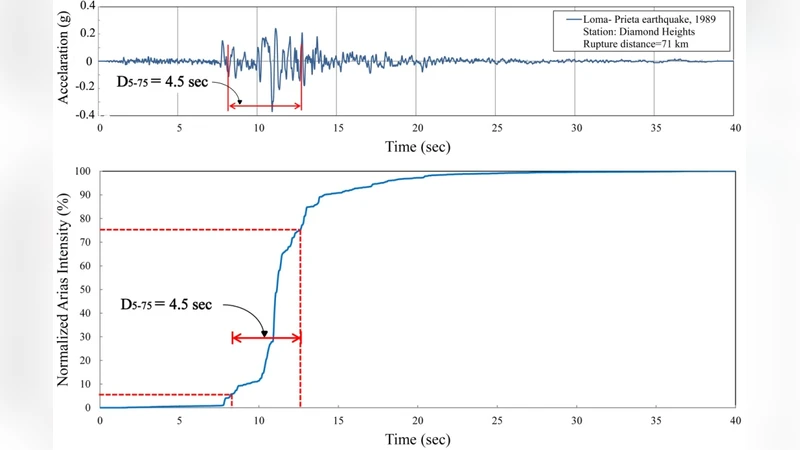
This study proposes a new approach to incorporate motion duration in incremental dynamic assessments. In the proposed methodology, at each intensity level, a simulation-based approach, which is verified with actual data, is employed to determine the median duration and the median acceleration spectra of ground motions expected to occur at the site. Afterward, at each intensity level, artificial or spectrally matched motions are produced based on the median acceleration spectra and the median duration, indicating that different intensity levels are directly covered by the generated artificial or adjusted motions rather than just scaling up and down a set of recorded ground motions. In the proposed methodology, duration and acceleration spectral shape changes against intensity level while they remain the same for different intensity levels in approach where responses are derived by scaling up and down of a set of ground motions. The functional relationship between duration and seismic intensity level, which is vital for the estimation of median duration at each intensity level, is firstly investigated for the sites with different soil conditions and rupture distances. Not only is it demonstrated that the data can fit into exponential functions, but the sensitivity of the functions against different parameters is also explored as well. The proposed duration-consistent incremental seismic assessment is used in nonlinear seismic assessment of two single degree of freedom structures, with and without a degrading behavior capability. It is revealed that when changes in duration and spectral shape of the motions at different intensity levels are considered in the nonlinear dynamic analysis, an impactful influence that cannot be easily ignored is witnessed in the structural responses of incremental analyses.
💡 Research Summary
The paper introduces a novel framework for incorporating strong‑motion duration into incremental seismic assessments, addressing a long‑standing limitation of conventional methods that treat ground‑motion records as merely scalable in amplitude. The authors first establish a data‑driven relationship between seismic intensity (or magnitude) and median ground‑motion duration for a variety of site conditions (soil stiffness) and rupture distances. By combining recorded strong‑motion data with physics‑based simulations, they extract, for each intensity level, (i) the median acceleration spectrum and (ii) the median duration. Statistical analysis shows that duration follows an exponential function of intensity, with coefficients that are sensitive to soil type and distance, thereby providing a site‑specific duration‑intensity model.
Having obtained intensity‑specific spectral shapes and durations, the authors generate a suite of artificial or spectrally‑matched motions for each intensity level. This is achieved through a hybrid procedure: (a) spectrum‑matching synthesis creates accelerograms whose Fourier amplitude spectra conform to the target median spectrum, and (b) time‑scaling adjusts the temporal length of the records to match the target median duration. The resulting motion set preserves the realistic variability of recorded earthquakes while ensuring that each intensity level is represented by motions whose spectral shape and duration are consistent with empirical observations, rather than by a single set of records simply scaled up or down.
To evaluate the impact of this duration‑consistent approach, the study conducts incremental nonlinear dynamic analyses on two single‑degree‑of‑freedom (SDOF) systems. The first system employs a conventional bilinear hysteretic model, while the second incorporates a degrading stiffness behavior that captures strength loss with increasing deformation. For each system, five intensity levels (e.g., corresponding to M5–M9) are examined using both the traditional scaling method and the newly generated duration‑consistent motions.
Results reveal several critical findings. First, when duration increases with intensity, both peak displacement and energy absorption rise markedly, especially for the degrading‑stiffness system where longer durations enhance the structure’s ability to dissipate energy, leading to lower peak forces for a given intensity. Second, changes in spectral shape with intensity affect the distribution of response across frequency ranges: high‑frequency‑rich motions at higher intensities tend to reduce the structure’s capacity more sharply than low‑frequency‑dominant motions, which primarily increase displacements. Third, the conventional scaling approach fails to capture these nuances, potentially leading to either overly conservative or non‑conservative design decisions.
The sensitivity analysis of the duration‑intensity functions demonstrates that soft soils exhibit a steeper increase in duration with intensity, while greater rupture distances attenuate the duration growth. These insights provide practical guidance for calibrating site‑specific seismic hazard models.
Finally, the authors outline future research directions, including extending the methodology to multi‑degree‑of‑freedom (MDOF) structures, integrating the approach with region‑wide ground‑motion databases, and exploring the coupling between duration, peak ground acceleration, and other intensity measures. By explicitly accounting for duration variations across intensity levels, the proposed framework offers a more realistic prediction of structural response, thereby improving seismic risk assessments and informing more resilient design practices.
Comments & Academic Discussion
Loading comments...
Leave a Comment