On the Unicity of the Homotopy Theory of Higher Categories
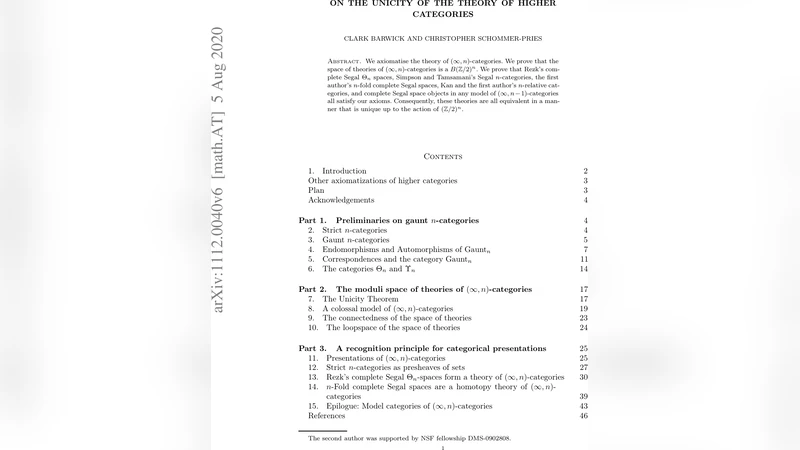
We axiomatise the theory of $(\infty,n)$-categories. We prove that the space of theories of $(\infty,n)$-categories is a $B(\mathbb{Z}/2)^n$. We prove that Rezk’s complete Segal $\Theta_n$-spaces, Simpson and Tamsamani’s Segal $n$-categories, the first author’s $n$-fold complete Segal spaces, Kan and the first author’s $n$-relative categories, and complete Segal space objects in any model of $(\infty,n-1)$-categories all satisfy our axioms. Consequently, these theories are all equivalent in a manner that is unique up to the action of $(\mathbb{Z}/2)^n$.
💡 Research Summary
The paper by Clark Barwick and Christopher Schommer‑Pries provides a comprehensive axiomatization of the theory of (∞, n)‑categories and proves a striking uniqueness result: the moduli space of all such theories is equivalent to the classifying space B(ℤ/2)ⁿ. The authors begin by introducing the notion of a “gaunt” strict n‑category—an n‑category in which every invertible k‑morphism (1 ≤ k ≤ n) is an identity. Gaunt n‑categories form a full subcategory Gauntₙ ⊂ Catₙ, and the cells Cₖ (0 ≤ k ≤ n) generate Catₙ under colimits. By localizing Catₙ at the gaunt objects they obtain a presentable, locally finitely presentable category Gauntₙ.
The core of the work is a list of five axioms (C.1–C.5) that any ∞‑category C intended to model (∞, n)‑categories must satisfy:
- Strong Generation (C.1): Every object of C is the canonical colimit of all gaunt n‑categories mapping into it.
- Weak Generation (C.2): Each object admits a “cell decomposition”, i.e. it is a colimit of the basic cells Cₖ.
- Internal Homs (C.3): For each k, the over‑category of objects over the k‑cell Cₖ possesses internal Hom objects.
- Fundamental Pushouts (C.4): A finite list S₀₀ of specific pushouts of gaunt n‑categories must remain pushouts in C.
- Universality (C.5): If another ∞‑category D contains the gaunt n‑categories as a full subcategory and satisfies the same axioms, then there is a left adjoint K : C → D whose restriction to gaunt objects is equivalent to the inclusion, and which is an equivalence on cells.
An ∞‑category satisfying these axioms is called a “theory of (∞, n)‑categories”. The authors then construct a concrete example of such a theory, proving that the space Thy(∞, n) of all theories is non‑empty and connected. To compute its homotopy type, they analyze the automorphism group of the universal theory. By studying natural transformations on Gauntₙ they show that the only non‑trivial automorphisms arise from taking opposites at each categorical level. Since each level admits an involution, the full automorphism group is (ℤ/2)ⁿ, and the classifying space of this discrete group is precisely B(ℤ/2)ⁿ. Consequently, any two theories are equivalent, and the set of equivalences between them is a torsor under (ℤ/2)ⁿ.
The final part of the paper verifies that all major models of (∞, n)‑categories known in the literature satisfy the five axioms:
- Rezk’s complete Segal Θₙ‑spaces – using the Θₙ‑diagram category and Rezk’s Segal conditions.
- n‑fold complete Segal spaces (Barwick) – obtained by iterating the complete Segal space construction.
- Simpson‑Tamsamani Segal n‑categories – via iterated Segal conditions and completeness.
- n‑relative categories (Barwick–Kan) – employing a relative‑category model structure.
- Enriched categories – categories enriched in any internal model of (∞, n)‑categories.
- Quasi‑categories (Boardman‑Vogt) for n = 1, and Lurie’s marked and scaled simplicial sets for n = 1, 2.
For each model the authors check the five axioms, often by exhibiting the required pushouts, internal Homs, and cell decompositions. As a corollary, all these models are Quillen equivalent, and any Quillen adjunction between two such model categories is a Quillen equivalence precisely when it preserves cells up to weak equivalence.
In summary, the paper establishes a robust, model‑independent foundation for (∞, n)‑categories: any reasonable model must satisfy the five axioms, and any two such models are uniquely equivalent up to the independent choice of opposite at each of the n categorical levels. This result not only clarifies the landscape of higher‑category theory but also provides a practical checklist for verifying new models and for transferring constructions across existing ones.
Comments & Academic Discussion
Loading comments...
Leave a Comment