From diffusion in compartmentalized media to non-Gaussian random walks
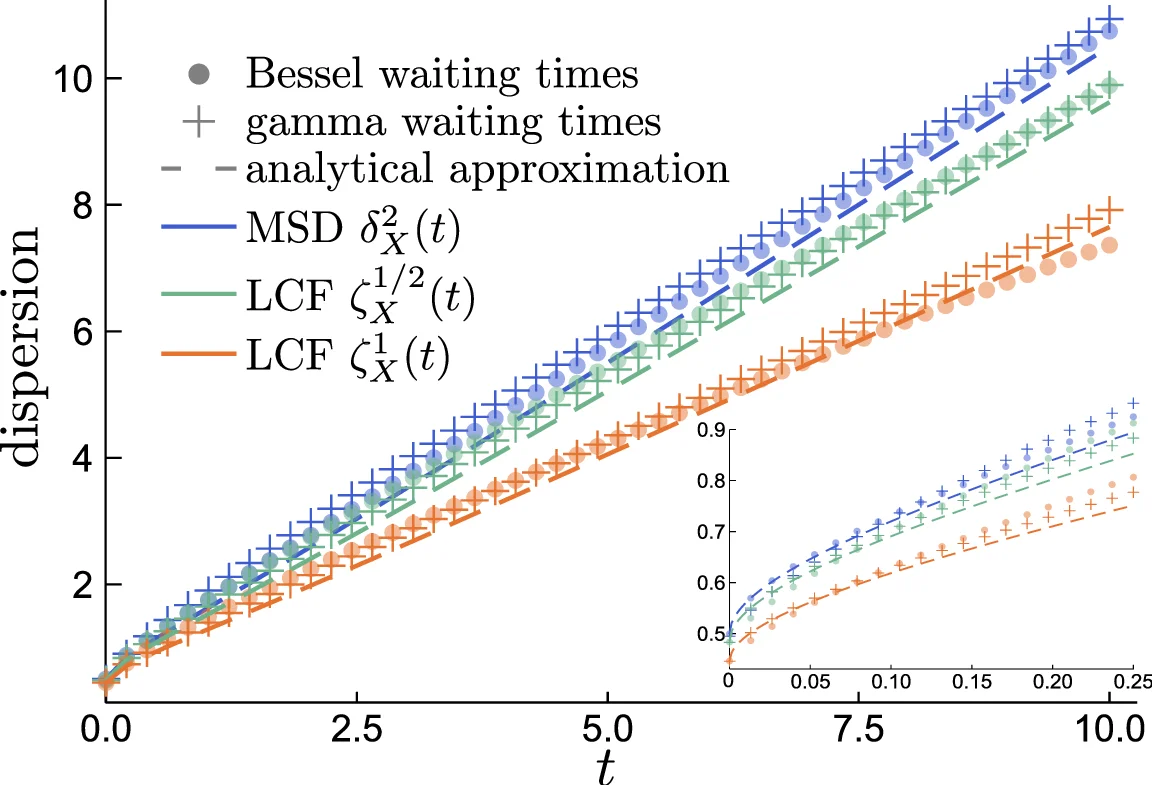
In this work we establish a link between two different phenomena that were studied in a large and growing number of biological, composite and soft media: the diffusion in compartmentalized environment and the Brownian yet non-Gaussian diffusion that exhibits linear growth of the mean square displacement joined by the exponential shape of the positional probability density. We explore a microscopic model that gives rise to transient confinement, similar to the one observed for hop-diffusion on top of a cellular membrane. The compartmentalization of the media is achieved by introducing randomly placed, identical barriers. Using this model of a heterogeneous medium we derive a general class of random walks with simple jump rules that are dictated by the geometry of the compartments. Exponential decay of positional probability density is observed and we also quantify the significant decrease of the long time diffusion constant. Our results suggest that the observed exponential decay is a general feature of the transient regime in compartmentalized media.
💡 Research Summary
In this paper the authors establish a unified theoretical framework that connects two seemingly distinct phenomena observed in a wide range of soft and biological media: diffusion in compartmentalized environments and Brownian yet non‑Gaussian diffusion characterized by a linear mean‑square displacement (MSD) together with exponential tails in the positional probability density function (PDF). The work is motivated by experimental observations of hop‑diffusion on cellular membranes, porous materials, and colloidal systems near the glass transition, where particles experience transient confinement by semi‑permeable barriers, leading to a dramatic reduction of the long‑time effective diffusion coefficient relative to the short‑time intra‑compartment diffusion.
The authors begin by a general entropy‑based argument: in a bounded domain the maximum‑entropy distribution is uniform, not Gaussian. When barriers are sparse enough that particles spend a relaxation time t_r to explore a compartment and an escape time t_e to cross a barrier (t_r ≪ t_e), the system exhibits three regimes. For t ≪ t_r the motion is essentially free; for t ≫ t_e the process becomes ordinary Brownian with a reduced diffusion constant; and for the intermediate window t_r ≲ t ≲ t_e the dynamics are dominated by confinement, producing non‑Gaussian PDFs that reflect the geometry of the compartments.
To make these ideas quantitative the authors construct a one‑dimensional model in which identical thin barriers are placed at random positions according to a Poisson process, implying an exponential distribution of compartment lengths L with p_L(l)=e^{-l}. Within each compartment the particle diffuses with coefficient D, while inside a barrier the coefficient is D_b ≪ D. By adopting the Hänggi–Klimontovich interpretation of the stochastic differential equation dX_t=√{2D(X_t)} dB_t, they obtain the corresponding Fokker‑Planck equation with continuity of flux at the interfaces. In the limit of vanishing barrier thickness and D_b→0 while keeping κ=D_b/Δx finite, the interface conditions reduce to continuity of the probability density and a jump condition for its gradient proportional to κ
Comments & Academic Discussion
Loading comments...
Leave a Comment