On Competitive Analysis for Polling Systems
Polling systems have been widely studied, however most of these studies focus on polling systems with renewal processes for arrivals and random variables for service times. There is a need driven by practical applications to study polling systems with arbitrary arrivals (not restricted to time-varying or in batches) and revealed service time upon a job’s arrival. To address that need, our work considers a polling system with generic setting and for the first time provides the worst-case analysis for online scheduling policies in this system. We provide conditions for the existence of constant competitive ratios, and competitive lower bounds for general scheduling policies in polling systems. Our work also bridges the queueing and scheduling communities by proving the competitive ratios for several well-studied policies in the queueing literature, such as cyclic policies with exhaustive, gated or l-limited service disciplines for polling systems.
💡 Research Summary
This paper, “On Competitive Analysis for Polling Systems,” presents a pioneering worst-case analysis of online scheduling policies for a general polling system model, bridging the gap between queueing theory and scheduling theory.
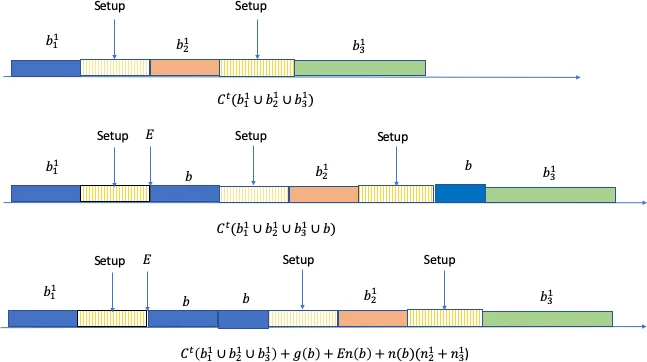
Introduction & Problem Definition: The study is motivated by modern applications like smart manufacturing (e.g., 3D printing) where a single server must process jobs from multiple parallel queues. A key setup time (τ) is incurred whenever the server switches between queues. The model is “general” because it makes no stochastic assumptions: job arrivals can be arbitrary (time-varying, batched, etc.), and the processing time (p_i) of a job is revealed deterministically upon its arrival (r_i). The objective is to minimize the total completion time (∑C_i). The authors analyze this as an online scheduling problem (1|r_i, τ|∑C_i), where the scheduler has no knowledge of future jobs.
General Foundational Results (Section 2): The paper first establishes fundamental limits. Theorem 1 proves a lower bound: any online policy whose routing discipline is purely static, random, purely queue-length-based, or purely processing-time-based cannot achieve a competitive ratio smaller than k (the number of queues). This highlights the inherent inefficiency of simple routing schemes in the worst case when setup times are present. Conversely, Theorem 2 provides a positive guarantee: under bounded processing time variation (p_max ≤ γ p_min) and bounded setup time relative to the smallest job (τ ≤ θ p_min), any non-preemptive, work-conserving policy (which never idles or sets up an empty queue while the system is busy) is at least (γ + θ)-competitive. This shows that simple, non-idling policies can be robust under reasonable conditions.
Analysis of Specific Policy Classes:
- Cyclic-Based Policies (Section 3): The authors analyze policies combining a cyclic routing order with classic queueing service disciplines: Exhaustive (serve until the queue is empty), Gated (serve only jobs present at the start of the visit), and l-Limited (serve at most l jobs per visit). They prove that these policies, widely studied for their average performance in stochastic settings, also achieve a constant competitive ratio of κ = max{(k+1)γ/k, k+1} in the worst-case model with bounded processing times. This formally connects well-known queueing policies to scheduling-theoretic performance guarantees.
- Processing-Time-Based Policies (Section 4): The paper explores policies that actively utilize the revealed processing time information, proposing and analyzing variants that balance the known information about present jobs with the uncertainty of future arrivals.
Contributions and Significance: This work makes four key contributions: 1) It is the first to perform a competitive analysis of online policies for polling systems without stochastic assumptions. 2) It bridges the queueing and scheduling communities by proving competitive ratios for classic queueing policies. 3) It provides a general lower bound for online policies. 4) It proposes new policies that balance exploiting known information and hedging against future uncertainty. By providing guaranteed worst-case performance bounds, this analysis offers system designers a tool for building more reliable and predictable systems in applications like flexible manufacturing and communication networks, where arrival patterns can be irregular and predictable performance is critical.
Comments & Academic Discussion
Loading comments...
Leave a Comment