Consensus Algorithms and the Decomposition-Separation Theorem
Convergence properties of time inhomogeneous Markov chain based discrete and continuous time linear consensus algorithms are analyzed. Provided that a so-called infinite jet flow property is satisfied by the underlying chains, necessary conditions for both consensus and multiple consensus are established. A recenet extension by Sonin of the classical Kolmogorov-Doeblin decomposition-separation for homogeneous Markov chains to the inhomogeneous case is then employed to show that the obtained necessary conditions are also sufficient when the chain is of Class P*, as defined by Touri and Nedic. It is also shown that Sonin’s theorem leads to a rediscovery and generalization of most of the existing related consensus results in the literature.
💡 Research Summary
The paper investigates the convergence behavior of linear consensus algorithms whose dynamics are driven by time‑varying Markov chains, covering both discrete‑time and continuous‑time settings. The authors consider an N‑agent system with state vector x(t) evolving according to x(t + 1)=A(t)x(t), where each A(t) is a row‑stochastic matrix, i.e., a transition matrix of a backward Markov chain. Consensus (all agents converge to the same value) is shown to be equivalent to ergodicity of the chain {A(t)}, while multiple consensus corresponds to class‑ergodicity (convergence of products A(t)A(t‑1)…A(t₀) for any t₀).
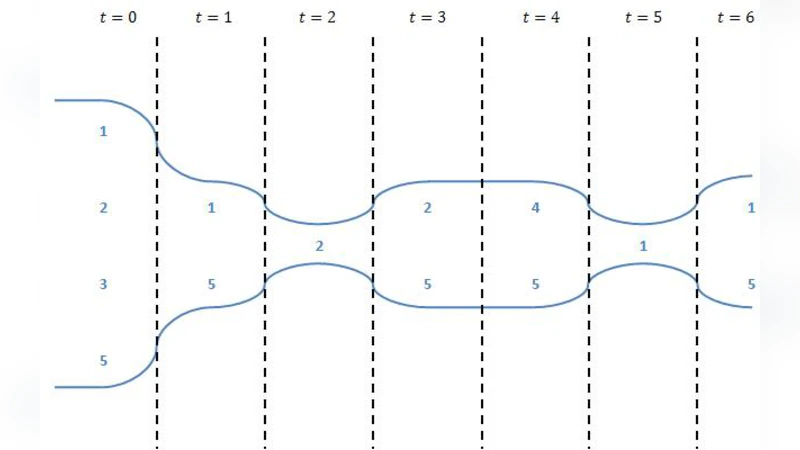
A central contribution is the introduction of the “infinite jet‑flow” property. A jet is a time‑indexed sequence of non‑empty subsets of agents; proper jets never become empty. For two disjoint jets Jₛ and Jₖ, the total interaction U(Jₛ,Jₖ) is defined as the sum over time of the bidirectional transition probabilities between the two jets. The chain possesses the infinite jet‑flow property if, for every proper jet J, the interaction between J and its complement is unbounded. This condition can be visualized through the infinite‑flow graph G_A whose edges connect pairs (i,j) whose cumulative bidirectional weights diverge; each connected component of G_A is called an “island”.
Theorem 1 proves that class‑ergodicity can hold only if the infinite jet‑flow property holds on each island. The proof uses an ℓ₁‑approximation argument: by zeroing out the interactions between a bounded‑flow jet and its complement, one obtains a chain B(t) that shares the same ergodic classes as A(t). If the original chain were class‑ergodic, B(t) would still be, yet the constructed dynamics would prevent the agents in the jet from mixing with the rest, contradicting convergence. Corollary 1 follows, stating that ergodicity itself requires the infinite jet‑flow property (i.e., the infinite‑flow graph must be connected).
The paper further defines an “independent jet” as a jet whose total inflow from the complement is finite. Theorem 2 shows that the existence of two disjoint independent jets precludes ergodicity. This result subsumes Corollary 1 because the failure of infinite jet‑flow implies the presence of two disjoint independent jets.
A pivotal theoretical tool is Sonin’s Decomposition‑Separation (D‑S) theorem, originally formulated for homogeneous Markov chains and later extended to the inhomogeneous case. The authors demonstrate that for any backward chain {A(t)} there exists an absolute probability sequence {m(t)} (all entries positive) and a forward chain {P(t)} satisfying a_ij(t)=p_ji(t)m_j(t)/m_i(t+1). This construction yields a physical interpretation: imagine cups containing liquid volumes m_i(t); the transition probabilities dictate how liquid moves between cups, while a substance’s concentration in each cup evolves exactly according to the consensus update (1). The D‑S theorem then characterizes the asymptotic behavior of both the volume vector m(t) and the concentration vector x(t) in terms of islands and jets.
Building on the D‑S framework, the authors focus on chains belonging to Class P* (as defined by Touri and Nedic). A chain is in Class P* if it admits a uniformly positive absolute probability sequence. Within this class, the infinite jet‑flow property becomes not only necessary but also sufficient for both ergodicity and class‑ergodicity. Consequently, the paper provides a complete characterization: for Class P* chains, consensus occurs iff the infinite‑flow graph is connected; multiple consensus occurs iff each island satisfies the infinite jet‑flow property.
The paper proceeds to show that this unified approach subsumes most existing convergence results for linear consensus algorithms, including those based on B‑connectivity, cut‑balance, doubly stochastic matrices, and other structural assumptions. A geometric viewpoint is introduced to handle both discrete and continuous time protocols, and the analysis is extended to continuous‑time systems by interpreting the state‑transition matrix Φ(t,τ) as the solution of a time‑varying linear differential equation.
In summary, the authors develop a novel structural condition— the infinite jet‑flow property— and, via Sonin’s D‑S theorem, prove that for Class P* Markov chains this condition exactly characterizes when linear consensus algorithms achieve consensus or multiple consensus. The work unifies and generalizes a broad spectrum of prior results, offering a powerful and elegant framework for analyzing convergence in time‑inhomogeneous multi‑agent systems.
Comments & Academic Discussion
Loading comments...
Leave a Comment