Atiyah-Bott index on stratified manifolds
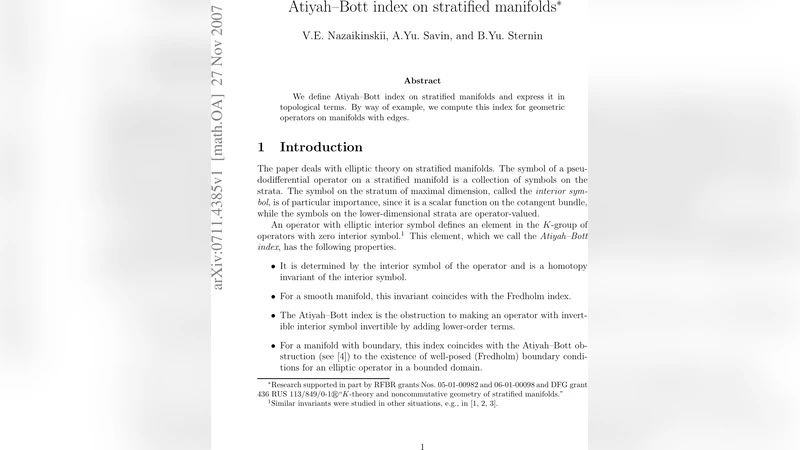
We define Atiyah-Bott index on stratified manifolds and express it in topological terms. By way of example, we compute this index for geometric operators on manifolds with edges.
💡 Research Summary
The paper introduces a novel extension of the Atiyah‑Bott index from smooth manifolds to the much broader class of stratified manifolds—spaces that consist of a hierarchy of strata, each possibly of different dimension and possessing singularities along lower‑dimensional interfaces. After a concise review of the classical Atiyah‑Bott and Atiyah‑Singer index theorems, the authors set up the geometric and analytic framework needed to treat stratified spaces. They define a stratified manifold as a union of a principal (regular) stratum together with a finite collection of singular strata, each equipped with its own smooth structure and compatible tubular neighborhoods. Vector bundles and pseudodifferential operators are then defined on each stratum, and a transmission (or gluing) condition is imposed along the interfaces to ensure that symbols match appropriately across strata. This transmission condition is encoded by a family of “transition operators” which act as boundary maps in K‑theory.
With this machinery in place, the authors formulate the Atiyah‑Bott index for an elliptic operator (D) on a stratified manifold. The index is expressed as a sum of two contributions: (1) the usual Atiyah‑Singer index computed on each smooth stratum, and (2) a boundary contribution arising from the transition operators, which lives in a relative K‑theory group associated with the pair (principal stratum, singular locus). The main theorem states that the total index equals the sum of these stratum‑wise indices plus the boundary term, and that this expression is invariant under homotopies of the operator that respect the stratified structure. The proof combines microlocal analysis, a careful construction of normalized symbol classes near singularities, and the use of the Thom isomorphism in K‑theory to relate the boundary term to a topological invariant of the singular set.
To illustrate the theory, the paper works out the case of manifolds with edges—a two‑dimensional surface whose boundary is a one‑dimensional edge. Classical geometric operators such as the Laplacian, the Dirac operator, and more general elliptic operators are examined. For each operator the authors compute the principal symbol on the interior and the transmission symbol on the edge, then apply the index formula. The interior contribution reproduces the familiar Atiyah‑Singer result (e.g., Euler characteristic for the Laplacian). The edge contribution is shown to be proportional to topological data of the edge, such as the number of connected components and the first Betti number, reflecting the presence of edge‑localized modes. The final index is therefore a linear combination of interior topological invariants and edge invariants, confirming that the new theory correctly captures both bulk and boundary phenomena.
The authors also compare their stratified Atiyah‑Bott index with the classical index in the special case where the singular strata are empty; the formula reduces exactly to the traditional Atiyah‑Bott/Atiyah‑Singer index, providing a consistency check. They discuss how the boundary term can be interpreted as a relative index in K‑theory, analogous to the index of a Fredholm pair, and how this perspective connects to physical models where edge states play a crucial role (e.g., topological insulators, waveguides).
In the concluding section, the paper outlines possible extensions: handling corners (intersections of edges), higher‑codimension singularities, and non‑compact stratified spaces. The authors suggest that their framework could be adapted to study index problems for nonlinear PDEs on singular spaces, as well as to provide a rigorous mathematical foundation for bulk‑boundary correspondence in condensed‑matter physics. Overall, the work delivers a comprehensive topological description of the Atiyah‑Bott index on stratified manifolds, bridges a gap between smooth index theory and singular geometry, and opens new avenues for applications in both pure mathematics and theoretical physics.
Comments & Academic Discussion
Loading comments...
Leave a Comment