Are Distributed Ledger Technologies Ready for Smart Transportation Systems?
The aim of this paper is to understand whether Distributed Ledger Technologies (DLTs) are ready to support complex services, such as those related to Intelligent Transportation Systems (ITS). In smart transportation services, a huge amount of sensed data is generated by a multitude of vehicles. While DLTs provide very interesting features, such as immutability, traceability and verifiability of data, some doubts on the scalability and responsiveness of these technologies appear to be well-founded. We propose an architecture for ITS that resorts to DLT features. Moreover, we provide experimental results of a real test-bed over IOTA, a promising DLT for IoT. Results clearly show that, while the viability of the proposal cannot be rejected, further work is needed on the responsiveness of DLT infrastructures.
💡 Research Summary
This paper presents a comprehensive investigation into the readiness of Distributed Ledger Technologies (DLTs) to support the demanding requirements of Intelligent Transportation Systems (ITS). The core question addressed is whether DLTs, despite offering attractive features like data immutability, traceability, and verifiability, can meet the scalability and real-time responsiveness needs of ITS applications, which involve massive, continuous data streams from numerous vehicles.
The authors first propose a conceptual system architecture for ITS that leverages DLTs. In this model, vehicles periodically transmit sensed data (or corresponding digests) to DLT nodes. This data is immutably recorded on the ledger, forming a trusted foundation for various services like traffic efficiency analysis, safety applications, and environmental monitoring. The paper highlights IOTA as a promising, fee-less DLT designed for IoT/ITS scenarios and specifically suggests using its Masked Authenticated Messaging (MAM) extension to manage encrypted data streams for individual vehicles, facilitating access control and data privacy.
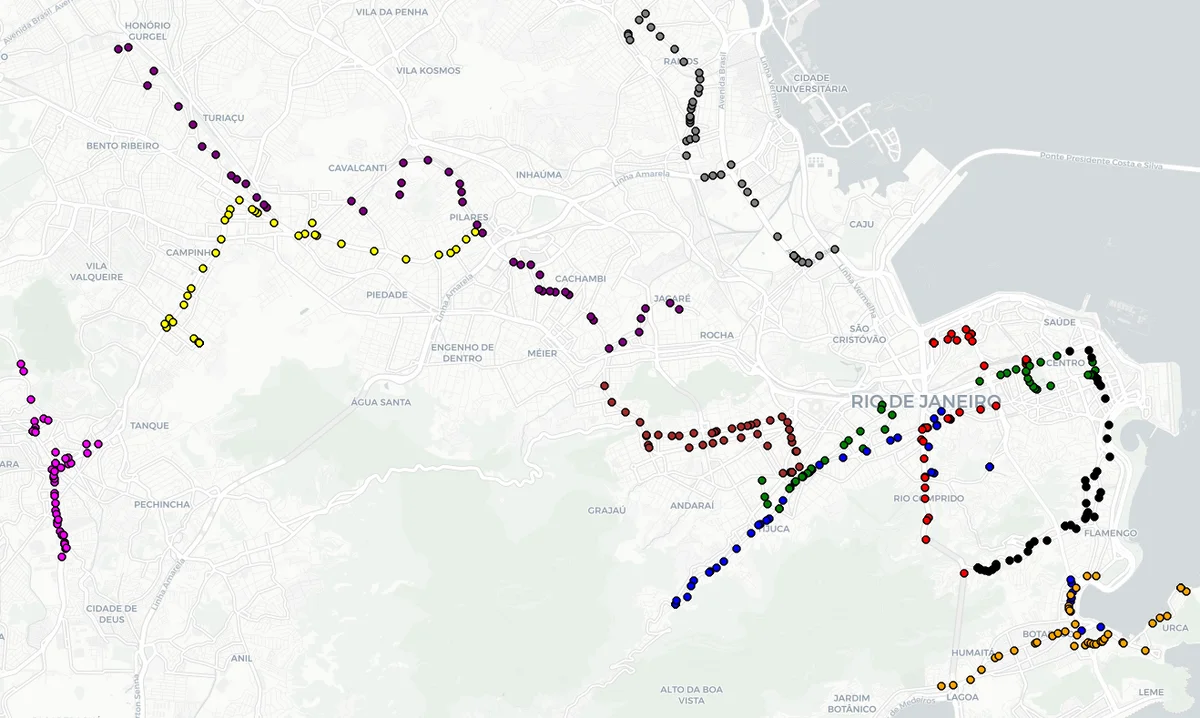
The second and pivotal part of the work is an extensive experimental evaluation based on real-world mobility traces from buses in Rio de Janeiro. The study simulates fleets of 60, 120, and 240 buses, each generating messages approximately every 80 seconds. These messages are published as transactions to the IOTA Tangle via a pool of publicly available full nodes. A key aspect of the experiment is the comparison of three distinct strategies for selecting which full node handles each transaction: (1) Fixed Random (a single random node per bus), (2) Dynamic Random (a new random node for each message), and (3) Adaptive RTT (selecting the best-performing node based on historical Round-Trip Time measurements).
The results are revealing and critical for assessing practical viability. Both random selection strategies (Fixed and Dynamic) exhibited high error rates (around 10-15%) and significant latency for transaction confirmation, primarily due to performance variability and instability among public IOTA nodes. In stark contrast, the Adaptive RTT strategy dramatically reduced the error rate to below 1% and yielded more consistent and lower latencies. This underscores a major finding: the current performance and reliability of the IOTA network are highly heterogeneous, and intelligent, application-layer node selection is crucial for achieving usable performance.
In conclusion, the paper demonstrates that while the proposed DLT-based architecture for ITS is conceptually viable and offers significant benefits in terms of data trust, the technology is not yet fully ready for prime time. The experimental evidence clearly indicates that responsiveness and reliability remain substantial challenges. The authors assert that further work is imperative to improve the core responsiveness of DLT infrastructures like IOTA, alongside efforts to achieve full decentralization (removing the reliance on the Coordinator node) and to develop robust node selection and management mechanisms for end-user applications.
Comments & Academic Discussion
Loading comments...
Leave a Comment