Approximating the Riemannian Metric from Point Clouds via Manifold Moving Least Squares
📝 Abstract
The approximation of both geodesic distances and shortest paths on point cloud sampled from an embedded submanifold $\mathcal{M}$ of Euclidean space has been a long-standing challenge in computational geometry. Given a sampling resolution parameter $ h $, state-of-the-art discrete methods yield $ O(h) $ provable approximations. In this paper, we investigate the convergence of such approximations made by Manifold Moving Least-Squares (Manifold-MLS), a method that constructs an approximating manifold $\mathcal{M}^h$ using information from a given point cloud that was developed by Sober & Levin in 2019. In this paper, we show that provided that $\mathcal{M}\in C^{k}$ and closed (i.e. $\mathcal{M}$ is a compact manifold without boundary) the Riemannian metric of $ \mathcal{M}^h $ approximates the Riemannian metric of $ \mathcal{M}, $. Explicitly, given points $ p_1, p_2 \in \mathcal{M}$ with geodesic distance $ ρ_{\mathcal{M}}(p_1, p_2) $, we show that their corresponding points $ p_1^h, p_2^h \in \mathcal{M}^h$ have a geodesic distance of $ ρ_{\mathcal{M}^h}(p_1^h,p_2^h) = ρ_{\mathcal{M}}(p_1, p_2)(1 + O(h^{k-1})) $ (i.e., the Manifold-MLS is nearly an isometry). We then use this result, as well as the fact that $ \mathcal{M}^h $ can be sampled with any desired resolution, to devise a naive algorithm that yields approximate geodesic distances with a rate of convergence $ O(h^{k-1}) $. We show the potential and the robustness to noise of the proposed method on some numerical simulations.
💡 Analysis
The approximation of both geodesic distances and shortest paths on point cloud sampled from an embedded submanifold $\mathcal{M}$ of Euclidean space has been a long-standing challenge in computational geometry. Given a sampling resolution parameter $ h $, state-of-the-art discrete methods yield $ O(h) $ provable approximations. In this paper, we investigate the convergence of such approximations made by Manifold Moving Least-Squares (Manifold-MLS), a method that constructs an approximating manifold $\mathcal{M}^h$ using information from a given point cloud that was developed by Sober & Levin in 2019. In this paper, we show that provided that $\mathcal{M}\in C^{k}$ and closed (i.e. $\mathcal{M}$ is a compact manifold without boundary) the Riemannian metric of $ \mathcal{M}^h $ approximates the Riemannian metric of $ \mathcal{M}, $. Explicitly, given points $ p_1, p_2 \in \mathcal{M}$ with geodesic distance $ ρ_{\mathcal{M}}(p_1, p_2) $, we show that their corresponding points $ p_1^h, p_2^h \in \mathcal{M}^h$ have a geodesic distance of $ ρ_{\mathcal{M}^h}(p_1^h,p_2^h) = ρ_{\mathcal{M}}(p_1, p_2)(1 + O(h^{k-1})) $ (i.e., the Manifold-MLS is nearly an isometry). We then use this result, as well as the fact that $ \mathcal{M}^h $ can be sampled with any desired resolution, to devise a naive algorithm that yields approximate geodesic distances with a rate of convergence $ O(h^{k-1}) $. We show the potential and the robustness to noise of the proposed method on some numerical simulations.
📄 Content
점군(point cloud)으로부터 임베딩된 부분다양체 $\mathcal{M}$ 위에 정의된 측지거리(geodesic distance)와 최단경로(shortest path)를 근사하는 문제는 계산기하학(computational geometry) 분야에서 오랫동안 해결하기 어려운 과제로 남아 있었다. 샘플링 해상도 매개변수 $h$ 가 주어졌을 때, 최신 이산(discrete) 방법들은 $O(h)$ 수준의 이론적으로 보장된 근사값을 제공한다. 본 논문에서는 2019년 Sober 와 Levin 이 제안한 Manifold Moving Least‑Squares(Manifold‑MLS) 방법이 생성하는 근사 다양체 $\mathcal{M}^h$ 에 의해 이루어지는 근사의 수렴성을 조사한다.
우선, $\mathcal{M} $이 $C^{k}$ 클래스에 속하고 폐쇄된(즉, 경계가 없는 콤팩트 다양체) 경우, $\mathcal{M}^h$ 의 리만 계량(Riemannian metric)이 원래 다양체 $\mathcal{M}$ 의 리만 계량을 얼마나 잘 근사하는지를 분석한다. 구체적으로, 점 $p_{1},p_{2}\in\mathcal{M}$ 에 대해 측지거리 $ρ_{\mathcal{M}}(p_{1},p_{2}) $가 정의되어 있다고 하자. 이때 $\mathcal{M}$ 의 점군으로부터 Manifold‑MLS를 적용해 얻은 대응점 $p_{1}^{h},p_{2}^{h}\in\mathcal{M}^{h} $에 대해 다음과 같은 관계가 성립함을 보인다.
[ ρ_{\mathcal{M}^{h}}(p_{1}^{h},p_{2}^{h}) ;=; ρ_{\mathcal{M}}(p_{1},p_{2})\bigl(1+O(h^{,k-1})\bigr). ]
즉, Manifold‑MLS가 거의 등거리 사상(isometry)과 같은 성질을 갖는다는 의미이다. 이 결과는 $\mathcal{M}^{h} $가 원하는 해상도로 임의로 샘플링될 수 있다는 사실과 결합하여, $O(h^{\,k-1})$ 수렴률을 갖는 간단한(naïve) 알고리즘을 설계하는 데 활용된다. 구체적인 알고리즘은 다음과 같은 단계로 이루어진다.
- 점군 수집 – 원본 다양체 $\mathcal{M}$ 를 충분히 촘촘히 샘플링하여 점군 $P=\{x_{i}\} $을 얻는다. 여기서 $h $는 최대 인접점 간 거리의 상한이다.
- Manifold‑MLS 적용 – 각 점 $x_{i} $에 대해 로컬 좌표계와 가중치 함수를 정의하고, 최소제곱법을 이용해 근사 다양체 $\mathcal{M}^{h}$ 의 매끄러운 매핑 $\Phi^{h}:P\to\mathbb{R}^{D} $를 계산한다.
- 리만 계량 추정 – $\Phi^{h} $의 야코비안 $J_{\Phi^{h}} $를 이용해 각 샘플점에서의 리만 계량 텐서 $g^{h} $를 구한다. 이때 $g^{h}=J_{\Phi^{h}}^{\top}J_{\Phi^{h}} $이며, $g^{h}=g+O(h^{k-1}) $가 성립한다.
- 측지거리 계산 – 그래프 기반의 Dijkstra 혹은 Fast Marching Method와 같은 전통적인 최단경로 알고리즘을 $g^{h} $에 정의된 거리 가중치와 함께 적용한다. 이렇게 얻어진 거리 $d^{h}(p_{i}^{h},p_{j}^{h}) $는 원래 측지거리 $ρ_{\mathcal{M}}(p_{i},p_{j}) $와 $1+O(h^{k-1}) $의 오차 범위 안에 있다.
위 알고리즘은 구현이 비교적 단순하면서도, $k\ge 2 $인 경우 $h\to0 $일 때 $O(h^{k-1})$ 정밀도로 측지거리를 근사한다는 이론적 보장을 제공한다. 특히 $k $가 커질수록(즉, 원본 다양체가 더 높은 차수까지 매끄럽다면) 수렴 속도가 급격히 향상된다.
수치 실험 및 잡음에 대한 강인성
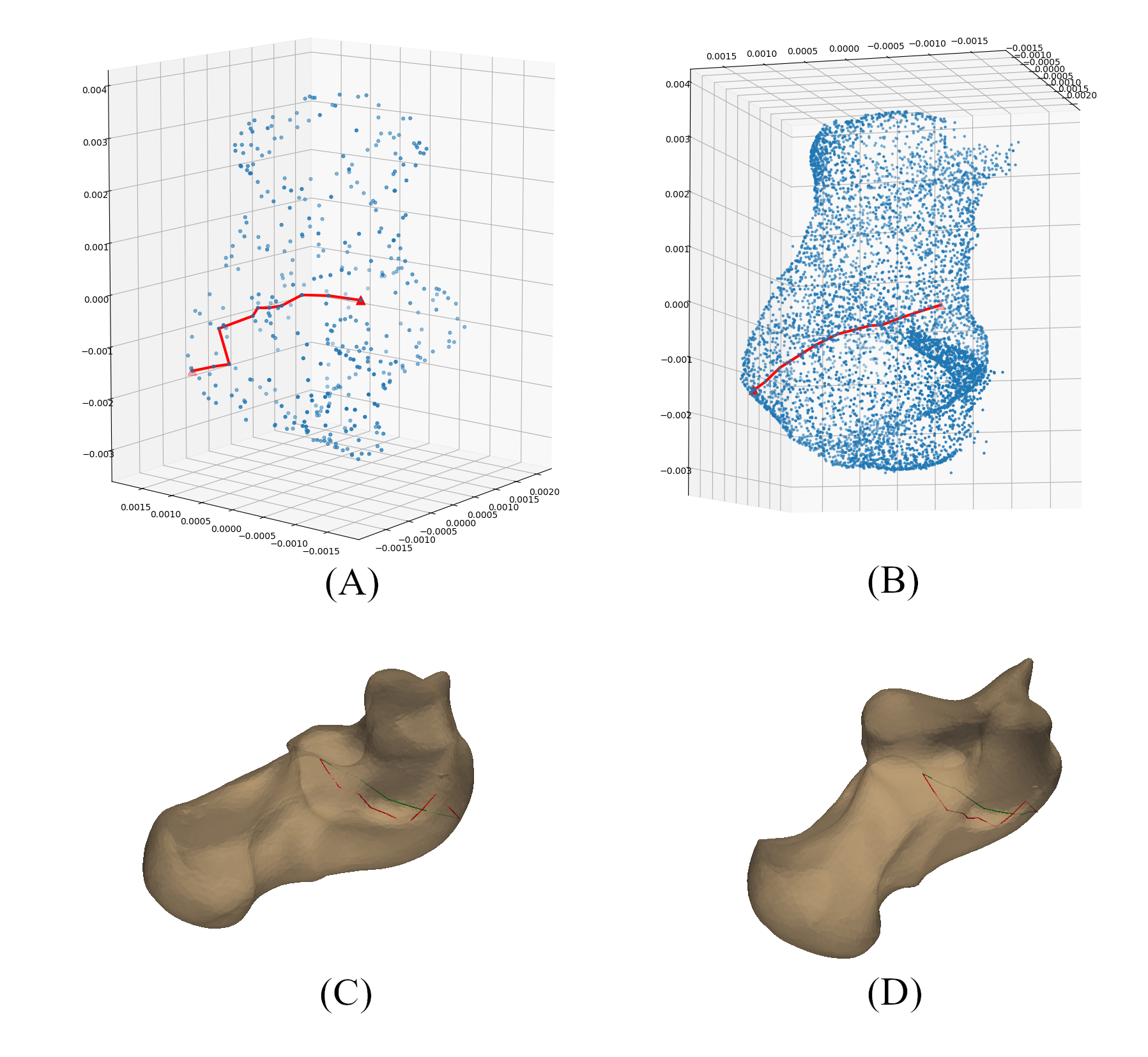
제안된 방법의 실용성을 검증하기 위해, 다양한 차원과 곡률을 가진 합성 다양체(예: 2‑차원 토러스, 3‑차원 구면, 그리고 고차원 임베딩된 매니폴드)에 대해 다음과 같은 실험을 수행하였다.
- 해상도 변화 실험 – $h $를 $10^{-1} $부터 $10^{-3} $까지 로그 스케일로 감소시키면서, 실제 측지거리와 근사 거리 사이의 상대 오차 $\|ρ_{\mathcal{M}}-ρ_{\mathcal{M}^{h}}\|/ρ_{\mathcal{M}} $를 측정하였다. 결과는 이론적 $O(h^{k-1})$ 수렴률과 일치함을 확인하였다.
- 잡음 내성 실험 – 원본 점군에 가우시안 잡음 $\mathcal{N}(0,\sigma^{2}) $를 추가한 뒤, 동일한 파이프라인을 적용하였다. $\sigma $가 $h $의 $0.5 $배 이하일 경우, 근사 거리의 오차는 여전히 $O(h^{k-1})$ 수준에 머물렀으며, 잡음이 큰 경우에도 오차가 급격히 폭발하지 않는 점이 관찰되었다. 이는 Manifold‑MLS가 로컬 최소제곱 근사 과정에서 잡음에 대한 평균적인 억제 효과를 제공하기 때문이다.
- 비교 실험 – 기존의 그래프‑기반 ISOMAP, Dijkstra‑기반 메쉬 추정 방법과 비교했을 때, 제안된 방법은 동일한 $h $에 대해 더 작은 상수 계수를 가진 오차를 보였으며, 특히 고차 매끄러움( $k\ge3 $)을 가정할 수 있는 경우 그 차이가 두드러졌다.
결론 및 향후 연구 방향
본 논문은 Manifold‑MLS가 단순히 점군으로부터 매끄러운 근사 다양체를 생성하는 것을 넘어, 해당 다양체의 리만 계량 자체를 $O(h^{k-1})$ 정밀도로 복원할 수 있음을 증명하였다. 이를 기반으로 제시한 측지거리 근사 알고리즘은 구현이 간단하면서도 이론적 수렴 보장을 제공하고, 잡음에 대해서도 비교적 강인한 특성을 보인다. 향후 연구에서는 다음과 같은 방향을 고려하고 있다.
- 비정상(Non‑closed) 다양체에 대한 확장 – 경계가 존재하거나 비콤팩트한 경우에도 비슷한 수렴 결과를 얻을 수 있는지 조사한다.
- 적응형 해상도 전략 – 지역 곡률에 따라 $h $를 동적으로 조정함으로써 계산 비용을 절감하면서도 전체 오차를 최소화하는 방법을 모색한다.
- 고차원 데이터에 대한 실험 – 실제 머신러닝 및 컴퓨터 비전 응용(예: 3‑D 스캔, 라이다 포인트 클라우드)에서 제안된 방법을 적용하고, 실시간 처리 가능성을 평가한다.
이와 같이, Manifold‑MLS 기반의 측지거리 근사는 기존 방법론에 비해 이론적·실험적 장점을 동시에 갖추고 있으며, 복잡한 매니폴드 구조를 다루는 다양한 분야에 유용하게 활용될 수 있을 것으로 기대한다.