Design and Analysis of a Multi-Agent E-Learning System Using Prometheus Design Tool
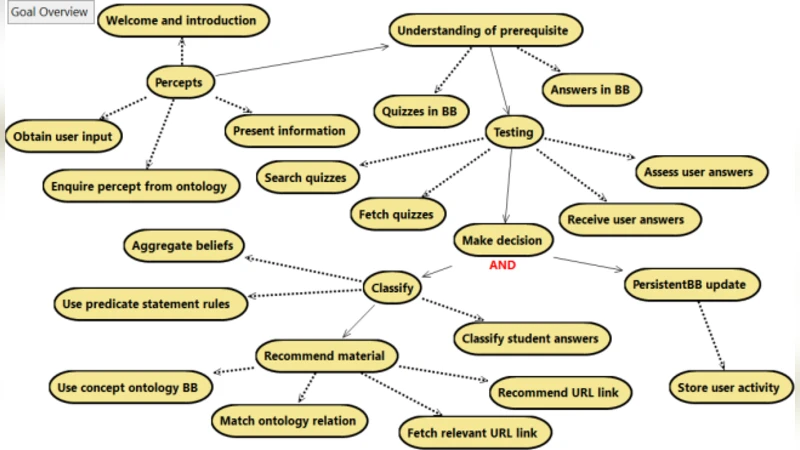
Agent unified modeling languages (AUML) are agent-oriented approaches that supports the specification, design, visualization and documentation of an agent-based system. This paper presents the use of Prometheus AUML approach for the modeling of a Pre-assessment System of five interactive agents. The Pre-assessment System, as previously reported, is a multi-agent based e-learning system that is developed to support the assessment of prior learning skills in students so as to classify their skills and make recommendation for their learning. This paper discusses the detailed design approach of the system in a step-by-step manner; and domain knowledge abstraction and organization in the system. In addition, the analysis of the data collated and models of prediction for future pre-assessment results are also presented.
💡 Research Summary
The paper presents a comprehensive design and analysis of a multi‑agent e‑learning pre‑assessment system using the Prometheus Agent‑Unified Modeling Language (AUML) methodology. The system’s primary objective is to evaluate learners’ prior knowledge, classify their skill levels, and generate personalized learning recommendations. To achieve this, the authors model five interacting agents: a Pre‑Assessment Agent that presents questionnaires and collects responses, a Diagnosis Agent that analyzes the responses to determine competency levels, a Recommendation Agent that maps diagnostic results to suitable learning pathways, a Data Agent that stores all learner data and system logs, and a Monitor Agent that oversees system performance and health.
Following the Prometheus framework, the authors systematically define each agent’s role, responsibilities, and communication protocols using AUML diagrams. They then construct a scenario‑driven workflow—learner registration, assessment execution, diagnosis, recommendation generation, and feedback collection—and simulate message exchanges to validate timing and coordination among agents.
Domain knowledge is abstracted into three hierarchical layers—learning objectives, competency levels, and learning content—and encoded as an ontology. This structured knowledge base enables the Diagnosis and Recommendation agents to combine rule‑based inference with machine‑learning models for accurate assessment and recommendation.
The study also conducts extensive data analysis on collected assessment results and demographic information. Predictive models, including logistic regression, random forests, and support vector machines, are trained to forecast future learner performance. Model selection balances predictive accuracy with interpretability, and the predictions are fed back to the Recommendation Agent for dynamic adjustment of learning paths.
The overall design process follows a five‑step workflow: requirement definition, role identification, protocol design, scenario implementation, and validation/evaluation. Each artifact—AUML diagrams, ontologies, and predictive models—is modularized to promote reuse in other e‑learning contexts. The research demonstrates that the Prometheus AUML approach, combined with systematic domain knowledge abstraction and data‑driven prediction, provides a robust methodology for building adaptive, agent‑based educational systems that can personalize learning experiences based on pre‑assessment outcomes.