Programme de Langlands en bref
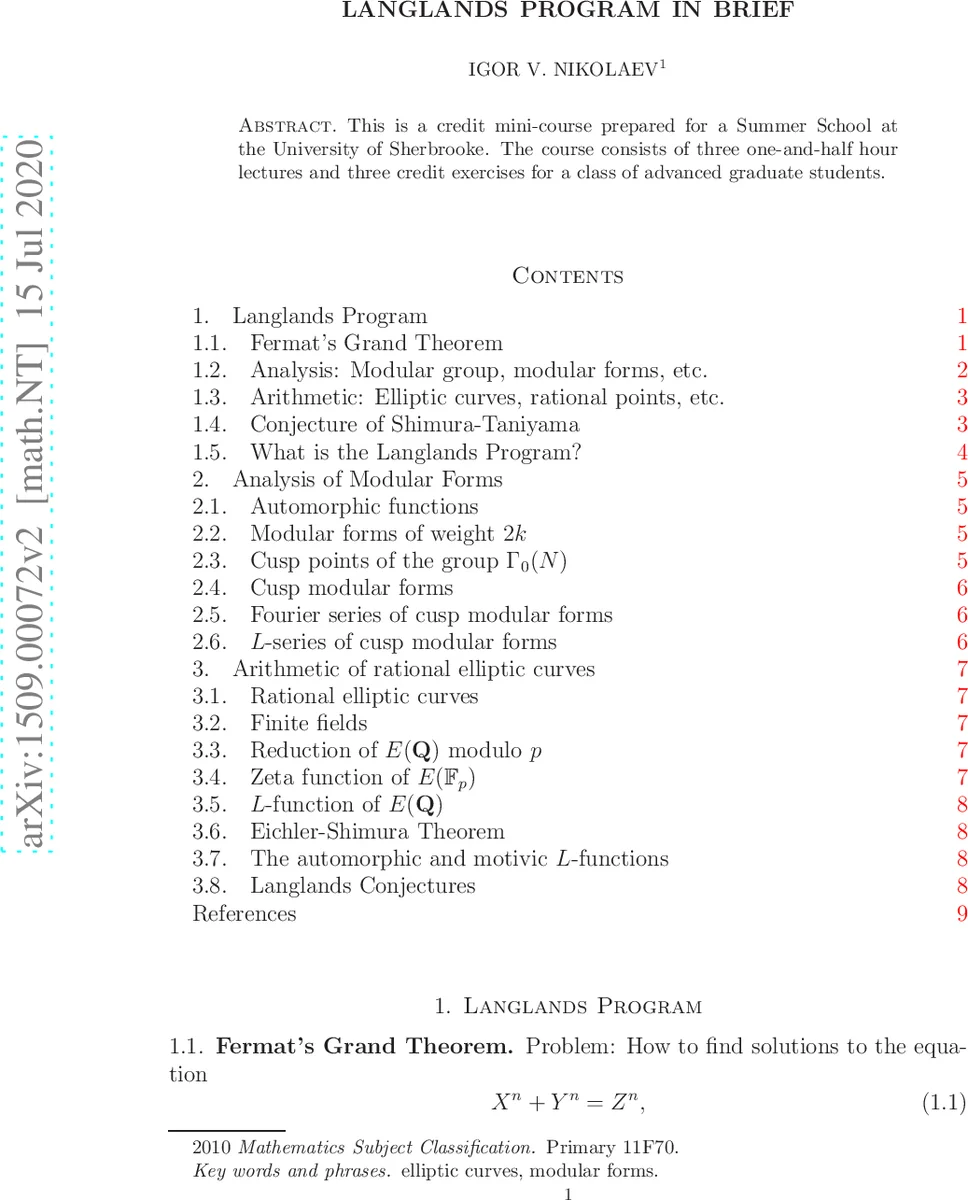
This is a credit mini-course in French prepared for a Summer School at the University of Sherbrooke. The course consists of three one-and-half hour lectures and three credit exercises for a class of advanced graduate students.
💡 Research Summary
The manuscript “Programme de Langlands en bref” is a compact, three‑lecture mini‑course prepared for an advanced graduate summer school at the University of Sherbrooke. Its purpose is to give students a rapid yet coherent overview of the Langlands program, emphasizing the bridge between automorphic representations of Lie groups (mainly GL₂/SL₂) and arithmetic objects such as rational elliptic curves and their L‑functions.
The first lecture begins with a historical motivation: Fermat’s Last Theorem (referred to as “Fermat’s Grand Theorem”). The author sketches the modern proof strategy: associate to a putative non‑trivial solution of Xⁿ+Yⁿ=Zⁿ a Frey elliptic curve E: Y²Z = X(X−apZ)(X+bpZ) with a·p−b·p=c·p, argue that this curve would be non‑modular, and then invoke the modularity theorem (formerly the Shimura–Taniyama conjecture, proved by Wiles) to obtain a contradiction. While the logical outline is correct, the manuscript provides no detailed justification for the non‑modularity claim, leaving a gap that would need to be filled by a separate discussion of the Ribet level‑lowering theorem.
Next, the lecture introduces the modular group SL₂(ℤ) and its congruence subgroups Γ₀(N). Definitions of the upper half‑plane ℍ, the action of SL₂(ℤ) by fractional linear transformations, and the quotient Riemann surface X₀(N)=ℍ/Γ₀(N) are given. The author explains how the genus of X₀(N) depends on N (e.g., N=2 yields a sphere, N=11 a torus) and defines modular forms of weight 2k as holomorphic functions satisfying f(az+b / cz+d) = (cz+d)^{2k} f(z) for all matrices in Γ₀(N). The special case k=1 is highlighted because weight‑2 modular forms correspond to holomorphic differentials on X₀(N).
The second lecture focuses on the arithmetic side. An elliptic curve over ℚ is defined by a cubic equation y² = x(x−1)(x−λ) with λ∈ℚ, and rational points correspond to integer triples (X,Y,Z) satisfying the homogeneous equation. The Shimura–Taniyama conjecture (now a theorem) is stated: every rational elliptic curve is modular, i.e., there exists an integer N>1 and a non‑constant holomorphic map X₀(N) → E(ℚ). The author then explains why this result is crucial for proving Fermat’s theorem: a non‑modular Frey curve would contradict the theorem, forcing the original Diophantine equation to have no non‑trivial solutions.
The third lecture introduces automorphic functions as a generalisation of periodic functions and defines cusp forms (holomorphic weight‑2 forms that vanish at all cusps of Γ₀(N)). The Fourier expansion f(z)=∑_{n≥1} c_n q^n with q=e^{2πiz} is presented, and the famous j‑invariant is given as an explicit example: j(z)=q^{-1}+744+196884q+… The coefficients of j(z) are noted to encode the dimensions of the sporadic simple groups, a celebrated “monstrous moonshine” phenomenon.
From the Fourier coefficients the L‑series L(s,f)=∑{n≥1} c_n n^{-s} is defined, extending the Riemann zeta function. The manuscript then turns to the arithmetic L‑function of an elliptic curve E(ℚ). After discussing reduction modulo a prime p, the local zeta function Z(u,E(ℱ_p)) = exp(∑{n≥1} |E(ℱ_{p^n})| u^n / n) is shown to simplify to 1/(1−a_p u + p u²) where a_p = p+1−|E(ℱ_p)|. The global L‑function is the Euler product L(s,E)=∏_p (1−a_p p^{-s}+p^{1-2s})^{-1}. The Birch–Swinnerton‑Dyer conjecture is mentioned: the order of vanishing of L(s,E) at s=1 equals the rank of E(ℚ).
The pivotal Eichler–Shimura theorem is then stated: for each N>1 there exists a weight‑2 cusp form f∈S₂(Γ₀(N)) and a rational elliptic curve E such that L(s,f)=L(s,E). The form f is a Hecke eigenform, unique up to scaling, and its L‑function is called automorphic, whereas L(s,E) is called motivic.
Finally, the author formulates the general Langlands conjecture: every motivic L‑function should factor as a product of automorphic L‑functions attached to suitable reductive algebraic groups. This encapsulates the philosophy that representation theory of adelic groups (automorphic side) governs all arithmetic information (motivic side).
The paper concludes with a short list of exercises (verifying group properties, giving examples of characteristic‑zero fields, etc.), an acknowledgment, and two references: Gelbart’s introductory survey and Langlands’s original ICM proceedings article.
Overall, the manuscript succeeds in presenting a bird’s‑eye view of the Langlands program, linking Fermat’s Last Theorem, modular forms, elliptic curves, and L‑functions in a pedagogical narrative. However, the text suffers from numerous typographical errors, fragmented sentences, and occasional mathematical inaccuracies (e.g., missing hypotheses for the Frey curve, incomplete discussion of Hecke operators). For a graduate audience, the material would need to be supplemented with more rigorous proofs, clearer notation, and a modern bibliography that includes recent advances such as the proof of the Sato–Tate conjecture, the Langlands reciprocity for GL_n, and the role of the trace formula. Nonetheless, as a concise introductory handout, it provides a useful scaffold on which a more detailed course can be built.
Comments & Academic Discussion
Loading comments...
Leave a Comment