Efficiency of equilibria in games with random payoffs
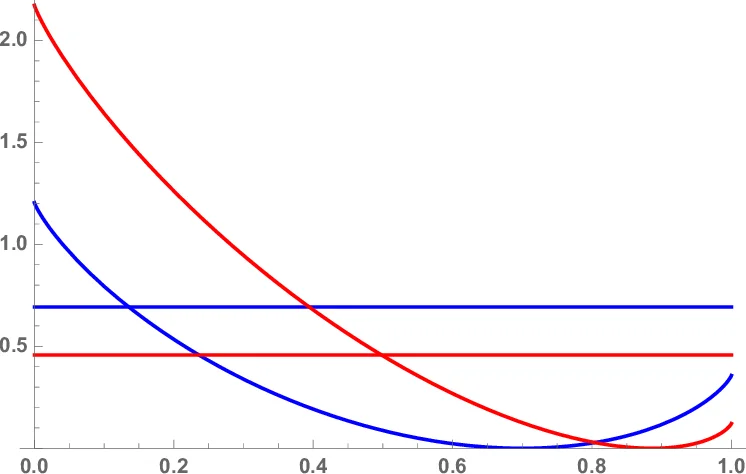
We consider normal-form games with $n$ players and two strategies for each player, where the payoffs are i.i.d. random variables with some distribution $F$ and we consider issues related to the pure equilibria in the game as the number of players diverges. It is well-known that, if the distribution $F$ has no atoms, the random number of pure equilibria is asymptotically Poisson$(1)$. In the presence of atoms, it diverges. For each strategy profile, we consider the (random) average payoff of the players, called Average Social Utility (ASU). In particular, we examine the asymptotic behavior of the optimum ASU and the one associated to the best and worst pure Nash equilibria and we show that, although these quantities are random, they converge, as $n\to\infty$ to some deterministic quantities.
💡 Research Summary
The paper studies normal‑form games with n players, each having two pure strategies, where every payoff entry is an independent draw from a common distribution F. The central object of interest is the Average Social Utility (ASU), defined as the average payoff across all players for a given pure strategy profile. The authors investigate the asymptotic behavior (as n → ∞) of three quantities: the socially optimal ASU (SO), the ASU of the best pure Nash equilibrium (BEq), and the ASU of the worst pure Nash equilibrium (WEq). Their analysis distinguishes two regimes for the distribution F: (i) continuous distributions (no atoms, α = 0) and (ii) distributions with atoms (α > 0).
Social optimum (SO).
Because there are 2ⁿ independent ASU values, SO is the maximum of 2ⁿ i.i.d. random variables with law F. Using Cramér’s large‑deviation theorem, the authors define the rate function I(x)=supₜ{xt−log E
Comments & Academic Discussion
Loading comments...
Leave a Comment