Integrable 7-point discrete equations and evolution lattice equations of order 2
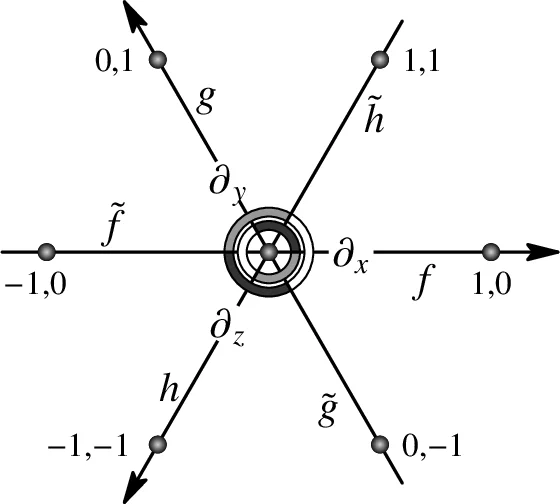
We consider differential-difference equations that determine the continuous symmetries of discrete equations on the triangular lattice. It is shown that a certain combination of continuous flows can be represented as a scalar evolution lattice equation of order 2. The general scheme is illustrated by a number of examples, including an analog of the elliptic Yamilov lattice equation.
💡 Research Summary
**
The paper investigates continuous symmetries of discrete equations defined on a triangular lattice, focusing on the class of 7‑point difference equations. The authors first introduce the discrete equation (6), which involves three shift operators (T_1, T_2, T_3) acting on a scalar field (q(n_1,n_2)). Continuous symmetries are described by differential‑difference equations (7) and (8), where the auxiliary quantities (F) and (\tilde F) are built from forward and backward differences of (q). Consistency between the discrete equation and its continuous symmetry is formalised in Definition 1 as the identity (\partial_x(F-\tilde F)=0) on the lattice; this leads to the algebraic condition (9) involving the Jacobians of (F) and (\tilde F) with respect to the shifted variables.
The next step is to select two neighbouring lattice lines and introduce variables (q(k)=q(j,k)) and (p(k)=q(j+1,k)). The three basic continuous flows (\partial_x,\partial_y,\partial_z) (corresponding to the three lattice directions) become two‑component systems (13) and (14). Because of the intrinsic (\mathbb Z_3) symmetry of the triangular lattice, any two of these flows can be chosen as a pair; the authors concentrate on (\partial_y) and (\partial_z). By projecting the two‑component system onto a single line (via the change of variables (15)), the authors obtain scalar lattice equations for a new field (u) that are different on even and odd sites (equations (16)–(17)).
A crucial observation is that, under the symmetry conditions (18) – namely (b=c), (g=h) and (\tilde g=\tilde h) – the sum of the two commuting flows, (\partial_t=\partial_y+\partial_z), collapses to an autonomous second‑order evolution lattice equation (19). This is the discrete analogue of the Ablowitz–Ladik lattice, where a symmetrised combination of two commuting flows yields a single integrable equation. The authors stress that analogous formulas arise if one chooses other pairs of basic flows, up to cyclic permutation of the functions (a,b,c) and (f,g,h).
The paper then presents a comprehensive list of integrable 7‑point equations of the form (23), where the functions (f,g,h) depend only on differences of (q) along the three lattice directions. Table 1 enumerates eight families (A)–(H) together with a rational case (I). All these equations are invariant under the one‑parameter translation (q\to q+\varepsilon) and admit a Lagrangian formulation with action (S=\sum\Phi(q-q_{-1,0})+\Psi(q-q_{0,-1})+\Chi(q-q_{1,1})). The authors verify that each family possesses a complete set of basic symmetries (10)–(12); the functions (a,b,c) are independent of the field (q) itself. While cases (A) and (B) were known from earlier works, the remaining families constitute new results.
A key technical result, Statement 3, asserts that for every entry of Table 1 the discrete equation (23) is consistent with the three symmetry flows (10)–(12), the flows commute, and they generate variational symmetries of the Lagrangian functional. The proof relies on the known correspondence between equations of type (6) and quad‑equations on a cubic lattice; the continuous limit along each coordinate direction yields the three symmetry flows.
The authors then discuss a broader class of equations obtained from the Q4 quad‑equation and its degenerations. Equation (5) represents the most general integrable second‑order lattice equation found in the paper. It involves an affine‑linear polynomial (P(u_{-1},u,u_1,u_2)) possessing square symmetry, and a symmetric biquadratic polynomial (H(u,u_1)) defined via mixed partial derivatives of (P). In the generic (elliptic) case, (5) cannot be reduced to any previously known lattice equation; however, in trigonometric and rational limits it can be transformed into the universal equation (4). Equation (4) itself, which appears after a suitable difference substitution (w=\phi
Comments & Academic Discussion
Loading comments...
Leave a Comment