Humans-as-a-sensor for buildings: Intensive longitudinal indoor comfort models
💡 Research Summary
This paper investigates whether occupants themselves can serve as high‑frequency sensors for indoor environmental quality by combining smartwatch‑based micro‑Ecological Momentary Assessments (micro‑EMA) with ambient and physiological sensor data. Thirty office workers participated in a two‑week field study during which they wore a Fitbit smartwatch running the open‑source “cozie” watch‑face. The device prompted them several times per day to rate their thermal, visual, and acoustic comfort on a five‑point Likert scale, yielding a total of 4,378 momentary preference responses. Simultaneously, environmental sensors recorded temperature, humidity, illuminance, and sound level, while wearable sensors captured heart rate and skin temperature, providing a rich multimodal time‑series dataset.
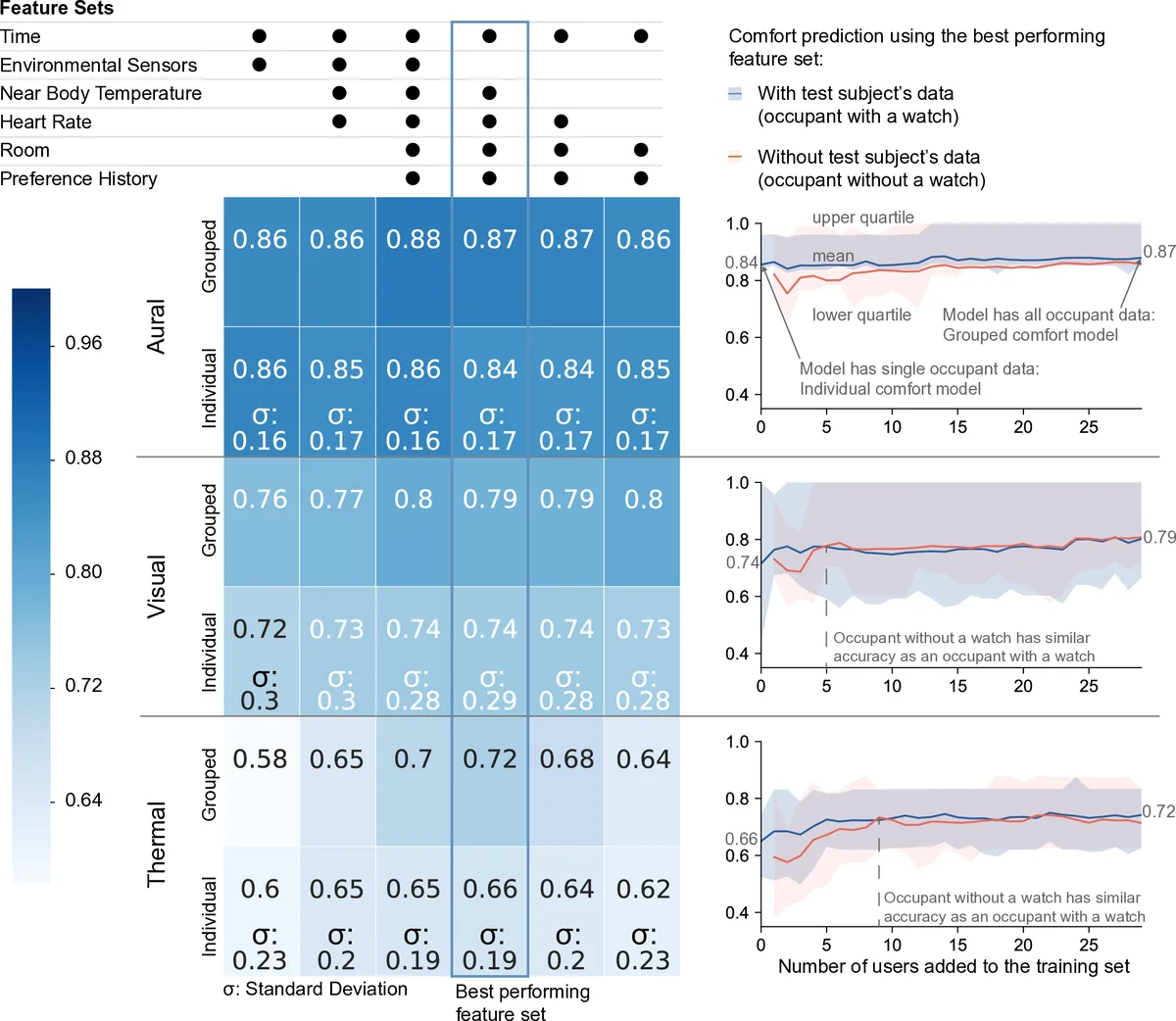
The authors first clustered participants and the spaces they occupied based on their preference patterns, producing groups such as “cooling‑seeker,” “light‑sensitive,” and “noise‑avoidant.” These clusters were then encoded as categorical features for machine‑learning models. Feature engineering produced four main sets: (1) statistical summaries of the environmental time series (mean, variance, volatility), (2) near‑body physiological metrics (heart‑rate variability, skin‑temperature changes), (3) individual historical preference ratios, and (4) the cluster label representing a person’s comfort type.
Using these features, the team trained several tree‑based multi‑class classifiers (XGBoost, Random Forest, LightGBM) and evaluated them via cross‑validation. The best models achieved micro‑averaged F1 scores of 0.64 for thermal preference, 0.80 for visual preference, and 0.86 for acoustic preference. Incorporating the cluster label improved performance by roughly 10–15 %, demonstrating that a simple representation of “comfort type” can mitigate the cold‑start problem when little personal history is available. Physiological signals contributed most to thermal predictions, whereas environmental summaries dominated visual and acoustic predictions.
The study highlights several key insights. First, high‑frequency subjective feedback captures psychological and physiological contexts that static sensor networks miss, substantially boosting prediction accuracy. Second, clustering occupants into comfort‑type groups provides a lightweight, interpretable prior that can be used in real‑time control loops. Third, a single smartwatch is sufficient to collect both subjective and objective data without imposing significant burden, addressing survey fatigue and scalability concerns that have hampered prior work.
The authors discuss practical implications for building operation: real‑time preference predictions could be fed into HVAC, lighting, and sound‑control systems to create adaptive environments that simultaneously improve occupant satisfaction and reduce energy use. Limitations include sensor calibration uncertainties, potential data gaps, and sensitivity to the chosen number of clusters. Future work should test the approach across diverse building typologies, integrate the predictions into live control algorithms, and quantify the resulting energy and comfort benefits.
In sum, the paper demonstrates that treating occupants as active sensors—via intensive longitudinal micro‑EMA on wearables—offers a viable, cost‑effective complement to traditional environmental sensing, paving the way for more personalized and responsive indoor environments.
Comments & Academic Discussion
Loading comments...
Leave a Comment