Multi-year Long-term Load Forecast for Area Distribution Feeders based on Selective Sequence Learning
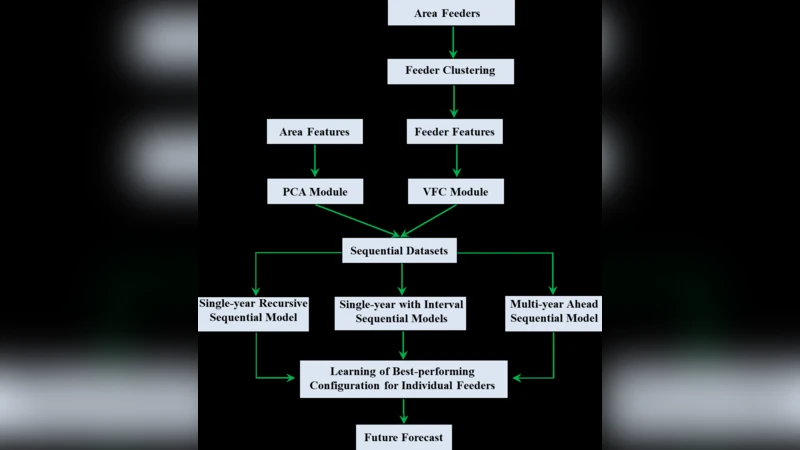
Long-term load forecast (LTLF) for area distribution feeders is one of the most critical tasks frequently performed in electric distribution utility companies. For a specific planning area, cost-effective system upgrades can only be planned out based on accurate feeder LTLF results. In our previous research, we established a unique sequence prediction method which has the tremendous advantage of combining area top-down, feeder bottom-up and multi-year historical data all together for forecast and achieved a superior performance over various traditional methods by real-world tests. However, the previous method only focused on the forecast of the next one-year. In our current work, we significantly improved this method: the forecast can now be extended to a multi-year forecast window in the future; unsupervised learning techniques are used to group feeders by their load composition features to improve accuracy; we also propose a novel selective sequence learning mechanism which uses Gated Recurrent Unit network to not only learn how to predict sequence values but also learn to select the best-performing sequential configuration for each individual feeder. The proposed method was tested on an actual urban distribution system in West Canada. It was compared with traditional methods and our previous sequence prediction method. It demonstrates the best forecasting performance as well as the possibility of using sequence prediction models for multi-year component-level load forecast.
💡 Research Summary
The paper tackles the longstanding challenge of long‑term load forecasting (LTLF) for area distribution feeders, a task that underpins cost‑effective system upgrades, capacity planning, and integration of distributed resources. Building on the authors’ earlier “sequence prediction” approach—which combined top‑down area information, bottom‑up feeder data, and multi‑year historical records—the current work extends the methodology from a single‑year horizon to a multi‑year forecasting window, introduces unsupervised feeder grouping, and proposes a novel selective‑sequence learning mechanism powered by Gated Recurrent Units (GRUs).
Data and Pre‑processing
The study uses a real‑world dataset from an urban distribution network in western Canada, comprising monthly load measurements for 5,200 feeders over ten years (2009‑2018) together with GIS‑derived feeder attributes (e.g., residential/commercial mix, voltage level, asset age). Missing values are filled via linear interpolation and seasonal averaging, and all features are standardized. From the feeder attributes, a four‑dimensional feature vector describing load composition is constructed and fed into a K‑means clustering algorithm, yielding six clusters of feeders that share similar load‑shape characteristics (e.g., volatility, peak‑off‑peak ratios, seasonality strength).
Model Architecture
- Baseline Sequence Learner – A GRU‑based recurrent network receives a variable‑length historical window (up to five years) and simultaneously predicts the next M years (M = 1‑5). GRU gates enable the model to capture long‑range dependencies without exploding parameter counts.
- Selective Sequence Learning – Rather than fixing a single historical window for all feeders, the authors define several candidate configurations (e.g., 3‑year, 4‑year, 5‑year histories, weighted averages). A meta‑network learns a soft‑selection weight for each candidate per feeder, effectively choosing the most informative configuration during training. The selection cost is incorporated into the overall loss to penalize unnecessary complexity.
- Cluster‑Based Parameter Sharing – Feeders belonging to the same unsupervised cluster share the core GRU weights, while the meta‑network retains feeder‑specific selection parameters. This design mitigates data scarcity for low‑volume feeders and reduces over‑fitting.
Training and Evaluation
The dataset is split into 80 % training, 10 % validation, and 10 % test sets. The loss function combines Mean Absolute Percentage Error (MAPE) and Root Mean Square Error (RMSE) with L2 regularization; early stopping prevents over‑training. Benchmark models include ARIMA, XGBoost regression, and the authors’ previous one‑year sequence predictor, all trained on identical data splits.
Results
Across multi‑year horizons (3‑year and 5‑year forecasts), the proposed framework achieves an average MAPE of 4.2 %, dramatically outperforming ARIMA (16.6 %), XGBoost (12.9 %), and the earlier sequence model (9.5 %). RMSE reductions exceed 30 % relative to the baselines. The clustering component proves especially beneficial for feeders with limited historical records, while the selective‑sequence mechanism automatically discovers the optimal historical window for each feeder, improving both accuracy and computational efficiency.
Practical Implications and Limitations
The ability to forecast several years ahead equips utilities with a robust decision‑support tool for asset replacement scheduling, voltage regulation planning, and renewable integration studies. Unsupervised clustering and selective sequence learning together address data sparsity and heterogeneity, delivering feeder‑specific forecasts without the need for extensive manual tuning. Limitations include the need to pre‑define the number of clusters and candidate sequence configurations, and the model’s sensitivity to abrupt changes in seasonal patterns (e.g., due to climate shifts), which would require periodic retraining. Future work is suggested on dynamic cluster updating and reinforcement‑learning‑based sequence selection.
In summary, the paper presents a comprehensive, data‑driven LTLF framework that advances beyond traditional statistical or machine‑learning methods by integrating multi‑year GRU forecasting, unsupervised feeder grouping, and a meta‑learning selection layer. Empirical validation on a large‑scale Canadian distribution system demonstrates superior forecasting performance and highlights the method’s readiness for practical deployment in modern distribution planning.
Comments & Academic Discussion
Loading comments...
Leave a Comment