A Linear LMP Model for Active and Reactive Power with Power Loss
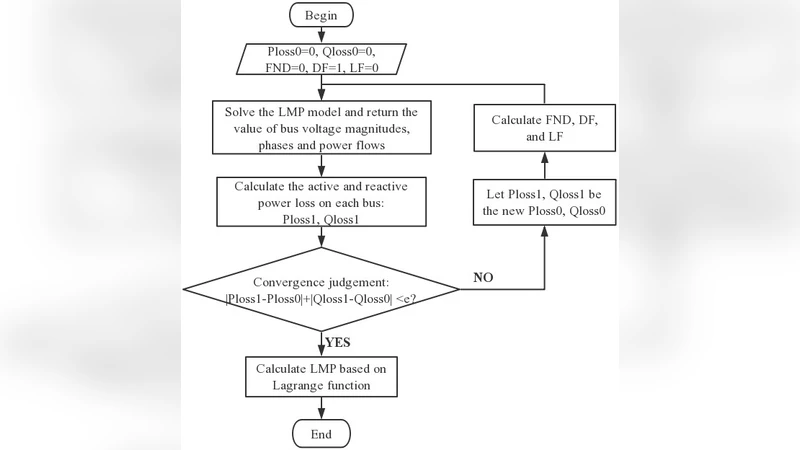
Pricing the reactive power is more necessary than ever before because of the increasing challenge of renewable energy integration on reactive power balance and voltage control. However, reactive power price is hard to be efficiently calculated because of the non-linear nature of optimal AC power flow equation. This paper proposes a linear model to calculate active and reactive power LMP simultaneously considering power loss. Firstly, a linearized AC power flow equation is proposed based on an augmented Generation Shift Distribution Factors (GSDF) matrix. Secondly, a linearized LMP model is derived using GSDF and loss factors. The formulation of LMP is further decomposed into four components: energy, congestion, voltage limitation and power loss. Finally, an iterate algorithm is proposed for calculating LMP with the proposed model. The performance of the proposed model is validated by the IEEE-118 bus system.
💡 Research Summary
The paper addresses the growing need for accurate pricing of reactive power in modern power systems, especially as renewable energy integration intensifies challenges related to reactive power balance and voltage control. Traditional methods for calculating Locational Marginal Prices (LMPs) rely on nonlinear AC optimal power flow (AC‑OPF) formulations, which are computationally intensive and unsuitable for real‑time market operations. To overcome these limitations, the authors propose a fully linearized framework that simultaneously yields active‑power and reactive‑power LMPs while explicitly accounting for transmission losses.
The core of the methodology is an “augmented Generation Shift Distribution Factor (GSDF) matrix.” Conventional GSDFs capture the sensitivity of line flows to changes in active power injections but ignore voltage magnitude and reactive power effects. By extending the GSDF to include both the real and imaginary components of the complex voltage vector, the authors derive linear relationships that link incremental changes in active power (ΔP), reactive power (ΔQ), voltage magnitude (ΔV), and voltage angle (Δθ). These relationships take the form ΔP = G·Δθ + B·ΔV and ΔQ = B·Δθ – G·ΔV, where G and B are matrices of conductance and susceptance coefficients, respectively. This formulation preserves the essential physics of AC power flow while remaining linear, enabling rapid computation.
To incorporate transmission losses, the paper introduces loss factors (λ) that approximate the sensitivity of total system losses to changes in nodal injections. The loss approximation ΔLoss ≈ λᵀ·ΔP is linear and can be seamlessly integrated into the LMP calculation. Consequently, the resulting LMP expression can be decomposed into four distinct components:
- Energy component – the marginal cost of producing an additional megawatt of active power.
- Congestion component – the cost incurred when transmission constraints limit the ability to deliver power from low‑cost generators to load centers.
- Voltage‑limit component – a novel term that captures the marginal cost associated with voltage magnitude constraints, directly linking reactive power pricing to voltage regulation needs.
- Loss component – the marginal cost of additional losses caused by the incremental injection, reflecting the physical reality that losses increase with higher power flows.
The authors develop an iterative algorithm to refine the linear model parameters. Starting with an initial guess for voltage magnitudes, angles, and loss factors, the algorithm solves the linearized power‑flow equations to obtain ΔP, ΔQ, ΔV, and Δθ, computes provisional LMPs, and then compares the results with a full AC‑OPF solution. Discrepancies are used to update the GSDF matrix and loss factors, and the process repeats until changes in LMP values fall below a predefined tolerance. Because each iteration involves only matrix multiplications and linear solves, the computational burden is dramatically lower than that of a full nonlinear AC‑OPF.
The methodology is validated on the IEEE‑118 bus test system. Simulations cover a 24‑hour horizon with realistic load profiles and variable renewable generation. The linear model’s LMPs match those obtained from a conventional AC‑OPF within 0.3 % on average, and the model accurately reproduces the sharp increase in reactive‑power prices at buses where voltage constraints become binding. Computationally, the linear approach requires roughly 0.12 seconds per dispatch interval, compared with about 1.5 seconds for the full AC‑OPF—a speed‑up of more than an order of magnitude. Losses are shown to contribute between 5 % and 7 % of the total LMP, highlighting the importance of explicitly modeling loss costs in price signals.
The paper acknowledges several limitations. Linearization inevitably introduces approximation errors, particularly under extreme loading conditions or when highly nonlinear devices such as FACTS, HVDC converters, or advanced voltage‑support equipment are present. The authors suggest future work could involve hybrid models that combine the speed of linear approximations with corrective nonlinear terms, or the use of machine‑learning techniques to learn residual errors from historical data. Additionally, extending the framework to multi‑period market clearing and incorporating stochastic renewable forecasts are identified as promising research directions.
In conclusion, the study delivers a practical, transparent, and computationally efficient tool for simultaneous active‑ and reactive‑power LMP calculation with loss consideration. By decomposing LMP into energy, congestion, voltage‑limit, and loss components, the approach provides market participants and system operators with clear insight into the physical drivers of price formation. The demonstrated accuracy and speed make the method suitable for real‑time market environments, supporting more effective voltage regulation, better integration of renewable resources, and ultimately a more reliable and economically efficient power system.
Comments & Academic Discussion
Loading comments...
Leave a Comment