Recursion operators and the hierarchies of MKdV equations related to $D_4^{(1)}$, $D_4^{(2)}$ and $D_4^{(3)}$ Kac-Moody algebras
💡 Research Summary
The paper presents a systematic construction of three distinct modified Korteweg‑de Vries (mKdV) hierarchies associated with the simple Lie algebra so(8) ≅ D₄, by exploiting three nonequivalent gradings that give rise to the Kac‑Moody algebras D(1)₄, D(2)₄ and D(3)₄ of heights 1, 2 and 3 respectively.
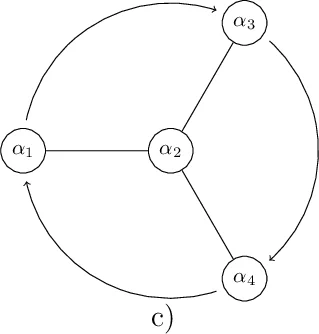
First, the authors recall the structure of D₄, its root system, and the two outer automorphisms: the mirror automorphism R (which swaps the two outer nodes of the Dynkin diagram) and the triality automorphism T (of order 3). Using these, they define three Coxeter‑type automorphisms:
- C₁ = S_{α₂}S_{α₁}S_{α₃}S_{α₄} (the standard Coxeter element),
- C₂ = C₁ R, and
- C₃ = S_{α₂}S_{α₁} T.
Each automorphism has a different order (Coxeter numbers h = 6, 8, 12) and induces a ℤ‑grading of D₄: g = ⊕_{k∈ℤ} g(k) where g(k) consists of the eigenspace of C with eigenvalue e^{2πik/h}. The authors construct explicit bases for all graded subspaces g(k), paying special attention to g(0) (the Cartan subalgebra) and g(±1) (the subspaces that will host the dynamical fields).
With the graded decomposition in hand, Lax pairs are built for each grading. The spatial Lax operator has the form L = ∂ₓ + U(x,λ) where U takes values in g(0) ⊕ g(1) ⊕ g(−1) and depends polynomially on the spectral parameter λ. The temporal operator M = ∂_{t} + V(x,λ) is constructed so that the zero‑curvature condition
Comments & Academic Discussion
Loading comments...
Leave a Comment