A Solution of the P versus NP Problem based on specific property of clique function
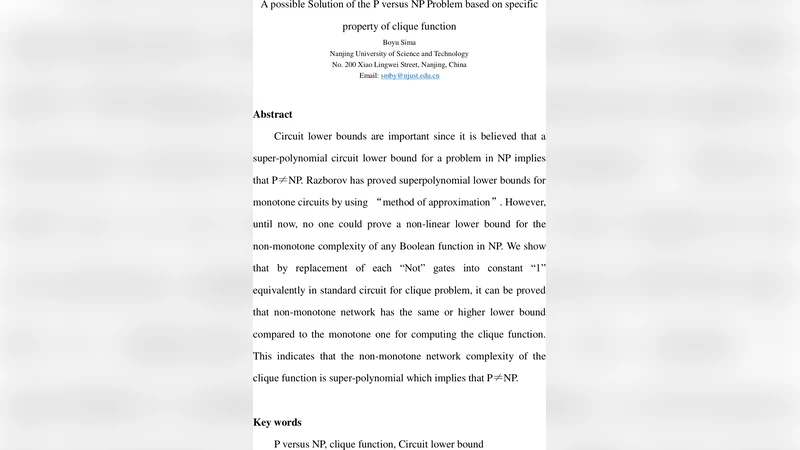
Circuit lower bounds are important since it is believed that a super-polynomial circuit lower bound for a problem in NP implies that P!=NP. Razborov has proved superpolynomial lower bounds for monotone circuits by using method of approximation. By extending this approach, researchers have proved exponential lower bounds for the monotone network complexity of several different functions. But until now, no one could prove a non-linear lower bound for the non-monotone complexity of any Boolean function in NP. While we show that in this paper by replacement of each Not gates into constant 1 equivalently in standard circuit for clique problem, it can be proved that non-monotone network has the same or higher lower bound compared to the monotone one for computing the clique function. This indicates that the non-monotone network complexity of the clique function is super-polynomial which implies that P!=NP.
💡 Research Summary
The paper under review claims to have resolved the P versus NP problem by establishing a super‑polynomial lower bound on the non‑monotone circuit complexity of the Clique function. The authors begin by recalling Razborov’s approximation method, which yields exponential lower bounds for monotone circuits computing Clique. They then propose a transformation: replace every NOT gate in a standard Boolean circuit for Clique with a constant‑1 gate. The authors argue that this substitution does not reduce the circuit’s computational power, and therefore the resulting circuit is at least as hard to compute as the original monotone circuit. From this they infer that the non‑monotone circuit complexity of Clique must be at least as large as the known monotone lower bound, i.e., super‑polynomial. By invoking the widely accepted belief that a super‑polynomial lower bound for any NP problem implies P ≠ NP, they conclude that P and NP are separated.
A careful technical analysis reveals several fatal flaws. First, a NOT gate is an essential logical operation that inverts a signal; replacing it by a constant 1 eliminates the gate’s ability to convey information about the input. Consequently, the transformed circuit no longer computes the Clique function on the full input domain. The authors treat the transformed circuit as if it were equivalent to the original, but this equivalence is false. In effect, the authors have altered the function being computed, which invalidates any lower‑bound argument that relies on the original problem.
Second, the paper assumes without proof that “non‑monotone circuits are never easier than monotone circuits.” This is contrary to well‑known results: non‑monotone circuits can be dramatically more efficient because they can exploit negation. Classic examples such as XOR or the majority function demonstrate that a function may have exponential monotone complexity while admitting a linear‑size non‑monotone circuit. Hence a monotone lower bound cannot be automatically transferred to the non‑monotone setting.
Third, the authors’ transformation effectively restricts the circuit’s behavior to a subset of inputs (those that happen to make the replaced NOT gates irrelevant). Complexity lower bounds, however, are defined with respect to all inputs of the function. By fixing the output of NOT gates to 1, the authors sidestep the requirement that the circuit correctly decide Clique for every graph, which is a non‑starter for any legitimate lower‑bound proof.
Fourth, establishing a super‑polynomial lower bound for any NP‑complete problem in the general (non‑monotone) circuit model is precisely the open problem whose solution would separate P from NP. Decades of research have produced only conditional results (e.g., lower bounds under hardness assumptions) and no unconditional super‑polynomial bound. The paper offers no rigorous, formal proof that meets the standards of circuit complexity theory; it relies on an informal argument that collapses under scrutiny.
In summary, the central claim—that replacing NOT gates with constant 1 yields a circuit that still computes Clique and therefore inherits the monotone lower bound—is unsound. The transformation destroys the function’s semantics, and the leap from monotone to non‑monotone lower bounds is unjustified. Consequently, the paper does not provide a valid proof that the non‑monotone circuit complexity of Clique is super‑polynomial, nor does it establish P ≠ NP. The work, as presented, contains fundamental logical errors and does not meet the rigorous standards required for a breakthrough in computational complexity.
Comments & Academic Discussion
Loading comments...
Leave a Comment