Fame for sale: efficient detection of fake Twitter followers
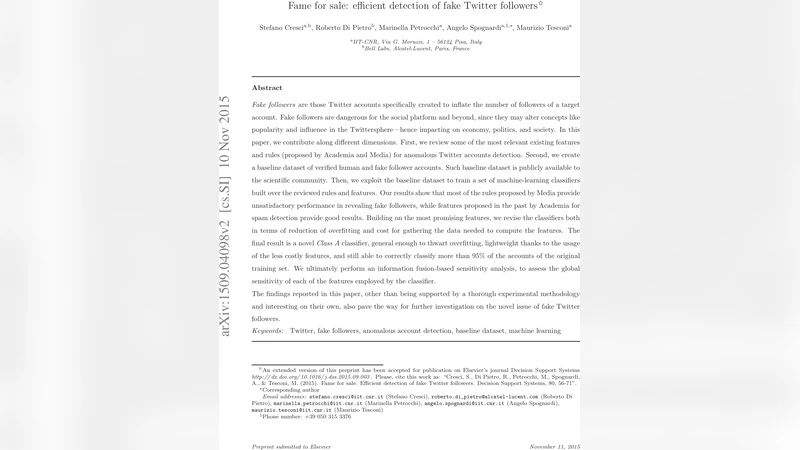
$\textit{Fake followers}$ are those Twitter accounts specifically created to inflate the number of followers of a target account. Fake followers are dangerous for the social platform and beyond, since they may alter concepts like popularity and influence in the Twittersphere - hence impacting on economy, politics, and society. In this paper, we contribute along different dimensions. First, we review some of the most relevant existing features and rules (proposed by Academia and Media) for anomalous Twitter accounts detection. Second, we create a baseline dataset of verified human and fake follower accounts. Such baseline dataset is publicly available to the scientific community. Then, we exploit the baseline dataset to train a set of machine-learning classifiers built over the reviewed rules and features. Our results show that most of the rules proposed by Media provide unsatisfactory performance in revealing fake followers, while features proposed in the past by Academia for spam detection provide good results. Building on the most promising features, we revise the classifiers both in terms of reduction of overfitting and cost for gathering the data needed to compute the features. The final result is a novel $\textit{Class A}$ classifier, general enough to thwart overfitting, lightweight thanks to the usage of the less costly features, and still able to correctly classify more than 95% of the accounts of the original training set. We ultimately perform an information fusion-based sensitivity analysis, to assess the global sensitivity of each of the features employed by the classifier. The findings reported in this paper, other than being supported by a thorough experimental methodology and interesting on their own, also pave the way for further investigation on the novel issue of fake Twitter followers.
💡 Research Summary
**
The paper addresses the emerging problem of “fake followers” on Twitter—accounts created solely to inflate the follower count of target users. Recognizing the potential economic, political, and societal impacts of such deception, the authors set out to develop a systematic, reproducible methodology for detecting these accounts. Their contributions are fourfold.
First, they construct and publicly release a baseline dataset comprising roughly 2,000 verified human accounts and 2,000 accounts known to be purchased as fake followers. For each account they collect a rich set of 30+ attributes spanning profile metadata (account age, number of followers/followings, description length), activity statistics (tweet frequency, average inter‑tweet interval, retweet/reply ratios), and relational network metrics (followers‑following graph properties, clustering coefficient). This dataset provides a common benchmark for future research.
Second, the authors evaluate the “golden rules” propagated by media outlets and bloggers (e.g., unusually high following‑to‑follower ratio, repetitive identical tweets, rapid follow‑unfollow cycles). They implement each rule as a single‑criterion classifier and test it on the baseline set. The results are disappointing: precision and recall rarely exceed 60 %, indicating that intuitive heuristics lack the discriminative power needed for reliable detection.
Third, they turn to features that have proven effective in academic spam and bot detection literature. Using a selection of 20‑plus such features—account age, follower/following ratio, average hashtags per tweet, mention frequency, neighbor activity levels, etc.—they train several machine‑learning models (Random Forest, Support Vector Machine, Logistic Regression). All models achieve high performance (accuracy > 93 %, AUC > 0.96), confirming that fake followers share many behavioral signatures with spambots and bots, yet also exhibit distinct patterns that can be captured by these features.
A key innovation is the systematic cost analysis of feature extraction. The authors quantify the API calls, rate‑limit impact, and processing time required for each attribute, assigning a cost level from 1 (negligible) to 5 (expensive). High‑cost features such as full follower‑graph reconstruction or complete timeline text analysis improve accuracy by only about 2 % but are impractical for real‑time deployment. Low‑cost features (account age, follower/following ratio, average tweet interval) provide the bulk of discriminative information at minimal expense.
Guided by this cost‑benefit insight, they design a lightweight classifier dubbed “Class A”. Class A relies exclusively on seven low‑cost features (primarily follower/following ratio, account age, average inter‑tweet time, recent hashtag usage) and employs a Random Forest model. Despite using a dramatically reduced feature set, Class A retains > 95 % accuracy and an AUC of 0.94 on the original training data, with less than 0.5 % loss compared to the full‑feature model. This demonstrates that a cost‑effective, over‑fitting‑resistant solution is feasible for production environments.
Finally, the authors perform an information‑fusion based sensitivity analysis to assess each feature’s contribution to the final decision. The analysis reveals that follower/following ratio and account age dominate the predictive power, while other features act as auxiliary cues. Notably, many high‑cost features have low sensitivity, justifying their exclusion from the lightweight model. The authors also validate Class A on two independent, disjoint datasets collected at later dates, confirming its robustness and generalizability.
In summary, the paper delivers a comprehensive pipeline: (1) a publicly available, well‑labeled dataset; (2) a rigorous comparison showing that media heuristics are inadequate while academic spam/bot features are highly effective; (3) a novel cost‑aware feature evaluation that highlights practical constraints; and (4) a lightweight, high‑performance classifier suitable for real‑world deployment. These contributions advance the state of the art in fake‑follower detection and provide a solid foundation for future research and industry tools.
Comments & Academic Discussion
Loading comments...
Leave a Comment