Enhancement of shock-capturing methods via machine learning
In recent years, machine learning has been used to create data-driven solutions to problems for which an algorithmic solution is intractable, as well as fine-tuning existing algorithms. This research applies machine learning to the development of an improved finite-volume method for simulating PDEs with discontinuous solutions. Shock capturing methods make use of nonlinear switching functions that are not guaranteed to be optimal. Because data can be used to learn nonlinear relationships, we train a neural network to improve the results of a fifth-order WENO method. We post-process the outputs of the neural network to guarantee that the method is consistent. The training data consists of the exact mapping between cell averages and interpolated values for a set of integrable functions that represent waveforms we would expect to see while simulating a PDE. We demonstrate our method on linear advection of a discontinuous function, the inviscid Burgers’ equation, and the 1-D Euler equations. For the latter, we examine the Shu-Osher model problem for turbulence-shockwave interactions. We find that our method outperforms WENO in simulations where the numerical solution becomes overly diffused due to numerical viscosity.
💡 Research Summary
This paper presents a novel hybrid approach that leverages machine learning to enhance the performance of a well-established shock-capturing numerical method, the fifth-order Weighted Essentially Non-Oscillatory scheme (WENO5-JS). The core innovation lies not in replacing the traditional algorithm but in augmenting it with a small neural network that acts as a corrective module.
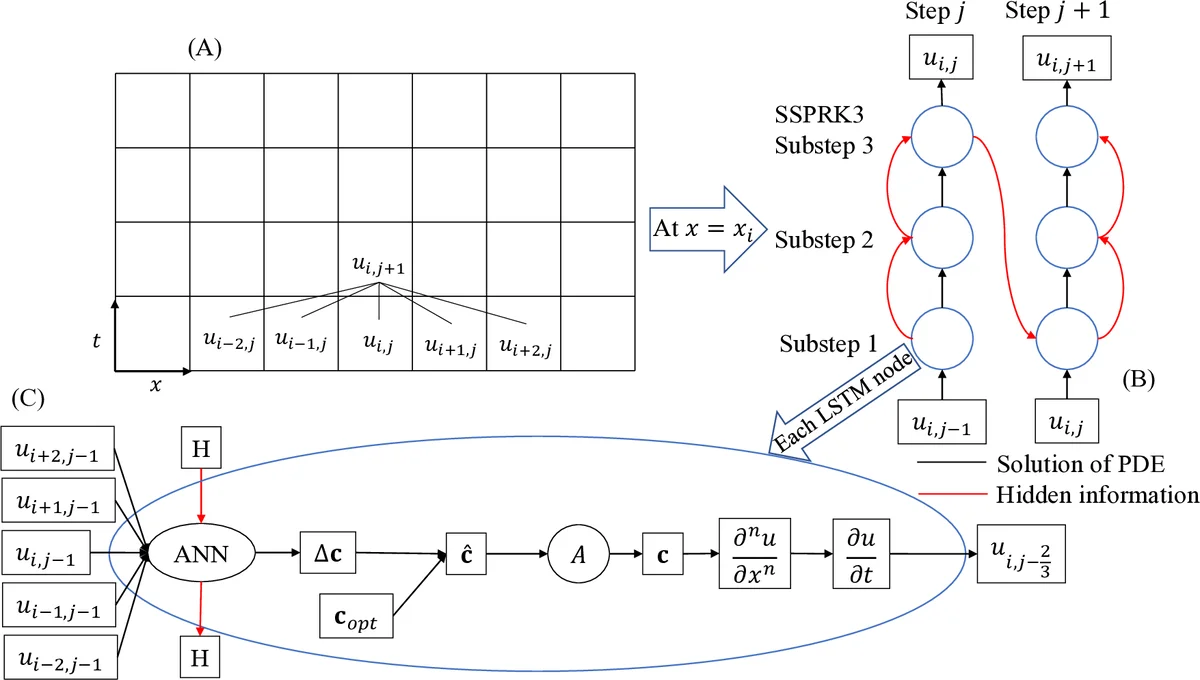
The proposed method, dubbed WENO-NN, operates within the standard finite-volume framework. For a given stencil of five cell averages, the conventional WENO5-JS algorithm is first executed to compute its nonlinear interpolation coefficients based on local smoothness indicators. These five coefficients are then fed as input to a compact neural network (3 hidden layers with 3 neurons each). The network is trained to output a perturbation to these coefficients. A key design choice is the application of L2 regularization on the network’s output, discouraging large deviations from the WENO-JS baseline and improving generalization to real simulations. Finally, a post-processing step enforces mathematical consistency by solving a constrained optimization problem that adjusts the perturbed coefficients to sum to one, a fundamental requirement for finite-volume schemes.
The training data is synthetically generated from a library of analytic functions—including step functions, sawtooth waves, hyperbolic tangents, and sinusoids—designed to represent waveforms commonly encountered in PDE solutions. For each function, the exact mapping between cell averages and the true value at the cell interface is computed, creating a dataset of approximately 75,000 samples.
The performance of WENO-NN is rigorously evaluated on three benchmark problems. First, for the linear advection of a discontinuous step function, WENO-NN demonstrates a remarkable ability to maintain a sharp shock profile over long simulation times, significantly reducing the numerical diffusion and spurious oscillations observed with standard WENO5-JS. Second, similar improvements are shown for the inviscid Burgers’ equation. The most compelling test is the third: the Shu-Osher problem for the one-dimensional Euler equations, which models the interaction of a shock wave with a density disturbance. Here, WENO-NN successfully captures the high-frequency turbulent features behind the shock with much greater clarity than WENO5-JS, which excessively smears these structures.
Analysis via the modified equation reveals that WENO-NN achieves this by effectively reducing the numerical viscosity coefficient near discontinuities compared to the base scheme. The paper concludes that the WENO-NN framework successfully integrates data-driven learning into a robust numerical method, offering a principled way to optimize the nonlinear components of shock-capturing schemes that have traditionally relied on heuristic design. The approach maintains the desirable properties of the original method while enhancing its resolution capabilities, and its modular nature suggests potential applicability to a broader class of numerical algorithms.
Comments & Academic Discussion
Loading comments...
Leave a Comment