Earth and Mars -- distinct inner Solar System products
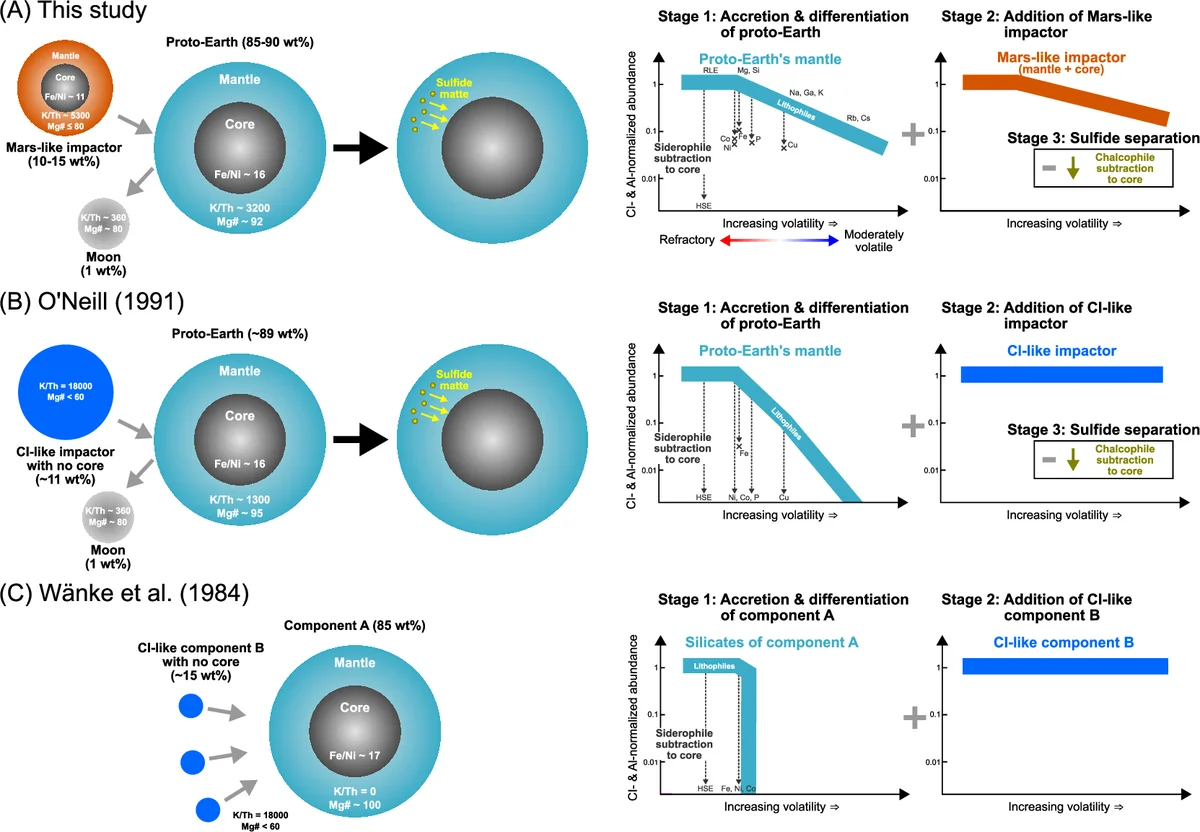
Composition of terrestrial planets records planetary accretion, core-mantle and crust-mantle differentiation, and surface processes. Here we compare the compositional models of Earth and Mars to reveal their characteristics and formation processes. Earth and Mars are equally enriched in refractory elements (1.9 $\times$ CI), although Earth is more volatile-depleted and less oxidized than Mars. Their chemical compositions were established by nebular fractionation, with negligible contributions from post-accretionary losses of moderately volatile elements. The degree of planetary volatile element depletion might correlate with the abundances of chondrules in the accreted materials, planetary size, and their accretion timescale, which provides insights into composition and origin of Mercury, Venus, the Moon-forming giant impactor, and the proto-Earth. During its formation before and after the nebular disk’s lifetime, the Earth likely accreted more chondrules and less matrix-like materials than Mars and chondritic asteroids, establishing its marked volatile depletion. A giant impact of an oxidized, differentiated Mars-like (i.e., composition and mass) body into a volatile-depleted, reduced proto-Earth produced a Moon-forming debris ring with mostly a proto-Earth’s mantle composition. Chalcophile and some siderophile elements in the silicate Earth added by the Mars-like impactor were extracted into the core by a sulfide melt. In contrast, the composition of Mars indicates its rapid accretion of lesser amounts of chondrules under nearly uniform oxidizing conditions. Mars’ rapid cooling and early loss of its dynamo likely led to the absence of plate tectonics and surface water, and the present-day low surface heat flux. These similarities and differences between the Earth and Mars made the former habitable and the other inhospitable to uninhabitable.
💡 Research Summary
**
The paper presents a detailed comparative study of Earth and Mars using the latest bulk compositional models for both planets. Both bodies contain roughly 1.9 × CI abundances of refractory elements (e.g., Al, Ca, Ti), indicating that they accreted from similarly enriched inner‑solar‑system material. However, the volatile element budgets diverge markedly. Earth is strongly depleted in moderately volatile lithophiles such as K, Rb, and U (K/U ≈ 1.4 × 10⁴, far below the CI value of ≈6.8 × 10⁴), whereas Mars retains higher volatile abundances (K/U ≈ 2.0 × 10⁴). The authors attribute this to differences in the proportion of chondrules versus matrix‑like material incorporated during accretion. Chondrules, formed under high‑temperature conditions, are volatile‑poor; Earth’s higher chondrule fraction leads to greater volatile loss, while Mars, accreting relatively more matrix material, preserves more volatiles.
Oxidation state, expressed as the atomic O/(Fe + Ni) ratio, is 3.7 for Earth and 8.7 for Mars, showing that Mars formed under more oxidizing conditions. This reflects distinct metal‑silicate partitioning during core formation. Earth’s core comprises ~32 % of the planet’s mass and includes a liquid outer core and a solid inner core, whereas Mars’ core is smaller (≈18–25 % by mass). The larger core‑to‑mantle ratio of Earth implies more extensive metal‑silicate separation, consistent with its greater size and longer cooling timescale.
Both planets exhibit elevated concentrations of highly siderophile elements (HSEs) in their silicate reservoirs, a signature of late accretion of chondritic material after >98 % of planetary growth. While the overall HSE patterns are similar, Earth’s mantle shows a super‑chondritic Ru/Ir ratio that cannot be reproduced by simple addition of volatile‑rich impactors, suggesting that high‑pressure, high‑temperature partitioning effects or a non‑representative meteoritic sample set are required.
Heat‑producing elements (K, Th, U) are distributed differently. Mars, with a higher surface‑to‑volume ratio and a thicker crust (30–60 km), concentrates ~50 % of its HPE budget in the crust, and radiogenic decay accounts for ~92 % of its surface heat flux (≈19 mW m⁻²). Earth’s crust contains only ~35 % of its HPE budget, and radiogenic heat contributes ~43 % of the global heat flow (≈90 mW m⁻²); the remainder is secular cooling. Consequently, Mars cooled rapidly, its mantle convection is weak, and its present‑day heat flow is low.
The authors link these geochemical and geophysical differences to planetary habitability. Earth’s larger, more reduced core sustained a long‑lived magnetic field; its higher mantle Mg# and vigorous convection supported plate tectonics, continuous recycling of volatiles, and stable surface water. Mars, being more oxidized, with a smaller core and rapid early cooling, lost its dynamo early, never developed sustained plate tectonics, and consequently could not retain surface water or a thick atmosphere.
In summary, while Earth and Mars share a common origin in terms of refractory element enrichment, divergent accretion histories—particularly the relative contributions of chondrules versus matrix material, the timing of accretion, and planetary size—produced distinct volatile depletion levels, oxidation states, core‑mantle ratios, and thermal evolutions. These differences underpin why Earth became a habitable world while Mars remained inhospitable.
Comments & Academic Discussion
Loading comments...
Leave a Comment