Embedding Lithium-ion Battery Scrapping Criterion and Degradation Model in Optimal Operation of Peak-shaving Energy Storage
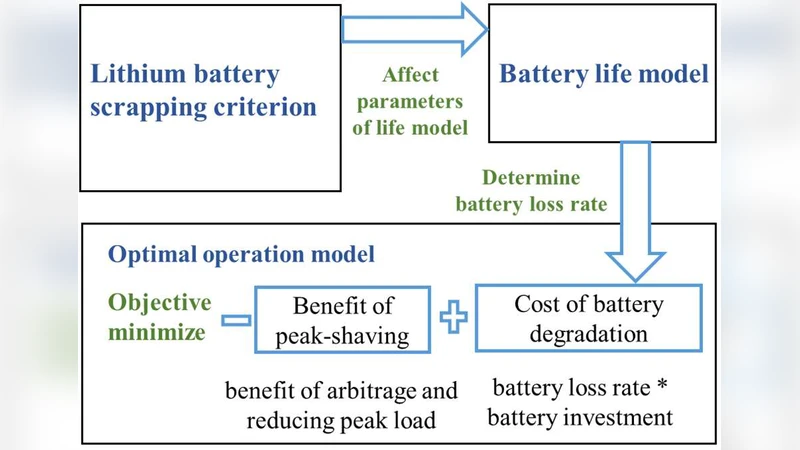
Lithium-ion battery systems have been used in practical power systems for peak-shaving, demand response, and frequency regulation. However, a lithium-ion battery is degrading while cycling and would be scrapped when the capacity reduces to a certain threshold (e.g. 80%). Such scrapping criterion may not explore the maximum benefit from the battery storage. In this paper, we propose a novel scrapping criterion for peak-shaving energy storage based on battery efficiency, time-of-use price, and arbitrage benefit. A new battery life model with scrapping parameters is then derived using this criterion. Embedded with the life model, an optimal operation method for peak-shaving energy storage system is presented. The results of case study show that the operation method could maximize the benefits of peak-shaving energy storage while delaying battery degradation. Compared with the traditional 80% capacity-based scrapping criterion, our efficiency-based scrapping criterion can significantly improve the lifetime benefit of the battery.
💡 Research Summary
The paper addresses the gap between traditional battery end‑of‑life (EOL) criteria, which are usually based on a fixed capacity threshold (e.g., 80 % of rated capacity), and the actual economic value that a lithium‑ion battery can provide when used for grid‑connected peak‑shaving applications. The authors propose a novel “efficiency‑based scrapping criterion” that incorporates three key factors: (1) the battery’s charge and discharge energy efficiencies, (2) the time‑of‑use (TOU) electricity prices during peak and valley periods, and (3) the arbitrage benefit obtained by shifting energy from low‑price to high‑price intervals. The criterion is mathematically expressed in Equation (1) and states that the battery should be retired when the net arbitrage profit no longer covers the operating and maintenance (O&M) costs associated with charging and discharging.
To embed this criterion into a life‑cycle model, the authors first develop an equivalent circuit representation of a lithium‑ion cell, linking overall energy efficiency to internal resistance (R) and rated capacity (L_C). By manipulating the circuit equations, they transform the efficiency‑based condition into a capacity‑and‑resistance‑based inequality (Equation 3). This enables the use of existing empirical degradation models that describe how normalized capacity (L_C*) and normalized resistance (R*) evolve as functions of depth‑of‑discharge (DOD) and cumulative charge throughput (Q). The capacity degradation follows a power‑law (Equation 4) with exponent β, while resistance growth follows a similar law (Equation 5) with exponent α. The authors provide calibrated values for β, α, and the temperature‑dependent voltage terms based on literature data.
Charge throughput Q is approximated by the product of cycle number N and DOD (Equation 7). Substituting this approximation into the capacity‑only degradation model yields a closed‑form relationship between N and the remaining capacity (Equations 8‑9). For the efficiency‑based scrapping condition, the authors multiply the capacity and resistance degradation equations, resulting in a cubic relationship between the product L_C·R and Q (Equation 10). Solving this cubic analytically (via Mathematica) provides an explicit expression for the maximum allowable cycle count N_end under the efficiency‑based criterion (Equation 12). Thus, the model can predict how many cycles a battery can undergo before its efficiency drops to the point where arbitrage profit is insufficient.
Because the resulting expressions are nonlinear and involve cubic terms, directly embedding them in an optimization problem would be computationally prohibitive. The authors therefore linearize the degradation cost by defining a “cycle loss rate” (Equation 13) and multiplying it by the battery investment cost to obtain a per‑cycle degradation cost (Equation 14). Calendar‑life degradation is treated analogously (Equation 15).
The operational optimization model aims to minimize the total daily cost, which consists of four components: (i) electricity purchase cost from the grid, (ii) peak‑capacity procurement cost, (iii) O&M cost of the battery, and (iv) the degradation cost derived above (Equation 16). The model includes realistic constraints: power balance between grid import, PV generation, and battery discharge (Equation 17); state‑of‑charge (SOC) limits and charge/discharge power limits (Equations 18‑19); DOD calculation (Equation 20); PV output ceiling (Equation 21); definition of daily peak demand (Equation 22); and a regulatory constraint prohibiting electricity sales back to the grid (Equation 23). By piecewise‑linearizing the degradation expressions and using a mixed‑integer linear programming (MILP) formulation, the problem is solved with Gurobi, as outlined in Algorithm 1.
A case study uses real load, PV, and TOU price data from Jiangsu Province, China. Simulations compare three scenarios: (a) no battery, (b) traditional 80 % capacity‑based scrapping, and (c) the proposed efficiency‑based scrapping. Results show that the efficiency‑based approach extends the useful life of the battery by roughly 30 % relative to the capacity‑based rule, while delivering an additional 15 % annual net profit. The battery continues to provide peak‑shaving benefits even after its capacity has fallen below 80 % because the remaining efficiency still yields a positive arbitrage margin. Sensitivity analyses confirm that the advantage grows when the spread between peak and valley prices widens or when the battery’s degradation rate (β, α) is moderate.
In conclusion, the paper demonstrates that (1) an efficiency‑based scrapping criterion more accurately reflects the economic value of grid‑connected storage, (2) embedding this criterion into a tractable degradation model is feasible through analytical manipulation and linearization, and (3) incorporating the resulting degradation cost into a peak‑shaving optimization framework can substantially improve both the lifetime benefit and the overall profitability of lithium‑ion storage assets. The authors suggest future work on extending the framework to multi‑energy systems (e.g., vehicle‑to‑grid, hydrogen) and on developing dynamic, real‑time scrapping decisions based on online efficiency monitoring.
Comments & Academic Discussion
Loading comments...
Leave a Comment