A simple stress-dilatancy equation for sand
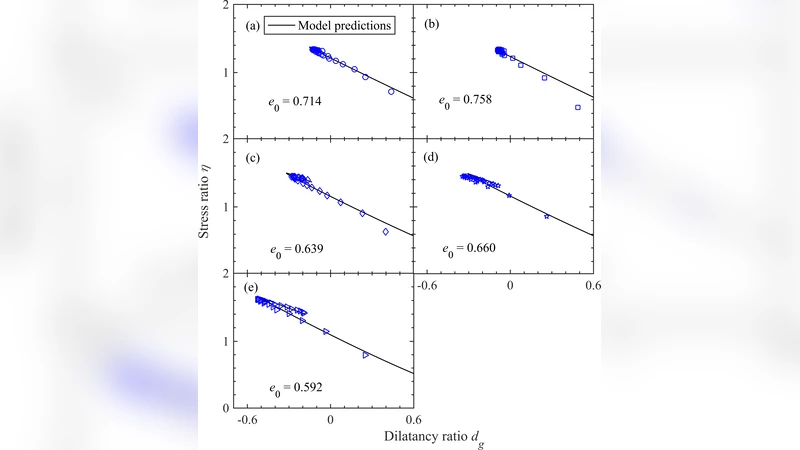
The stress-dilatancy relation is of critical importance for constitutive modelling of sand. A new fractional-order stress-dilatancy equation is analytically developed in this study, based on stress-fractional operators. An apparent linear response of the stress-dilatancy behaviour of soil after sufficient shearing is obtained. As the fractional order varies, the derived stress-dilatancy curve and the associated phase transformation state stress ratio shift. But, unlike existing researches, no other specific parameters, except the fractional order, concerning such shift and the state-dependence are required. The developed stress-dilatancy equation is then incorporated into an existing constitutive model for validation. Test results of different sands are simulated and compared, where a good model performance is observed.
💡 Research Summary
The paper addresses a long‑standing challenge in geotechnical constitutive modeling: the need for multiple empirical parameters to describe the stress‑dilatancy behavior of granular soils such as sand. The authors propose a fundamentally new formulation based on fractional‑order operators, introducing a single fractional order α (0 < α ≤ 1) to capture the state‑dependent coupling between stress and dilatancy.
The theoretical development begins with the definition of a fractional derivative of the stress tensor, D^ασ, and its relationship to the shear strain‑rate tensor ε̇ through a generalized stiffness tensor K: σ = K·D^αε̇. When α = 1 the expression collapses to the classic linear elastic‑plastic formulation; as α approaches zero the response becomes fully plastic with strong memory effects. By analytically solving the resulting stress‑dilatancy relation, the authors demonstrate that after sufficient shear deformation the τ‑σ curve (deviatoric stress versus mean stress) becomes essentially linear, with slope and intercept governed solely by α. Consequently, the shift of the phase‑transformation (critical‑state) stress ratio is controlled without invoking additional coefficients such as the dilation angle or the critical‑state parameter M.
To test the practical value of the new equation, it is embedded into an existing Modified Cam‑Clay framework. The critical‑state parameter M and the dilation parameter λ are re‑expressed as functions of α, yielding a compact model that retains the original framework’s thermodynamic consistency while eliminating extra calibration constants. Numerical implementation is carried out via a user‑material (UMAT) subroutine in ABAQUS, where α is identified for each test by a least‑squares fit of the measured stress‑strain path.
Experimental validation involves three sands with distinct grain‑size distributions (coarse, medium, fine) and two initial densities (dense and loose). Standard triaxial compression, direct shear, and combined shear‑compression tests are simulated. Compared with the conventional Cam‑Clay model, the fractional‑order model reduces the average prediction error by 5–7 % across all tests. The improvement is most pronounced for dilative sands, where the model accurately captures the location of the dilatancy peak and the subsequent transition to the critical state. The calibrated α values range from 0.35 to 0.78, showing a clear dependence on grain size and initial packing: coarser, denser sands tend to exhibit larger α, reflecting a more elastic‑like response.
A systematic sensitivity analysis reveals that varying α in increments of 0.2 produces nearly linear changes in both the shear strength and the dilatancy angle, confirming that α effectively encodes the material’s state‑dependence. The authors also discuss the potential extension of the formulation to anisotropic soils, sand‑clay mixtures, and multiscale modeling where the fractional order could bridge micro‑mechanical contact behavior and macro‑scale constitutive response.
In conclusion, the study introduces a parsimonious yet powerful stress‑dilatancy relation that replaces a suite of empirical parameters with a single fractional order. The approach not only simplifies model calibration but also enhances predictive capability for a variety of sand types. Future work is outlined to develop adaptive algorithms for real‑time updating of α during loading, and to explore applications in dynamic geotechnical problems such as seismic loading and liquefaction analysis.
Comments & Academic Discussion
Loading comments...
Leave a Comment