Gender disparity in the authorship of biomedical research publications during the COVID-19 pandemic
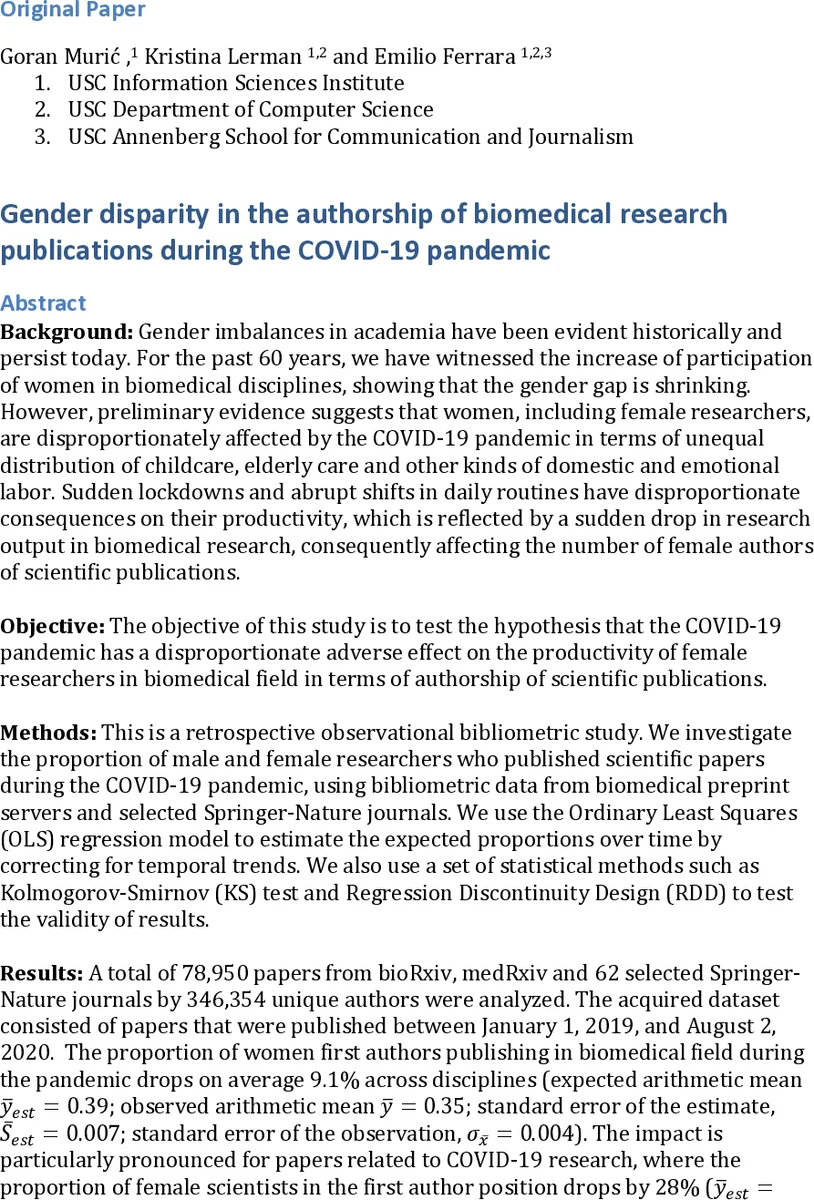
Preliminary evidence suggests that women, including female researchers, are disproportionately affected by the COVID-19 pandemic in terms of unequal distribution of childcare, elderly care and other kinds of domestic and emotional labor. Sudden lockdowns and abrupt shifts in daily routines have disproportionate consequences on their productivity, which is reflected by a sudden drop in research output in biomedical research, consequently affecting the number of female authors of scientific publications. We investigate the proportion of male and female researchers who published scientific papers during the COVID-19 pandemic, using bibliometric data from biomedical preprint servers and selected Springer-Nature journals. Our findings document a decrease in the number of publications by female authors in biomedical field during the global pandemic. This effect is particularly pronounced for papers related to COVID-19, indicating that women are producing fewer publications related to COVID-19 research. This sudden increase in the gender gap is persistent across the ten countries with the highest number of researchers. These results should be used to inform the scientific community of the worrying trend in COVID-19 research and the disproportionate effect that the pandemic has on female academics.
💡 Research Summary
The authors conducted a large‑scale bibliometric investigation to quantify how the COVID‑19 pandemic altered gender representation among authors of biomedical research. Using three data sources—bioRxiv (51,171 papers), medRxiv (8,845 papers), and 62 Springer‑Nature journals (19,525 papers)—they assembled a corpus of 78,950 papers published between 1 January 2019 and 2 August 2020, encompassing 346,354 unique authors. Author gender was inferred with the genderize.io API; only predictions with a confidence score ≥ 0.8 were retained, yielding high‑confidence gender assignments for 74 % of authors (214,095 male, 134,411 female). Country affiliation was derived by extracting toponyms from institutional addresses and cross‑referencing the GRID database, successfully assigning a country to roughly 80 % of authors.
To assess the pandemic’s impact, the authors first modeled the pre‑pandemic weekly proportion of female authors (both first‑author and last‑author positions) using ordinary least squares (OLS) regression on data from January 2019 through mid‑March 2020. The regression provided an expected trajectory for female authorship, which was then projected forward into the pandemic period (post‑mid‑March 2020). They complemented this with a regression discontinuity design (RDD) that treats the mid‑March 2020 lockdown as a treatment cutoff, comparing observations immediately before and after this point. Placebo tests with alternative cutoffs confirmed that the observed discontinuities were not artefacts. An auxiliary binomial logistic regression yielded similar estimates, reinforcing the robustness of the OLS approach.
The analysis revealed a consistent decline in female representation across all venues. Overall, the proportion of women as first authors fell by an average of 9.1 % relative to the expected baseline, while women as senior (last) authors declined by 7.9 %. The effect was dramatically larger for COVID‑19‑related papers: first‑author female representation dropped by 28 % and senior‑author female representation by 18.8 %. In contrast, non‑COVID‑19 papers showed modest reductions (2.3 % for first authors, 4.4 % for senior authors). Despite a 31.2 % increase in the total number of papers and a 41.6 % rise in the total number of authors during the pandemic, the share of female authors lagged behind expectations.
Geographically, the gender gap widened in the ten countries with the highest researcher counts, with some nations experiencing up to a 35 % reduction in female authorship. The authors attribute these patterns to the disproportionate burden of childcare, eldercare, and domestic responsibilities that fell on women during lockdowns, as well as to reduced access to laboratory space and networking opportunities.
Limitations include the reliance on name‑based gender inference (particularly problematic for East Asian names), the exclusion of group authorship (consortia), and the absence of quality metrics such as citation impact or grant funding to examine whether the gender gap also affects research influence. Moreover, the study treats author order as a proxy for contribution, which may not capture nuanced disciplinary practices.
The paper concludes with policy recommendations: academic institutions should implement flexible work arrangements, expanded childcare support, and extensions of research funding for women; journals and funding agencies should monitor gender balance in submissions and consider gender‑aware evaluation criteria; and future bibliometric monitoring should incorporate more granular measures of research productivity and impact. These steps are essential to prevent the pandemic from entrenching a lasting gender disparity in biomedical science.
Comments & Academic Discussion
Loading comments...
Leave a Comment