Relative utility bounds for empirically optimal portfolios
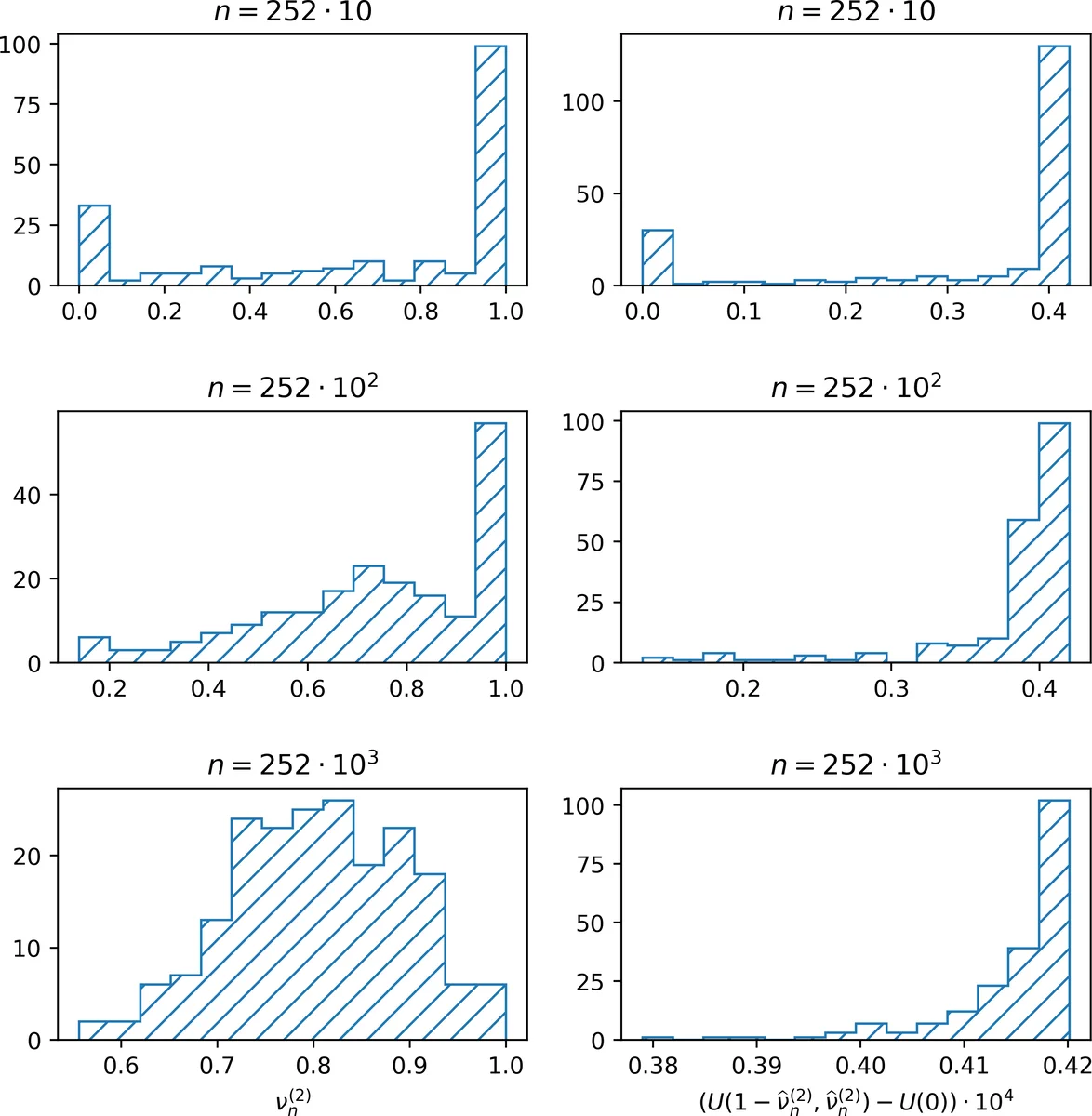
We consider a single-period portfolio selection problem for an investor, maximizing the expected ratio of the portfolio utility and the utility of a best asset taken in hindsight. The decision rules are based on the history of stock returns with unknown distribution. Assuming that the utility function is Lipschitz or Hölder continuous (the concavity is not required), we obtain high probability utility bounds under the sole assumption that the returns are independent and identically distributed. These bounds depend only on the utility function, the number of assets and the number of observations. For concave utilities similar bounds are obtained for the portfolios produced by the exponentiated gradient method. Also we use statistical experiments to study risk and generalization properties of empirically optimal portfolios. Herein we consider a model with one risky asset and a dataset, containing the stock prices from NYSE.
💡 Research Summary
The paper tackles the classic single‑period portfolio selection problem from a fresh “relative utility” perspective. Instead of maximizing the expected utility of a portfolio directly, the authors define the objective as the expected ratio between the utility of the chosen portfolio and the utility of the best‑performing asset in hindsight. Formally, for a portfolio weight vector ν∈Δ and a utility function u:(0,∞)→(0,∞) that is non‑decreasing and continuous, the relative utility is
U(ν)=E
Comments & Academic Discussion
Loading comments...
Leave a Comment