Exact discrete resonances in the Fermi-Pasta-Ulam-Tsingou system
In systems of N coupled anharmonic oscillators, exact resonant interactions play an important role in the energy exchange between normal modes. In the weakly nonlinear regime, those interactions may facilitate energy equipartition in Fourier space. We consider analytically resonant wave-wave interactions for the celebrated Fermi-Pasta-Ulam-Tsingou (FPUT) system. Using a number-theoretical approach based on cyclotomic polynomials, we show that the problem of finding exact resonances for a system of N particles is equivalent to a Diophantine equation whose solutions depend sensitively on the set of divisors of N. We provide an algorithm to construct all possible resonances, based on two methods: pairing-off and cyclotomic, which we introduce to build up explicit solutions to the 4-, 5- and 6-wave resonant conditions. Our results shed some light in the understanding of the long-standing FPUT paradox, regarding the sensitivity of the resonant manifolds with respect to the number of particles N and the corresponding time scale of the interactions leading to thermalisation. In this light we demonstrate that 6-wave resonances always exist for any N, while 5-wave resonances exist if N is divisible by 3 and N > 6. It is known (for finite N) that 4-wave resonances do not mix energy across the spectrum, so we investigate whether 5-wave resonances can produce energy mixing across a significant region of the Fourier spectrum by analysing the interconnected network of Fourier modes that can interact nonlinearly via resonances. The answer depends on the set of odd divisors of N that are not divisible by 3: the size of this set determines the number of dynamically independent components, corresponding to independent constants of motion (energies). We show that 6-wave resonances connect all these independent components, providing in principle a restoring mechanism for full-scale thermalisation.
💡 Research Summary
This paper provides a comprehensive analytical treatment of exact resonant wave‑wave interactions in the Fermi‑Pasta‑Ulam‑Tsingou (FPUT) chain consisting of N coupled anharmonic oscillators. The authors start from the Hamiltonian formulation with quadratic, cubic (α) and quartic (β) nonlinearities, introduce normal‑mode variables aₖ, and derive the dispersion relation ωₖ = 2√(κ/m) sin(πk/N). The resonant conditions for an M‑wave process are expressed as integer equations: the sum of wave numbers (with signs) must vanish modulo N, and the corresponding sum of frequencies must be zero. By substituting the trigonometric form of ωₖ with the complex primitive 2N‑th root of unity ζ = exp(iπ/N), the resonance equations are transformed into polynomial equations P(ζ)=0 with integer coefficients. The key insight is that these polynomials factor through cyclotomic polynomials Φ_d(ζ), allowing the resonance problem to be reduced to a linear Diophantine equation of the form a·x + b·y = 0.
Two constructive methods are presented. The “pairing‑off” method pairs each mode k with its complement N‑k, generating the simplest 2S‑wave resonances. This reproduces all known four‑wave resonances and, for even N, yields six‑wave resonances as well. However, pairing‑off alone cannot capture all possible resonances, especially when N is not a multiple of six or when five‑wave interactions are required. To overcome this limitation, the authors develop a cyclotomic approach that exploits products of cyclotomic polynomials, notably Φ₃(ζ)·Φ_d(ζ). This method shows that five‑wave resonances (quintets) exist precisely when N is divisible by three and N ≥ 9. Explicit constructions of such quintets are given, and their connectivity properties are analyzed.
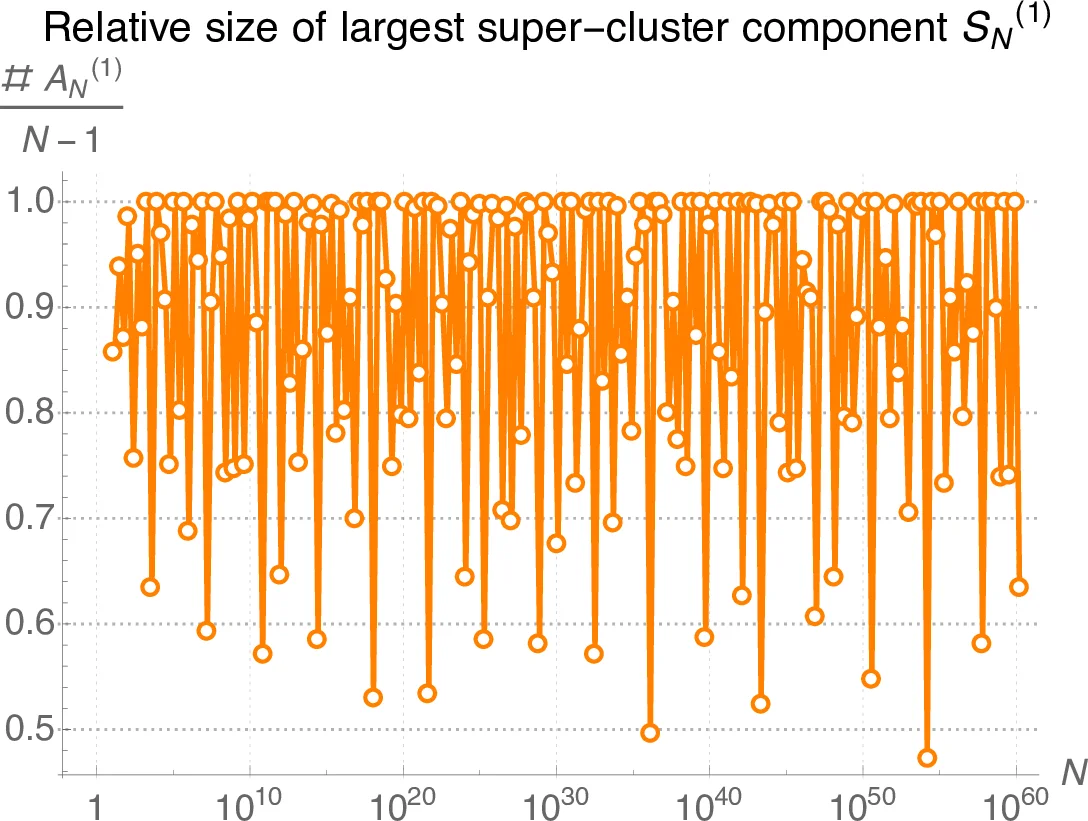
A central theme of the work is the dependence of resonant manifolds on the divisor structure of N. The set of odd divisors of N that are not multiples of three, denoted |D_odd{3}|, determines the number of dynamically independent components (clusters) in the Fourier space. Within each component, five‑wave resonances can exchange energy, but they cannot couple different components. Consequently, five‑wave processes alone cannot achieve full spectral mixing. In contrast, six‑wave resonances are shown to exist for any N and to connect all components, providing a mechanism for complete thermalisation.
The authors quantify the associated nonlinear time scales: τ₅ ∝ ε⁻⁴ for five‑wave interactions and τ₆ ∝ ε⁻⁵ for six‑wave interactions, where ε measures the nonlinearity strength. For very weak nonlinearity, five‑wave processes dominate the early dynamics, but the long‑term approach to equipartition is governed by the slower six‑wave channel.
Two illustrative examples, N = 75 (3·5²) and N = 420 (2²·3·5·7), are examined in detail. In both cases, the authors identify “octahedron clusters” formed by resonant quintets and construct a higher‑level graph (super‑clusters) whose vertices are these clusters and edges represent shared modes. The super‑clusters decompose into disjoint connected subgraphs, confirming that the divisor structure partitions the mode space into independent energy blocks. Six‑wave resonances bridge these blocks, ensuring that, in principle, the whole system can thermalise.
Mathematically, the paper culminates in a rigorous formulation using rings of integer‑coefficient polynomials and group theory, providing an algorithm that generates all possible M‑wave resonances for any N. This algorithm circumvents the combinatorial explosion of brute‑force numerical searches and offers a clear pathway to predict resonance existence, connectivity, and associated time scales.
In conclusion, the study reframes the long‑standing FPUT paradox through the lens of exact discrete resonances and number‑theoretic properties of the system size. It demonstrates that while four‑wave resonances are insufficient for energy mixing, five‑wave resonances appear under specific divisor conditions, and six‑wave resonances universally guarantee a route to full thermalisation. The framework is poised for extension to other lattice models (e.g., nonlinear Klein‑Gordon, discrete nonlinear Schrödinger) and for guiding experimental designs that probe weak‑nonlinearity dynamics in finite‑size systems.
Comments & Academic Discussion
Loading comments...
Leave a Comment