Toward Regional Characterizations of the Oceanic Internal Wavefield
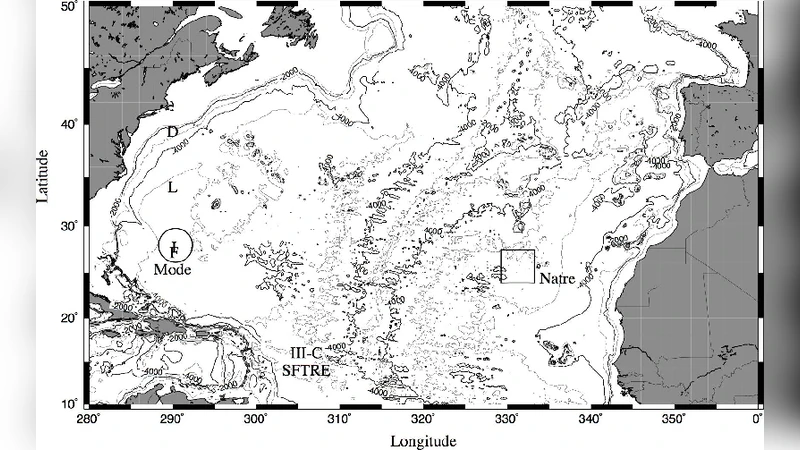
Many major oceanographic internal wave observational programs of the last 4 decades are reanalyzed in order to characterize variability of the deep ocean internal wavefield. The observations are discussed in the context of the universal spectral model proposed by Garrett and Munk. The Garrett and Munk model is a good description of wintertime conditions at Site-D on the continental rise north of the Gulf Stream. Elsewhere and at other times, significant deviations in terms of amplitude, separability of the 2-D vertical wavenumber - frequency spectrum, and departure from the model’s functional form are noted. Subtle geographic patterns are apparent in deviations from the high frequency and high vertical wavenumber power laws of the Garrett and Munk spectrum. Moreover, such deviations tend to co-vary: whiter frequency spectra are partnered with redder vertical wavenumber spectra. Attempts are made to interpret the variability in terms of the interplay between generation, propagation and nonlinearity using a statistical radiative balance equation. This process frames major questions for future research with the insight that such integrative studies could constrain both observationally and theoretically based interpretations.
💡 Research Summary
This paper presents a comprehensive re‑analysis of the major oceanic internal‑wave observational programs carried out over the past four decades, with the goal of quantifying how the deep‑ocean internal‑wave field varies across regions and seasons. The authors adopt the Garrett‑Munk (GM) universal spectral model as a reference framework. The GM model assumes that the two‑dimensional spectrum in vertical wavenumber (k) and frequency (ω) is separable and follows a k⁻² · ω⁻² power law.
First, the study confirms that the GM model provides an excellent description of wintertime conditions at Site‑D, a location on the continental rise north of the Gulf Stream. Here, the observed amplitude, vertical‑wavenumber slope, and frequency slope match the GM predictions closely, supporting the conventional view that strong wind‑ and current‑driven generation, together with relatively weak non‑linear interactions, dominate the wave field in this region.
In contrast, data from other geographic settings—tropical and subtropical basins, high‑latitude summer periods, and regions with complex bathymetry—show systematic departures from the GM form. The key deviations are: (1) overall spectral amplitudes that are 2–3 times larger than the GM climatology; (2) vertical‑wavenumber spectra that are “redder,” with slopes ranging from k⁻³ to k⁻⁴ rather than the canonical k⁻²; and (3) high‑frequency tails that are flatter, following ω⁻¹ to ω⁻¹·⁵ instead of ω⁻², i.e., the spectra become more “white” in frequency.
A striking observation is that these departures co‑vary: locations where the frequency spectrum is whiter tend to exhibit redder vertical‑wavenumber spectra. The authors interpret this covariation as an energy‑re‑distribution process in which non‑linear triadic interactions preferentially transfer energy from low‑vertical‑wavenumber (large‑scale) modes to high‑vertical‑wavenumber (small‑scale) modes, while the frequency domain retains a more uniform energy distribution. This behavior suggests that the internal‑wave field cannot be described by a single universal power law; instead, regional generation mechanisms (wind forcing, barotropic‑to‑internal conversion, topographic wave emission), propagation pathways (refraction, reflection, scattering by shear layers), and non‑linear dissipation all imprint distinct spectral signatures.
To formalize these ideas, the authors introduce a statistical radiative‑balance equation (RBE) for internal‑wave energy. The RBE expresses the temporal and spatial evolution of the spectral density as the sum of three contributions: (i) a generation term representing wind and current forcing; (ii) a propagation term accounting for linear wave dynamics (refraction, reflection, and scattering); and (iii) a non‑linear sink term describing energy loss through triadic interactions and wave breaking. By mapping the observed regional spectral deviations onto the three RBE terms, the study finds that, for example, Antarctic and sub‑Antarctic sites are dominated by propagation effects, whereas tropical basins exhibit strong generation and non‑linear sink contributions simultaneously.
The paper concludes with a forward‑looking research agenda. First, it calls for a global, high‑resolution three‑dimensional observation network (e.g., moored profilers, gliders, and satellite‑derived surface signatures) capable of capturing the full k‑ω spectrum continuously. Second, it advocates the development of laboratory and numerical experiments that can directly measure triadic interaction coefficients, thereby constraining the non‑linear sink term in the RBE. Third, it suggests the creation of region‑specific parameterizations of the RBE that can be incorporated into climate‑scale ocean models, allowing internal‑wave processes to be represented more realistically in global heat and tracer budgets.
Overall, the study demonstrates that while the Garrett‑Munk spectrum remains a valuable baseline, the real ocean exhibits systematic, geographically coherent departures that reflect the interplay of generation, propagation, and non‑linear dynamics. Recognizing and quantifying these departures is essential for improving our understanding of how internal waves contribute to ocean mixing, energy cascades, and ultimately the Earth’s climate system.
Comments & Academic Discussion
Loading comments...
Leave a Comment