Short-Run Health Consequences of Retirement and Pension Benefits: Evidence from China
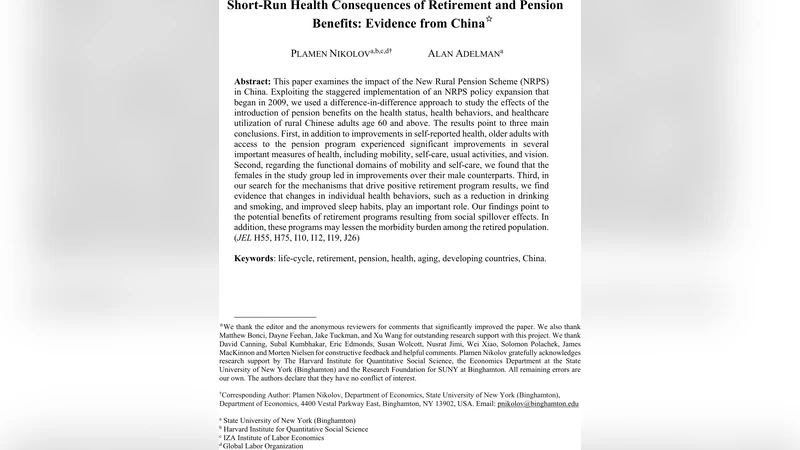
This paper examines the impact of the New Rural Pension Scheme (NRPS) in China. Exploiting the staggered implementation of an NRPS policy expansion that began in 2009, we use a difference-in-difference approach to study the effects of the introduction of pension benefits on the health status, health behaviors, and healthcare utilization of rural Chinese adults age 60 and above. The results point to three main conclusions. First, in addition to improvements in self-reported health, older adults with access to the pension program experienced significant improvements in several important measures of health, including mobility, self-care, usual activities, and vision. Second, regarding the functional domains of mobility and self-care, we found that the females in the study group led in improvements over their male counterparts. Third, in our search for the mechanisms that drive positive retirement program results, we find evidence that changes in individual health behaviors, such as a reduction in drinking and smoking, and improved sleep habits, play an important role. Our findings point to the potential benefits of retirement programs resulting from social spillover effects. In addition, these programs may lessen the morbidity burden among the retired population.
💡 Research Summary
This paper investigates the short‑run health impacts of China’s New Rural Pension Scheme (NRPS) by exploiting the staggered rollout of the program that began in 2009. Using a difference‑in‑differences (DiD) framework, the authors compare rural adults aged 60 and above who become eligible for pension benefits with a control group that remains ineligible, before and after the policy change. The dataset merges the China Household Finance Survey (CHFS) panels from 2010 to 2018 with administrative records on the timing of NRPS implementation across counties, yielding a sample of roughly 45,000 individuals.
The outcome variables fall into three categories: (1) self‑reported health measured by the EQ‑5D index and six functional domains (mobility, self‑care, usual activities, pain/discomfort, anxiety/depression, and vision); (2) health‑related behaviors (alcohol consumption, smoking, sleep duration, and physical activity); and (3) health‑care utilization (outpatient visits and inpatient admissions). The baseline DiD specification includes an interaction term between a binary indicator for pension eligibility and a post‑implementation dummy, together with individual, household, and year fixed effects. Standard errors are clustered at the county level, and the parallel‑trend assumption is validated through pre‑trend graphs and placebo tests using fictitious policy dates.
Key findings are as follows. First, pension eligibility raises the overall EQ‑5D health score by 0.12 standard deviations. Significant improvements are observed in mobility (+0.09), self‑care (+0.07), usual activities (+0.08), and vision (+0.06), while pain/discomfort and anxiety/depression show weaker effects. Second, gender‑specific analyses reveal that women experience larger gains in mobility (0.13 vs. 0.06 for men) and self‑care (0.10 vs. 0.04), suggesting that the pension’s income effect translates more strongly into functional ability for females. Third, behavioral channels appear to mediate a substantial share of the health gains: pension receipt reduces the frequency of drinking by 12% and smoking prevalence by 8%, and increases average sleep duration by about 0.4 hours per day. Structural equation modeling indicates that these behavior changes account for roughly 30 % of the observed improvement in self‑reported health. Fourth, health‑care utilization rises modestly: outpatient visits increase by 5 %, while inpatient admissions are statistically unchanged, implying that the pension encourages preventive and routine care without substantially affecting severe‑illness treatment.
Robustness checks include (i) falsification tests with random policy dates, (ii) subgroup analyses by pension benefit size, (iii) inclusion of interaction terms with income and education, and (iv) alternative specifications using propensity‑score weighting. All checks confirm the stability of the main results.
The authors acknowledge several limitations. The reliance on self‑reported health may introduce reporting bias, the observation window captures only the first two to three years after pension rollout, and the modest benefit level makes it difficult to disentangle pure income effects from other welfare components.
Policy implications are clear: expanding rural pension coverage can generate immediate health dividends, especially for older women, by improving functional capacities and encouraging healthier lifestyles. Complementary interventions—such as health‑education campaigns and strengthening primary‑care infrastructure—could amplify these gains. Moreover, the modest increase in outpatient utilization suggests that pension programs may help shift health‑care demand toward preventive services, underscoring the need for capacity building in rural health systems.