Asynchronous Distributed Averaging: A Switched System Framework for Average Error Analysis
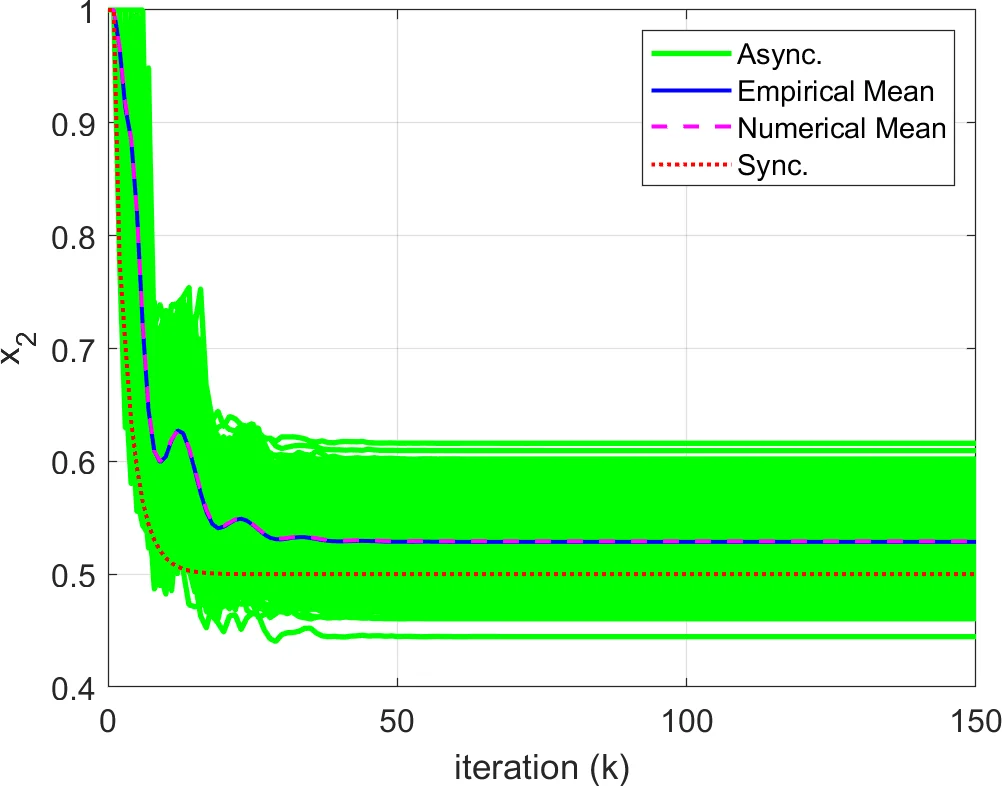
This paper investigates an expected average error for distributed averaging problems under asynchronous updates. The asynchronism in this context implies no existence of a global clock as well as random characteristics in communication uncertainty such as communication delays and packet drops. Although some previous works contributed to the design of average consensus protocols to guarantee the convergence to an exact average, these methods may increase computational burdens due to extra works. Sometimes it is thus beneficial to make each agent exchange information asynchronously without modifying the algorithm, which causes randomness in the average value as a trade-off. In this study, an expected average error is analyzed based on the switched system framework, to estimate an upper bound of the asynchronous average compared to the exact one in the expectation sense. Numerical examples are provided to validate the proposed results.
💡 Research Summary
The paper addresses the problem of distributed averaging in networks where agents operate without a global clock and experience communication uncertainties such as delays and packet drops. In such asynchronous settings, the classical consensus algorithms that guarantee convergence to the exact average either require synchronization or additional corrective protocols that increase computational load. The authors propose to keep the original averaging rule unchanged and instead quantify the expected deviation of the resulting asynchronous average from the true average.
The state update at each node i is modeled as
x_i(k_i+1) = a_ii x_i(k_i) + Σ_{j∈N_i} a_ij x_j(k*_j),
where A =
Comments & Academic Discussion
Loading comments...
Leave a Comment