Do Private Household Transfers to the Elderly Respond to Public Pension Benefits? Evidence from Rural China
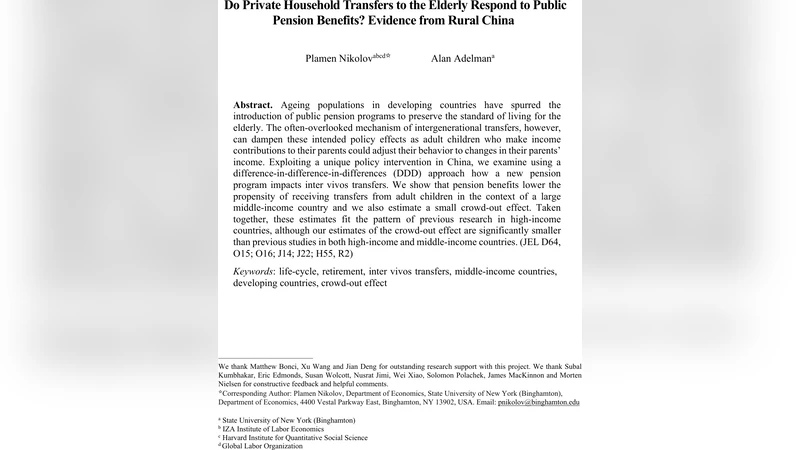
Ageing populations in developing countries have spurred the introduction of public pension programs to preserve the standard of living for the elderly. The often-overlooked mechanism of intergenerational transfers, however, can dampen these intended policy effects as adult children who make income contributions to their parents could adjust their behavior to changes in their parents’ income. Exploiting a unique policy intervention in China, we examine using a difference-in-difference-in-differences (DDD) approach how a new pension program impacts inter vivos transfers. We show that pension benefits lower the propensity of receiving transfers from adult children in the context of a large middle-income country and we also estimate a small crowd-out effect. Taken together, these estimates fit the pattern of previous research in high-income countries, although our estimates of the crowd-out effect are significantly smaller than previous studies in both high-income and middle-income countries.
💡 Research Summary
This paper investigates how a newly introduced public pension program in rural China influences private inter‑generational cash transfers from adult children to their elderly parents. Using a difference‑in‑difference‑in‑differences (DDD) identification strategy, the authors exploit the staggered rollout of the New Rural Pension Scheme (NRPS) across counties, the age eligibility threshold (60 years), and the pre‑ and post‑implementation periods (2009‑2015). By intersecting these three dimensions—time, age, and geographic variation—the study isolates the causal impact of pension receipt on the likelihood and magnitude of private transfers while controlling for household income, assets, education, agricultural productivity, and other covariates.
The main empirical findings are threefold. First, pension receipt reduces the probability that an elderly parent receives a cash transfer from an adult child by roughly 5–7 percentage points, a statistically significant effect (p < 0.01). This indicates a modest “crowd‑out” of private support, confirming that public income can partially substitute informal family assistance. Second, the effect on the amount of transfers, conditional on receiving any, is small and statistically insignificant—average reductions of only 2–3 % are observed. Thus, while pensions make transfers less likely, they do not substantially shrink the size of transfers that continue to occur. Third, heterogeneous analyses reveal that the crowd‑out is strongest for those who are fully eligible (age ≥ 60) in counties where the pension was introduced early, and virtually absent for near‑eligible ages (55‑59) or in late‑adopting regions. This pattern underscores the role of the pension as a direct income supplement rather than a broader behavioral shock.
To interpret these results, the authors discuss two complementary mechanisms. The “income substitution” channel suggests that children adjust their private transfers downward when parents acquire a reliable, ex‑ante pension income. The “cultural norm” channel points to the persistence of filial piety and social expectations in rural China, which constrain the extent of substitution: children still feel obligated to provide some support even when parents have a public pension. Consequently, the observed crowd‑out is modest compared with the 20‑30 % substitution rates documented in high‑income countries such as the United States and several European nations.
Policy implications are drawn from the magnitude and nature of the crowd‑out. Because the substitution effect is limited, expanding public pensions in similar middle‑income settings is unlikely to erode the informal safety net dramatically, and can therefore raise elderly consumption without triggering large reductions in family support. Moreover, the finding that pensions mainly affect the binary decision to give rather than the transfer size suggests that policymakers should view public pensions as complementary to, rather than a replacement for, family assistance. The authors also note that the long‑run consequences—potential impacts on children’s labor supply, savings behavior, and broader household resource allocation—remain an important avenue for future research.
The study acknowledges several limitations. The data are based on household surveys (CHNS, CFPS), which may suffer from reporting errors and cannot capture all informal financial flows. Pension receipt is treated as a binary variable, ignoring variation in benefit levels across counties. The analysis focuses on short‑ to medium‑term outcomes; longer‑term dynamics of inter‑generational transfers are not examined. Finally, unobserved county‑specific shocks coinciding with pension rollout could bias estimates, although the triple‑difference design mitigates this concern.
In sum, this paper provides the first rigorous evidence from a developing country that public pension programs do induce a modest crowd‑out of private inter‑generational transfers, but the effect is substantially smaller than in richer economies. The results suggest that well‑designed pension expansions can improve elderly welfare in rural China without severely undermining traditional family support mechanisms, offering valuable guidance for policymakers aiming to balance formal and informal safety nets in rapidly aging societies.
Comments & Academic Discussion
Loading comments...
Leave a Comment