Renewable Power Trades and Network Congestion Externalities
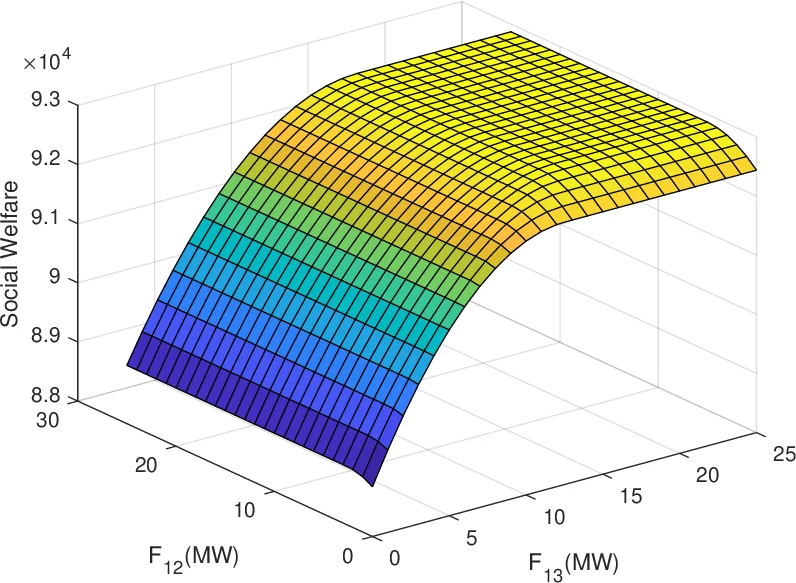
Integrating renewable energy production into the electricity grid is an important policy goal to address climate change. However, such an integration faces economic and technological challenges. As power generation by renewable sources increases, power transmission patterns over the electric grid change. Due to physical laws, these new transmission patterns lead to non-intuitive grid congestion externalities. We derive the conditions under which negative network externalities due to power trades occur. Calibration using a stylized framework and data from Europe shows that each additional unit of power traded between northern and western Europe reduces transmission capacity for the southern and eastern regions by 27% per unit traded. Such externalities suggest that new investments in the electric grid infrastructure cannot be made piecemeal. In our example, power infrastructure investment in northern and western Europe needs an accompanying investment in southern and eastern Europe as well. An economic challenge is regions facing externalities do not always have the financial ability to invest in infrastructure. Power transit fares can help finance power infrastructure investment in regions facing network congestion externalities. The resulting investment in the overall electricity grid facilitates integration of renewable energy production.
💡 Research Summary
The paper “Renewable Power Trades and Network Congestion Externalities” investigates a critical and non-intuitive challenge in integrating renewable energy into electricity grids: network congestion caused by the physical laws governing power flow, specifically Kirchhoff’s laws. As renewable generation often locates far from demand centers, long-distance power trades increase. The authors demonstrate that such trades can create significant negative externalities, where power exchange between one pair of regions reduces the available transmission capacity for trades between other regions.
The core of the paper establishes a stylized analytical framework with a four-node cyclic network comprising two net producers and two net consumers. This setup allows the authors to decompose the power flow on any network link into two additive components: a “goods flow” component that would exist if electricity behaved like any other traded commodity, and an “externality” component arising solely from the physics of electrical networks. This decomposition is key to isolating and quantifying the congestion externalities. The analysis then characterizes the “feasible trading region”—the set of all possible trades that respect all network line capacities—and derives conditions under which a trade between two nodes negatively constrains trades between other nodes.
To empirically quantify these externalities, the authors calibrate their model using data from the European power grid, divided into four regions: North (Germany, Scandinavia), East (Poland, Hungary, etc.), South (Italy, Greece), and West (France, Spain, Portugal). Europe is an ideal case study due to its already high level of market integration and significant long-distance power flows, particularly from renewable-rich northern regions to load centers.
The calibration yields striking results. It estimates that each additional unit of power traded between the Northern and Western regions reduces the transmission capacity available for trades between the Southern and Eastern regions by approximately 27% per unit traded. Furthermore, the existing level of North-West trade has already reduced the South-East line capacity by an amount equal to 10.3% of the North-West trade volume. The analysis also shows that the feasible set of all possible power trades is about 4% smaller, and the effective grid capacity for power is about 8.7% lower than it would be if power flowed like a standard commodity, highlighting the significant economic impact of grid physics.
The paper concludes with major policy implications. It argues that infrastructure investments to facilitate renewable integration cannot be made piecemeal—for example, by only upgrading lines directly from renewable hubs to cities. Because of network externalities, investment in one part of the grid (e.g., North-West) necessitates complementary investment in other affected parts (e.g., South-East) to prevent overall grid congestion. A key economic challenge is that regions suffering negative externalities may lack the financial means for such investment. To address this, the authors propose a “power transit fare” mechanism. By imposing a fee on trades that cause congestion externalities, revenue can be generated to finance necessary grid upgrades in the adversely affected regions, thereby internalizing the externality and promoting efficient, system-wide investment for a renewable future.
Comments & Academic Discussion
Loading comments...
Leave a Comment