Multipartite Gaussian Entanglement of Formation
Entanglement of formation is a fundamental measure that quantifies the entanglement of bipartite quantum states. This measure has recently been extended into multipartite states taking the name $α$-entanglement of formation. In this work, we follow an analogous multipartite extension for the Gaussian version of entanglement of formation, and focusing on the the finest partition of a multipartite Gaussian state we show this measure is fully additive and computable for 3-mode Gaussian states.
💡 Research Summary
The paper introduces a multipartite extension of the Gaussian entanglement of formation (GEoF), termed α‑Gaussian entanglement of formation (α‑GEoF), and focuses on the finest possible partition where each mode constitutes its own subsystem. Building on Szalay’s α‑entanglement framework, the authors define α‑von Neumann entropy, α‑entropy of entanglement (α‑EoE), and the corresponding convex‑roof extension α‑EoF for continuous‑variable (CV) systems. They then specialize to the N‑mode case (NGEoF), which sums the entanglement of every individual mode with the rest of the system, thereby providing a measure of the total quantum correlations present.
For Gaussian states, the von Neumann entropy depends solely on the symplectic eigenvalues of the covariance matrix. Exploiting this, the authors express α‑EoE as an average of the entropies of reduced covariance matrices and rewrite α‑GEoF as a minimization over pure‑state covariance matrices π such that the target covariance σ can be decomposed as σ = π + ϕ with ϕ ≥ 0. This reformulation reduces the infinite‑dimensional optimization to a finite‑parameter problem, making the measure computationally tractable.
A central result is the proof that NGEoF is fully additive: for any two independent Gaussian states ρ_A and ρ_B, NGEoF(ρ_A ⊗ ρ_B) = NGEoF(ρ_A) + NGEoF(ρ_B). This extends the known additivity of bipartite GEoF to the multipartite regime.
The authors then apply the formalism to three‑mode Gaussian states. By employing Gaussian local unitary (GLU) operations, any mixed three‑mode state can be brought to a standard form σ_sf without altering its entanglement. The optimization over pure‑state covariance matrices π is parametrized by 12 real variables (nine GLU parameters and three local squeezings). For a subclass of “q‑p” states—where the position (q) and momentum (p) quadratures are completely decoupled—the parameter space shrinks to six variables, allowing efficient numerical minimization.
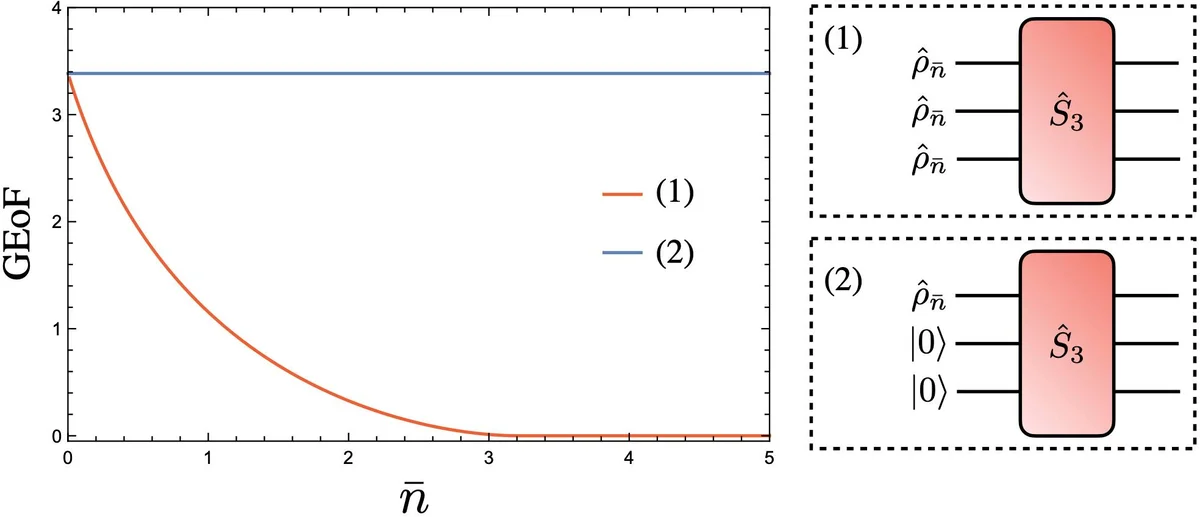
Numerical investigations consider two scenarios: (i) all three input modes are thermal with the same mean photon number (\bar n), and (ii) only one mode is thermal while the other two are vacuum. After applying a three‑mode squeezer S₃, the resulting NGEoF is plotted versus (\bar n). In case (i) the NGEoF grows with (\bar n); in case (ii) the NGEoF remains constant regardless of the thermal photon number, mirroring the known behavior of bipartite GEoF where a single thermal mode does not affect the formation cost. This demonstrates that NGEoF captures intuitive multipartite entanglement features and is robust against certain types of noise.
The conclusion emphasizes that α‑GEoF, and specifically NGEoF, provides a finite‑dimensional, additive, and computable multipartite entanglement measure for Gaussian states. The authors suggest future work to prove that NGEoF coincides with the N‑mode entropy of entanglement (NEoE) for arbitrary N, which would imply additivity of NEoF for all Gaussian states. They also point out the existence of genuine multipartite α‑EoF measures that vanish for states lacking genuine tripartite entanglement, proposing that extending recent upper‑bound results to the Gaussian regime could yield valuable insights.
Comments & Academic Discussion
Loading comments...
Leave a Comment