Deep Learning for Portfolio Optimization
💡 Research Summary
This paper presents a novel end-to-end deep learning framework for direct portfolio optimization, bypassing the traditional two-step process of forecasting returns and then optimizing allocations. The core innovation lies in using a neural network to output portfolio weights directly from market data, with the Sharpe ratio of the resulting portfolio serving as the direct objective function for optimization via gradient ascent.
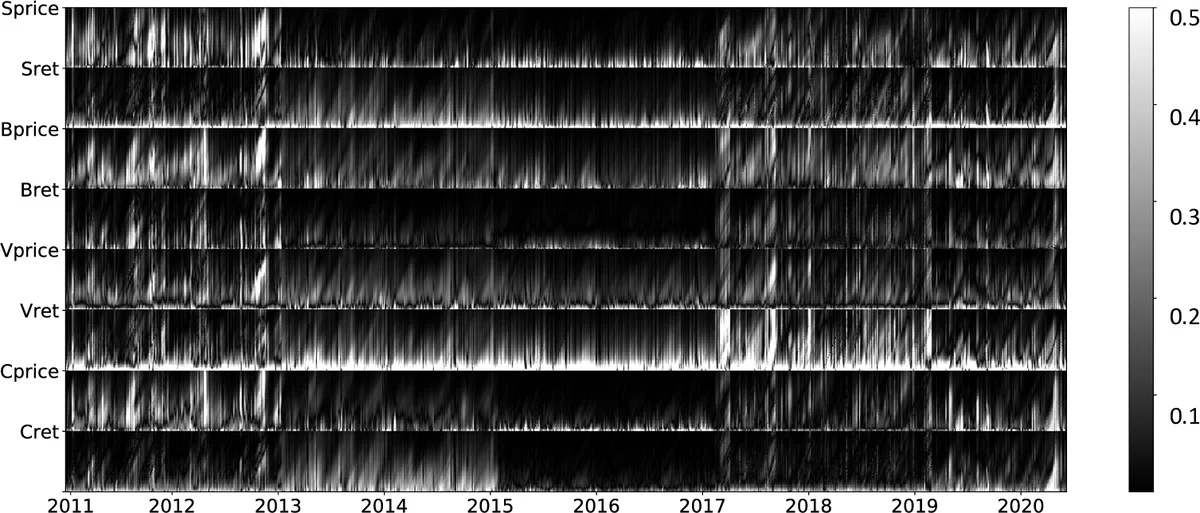
The methodology employs a Long Short-Term Memory (LSTM) network. The model takes concatenated historical price and return data from four major asset class Exchange-Traded Funds (ETFs)—VTI (US total stock market), AGG (US aggregate bonds), DBC (commodities), and VIX (volatility)—over a 50-day window as input. The LSTM processes this sequential data to capture cross-asset dynamics and temporal patterns. The output layer uses a softmax activation function to produce portfolio weights that are naturally normalized (sum to 1) and long-only (non-negative). These weights are used to calculate daily portfolio returns, from which the Sharpe ratio over the training period is computed. This Sharpe ratio is then maximized by updating the neural network’s parameters using gradient ascent, effectively training the network to allocate assets in a way that directly improves the risk-adjusted return metric.
The research addresses practical concerns through its experimental design. First, it uses broad-market ETFs instead of individual stocks, significantly reducing the asset selection universe while maintaining exposure to diverse, often low-correlated asset classes, which enhances diversification. Second, the performance evaluation incorporates “volatility scaling,” adjusting portfolio positions to target a specific volatility level. This allows for a fair comparison of strategy alpha decoupled from underlying market volatility and caters to different investor risk preferences. Third, transaction costs are explicitly modeled and included in the final return calculation, assessing the strategy’s robustness under various cost assumptions (from 1 to 10 basis points).
The backtest spans from 2011 to the end of April 2020, encompassing the market turmoil of early 2020. The proposed LSTM model is benchmarked against a suite of traditional strategies: static allocation mixes (simulating pension fund strategies), classical Mean-Variance (MV) optimization, Maximum Diversification (MD) portfolio, and a Diversity-Weighted Portfolio (DWP) from Stochastic Portfolio Theory. The model is retrained every two years using all available data up to that point.
Results demonstrate the superior performance of the deep learning approach. It consistently outperforms all baseline methods in terms of the Sharpe ratio across the testing period. Notably, it also achieves a lower maximum drawdown, indicating better risk management. The strategy shows relative resilience to increasing transaction costs, maintaining an advantage over benchmarks even at higher cost rates. Its strong performance during the COVID-19-induced market stress in Q1 2020 further underscores its potential robustness.
In conclusion, the paper successfully demonstrates that a relatively simple deep learning model can effectively solve the portfolio optimization problem by directly learning a mapping from raw market data to optimal asset allocations, with the final investment goal (Sharpe ratio) as the training signal. This end-to-end approach eliminates the disconnect between prediction accuracy and portfolio performance inherent in traditional methods, offering a powerful and practical data-driven alternative for portfolio construction.
Comments & Academic Discussion
Loading comments...
Leave a Comment