Finite-time stabilization control of quantum systems
The finite-time control problem of quantum systems is investigated in this paper. We first define finite-time stability and present a finite-time Lyapunov stability criterion for finite-dimensional quantum systems in coherence vector representation. …
Authors: Sen Kuang, Xiaoke Guan, Daoyi Dong
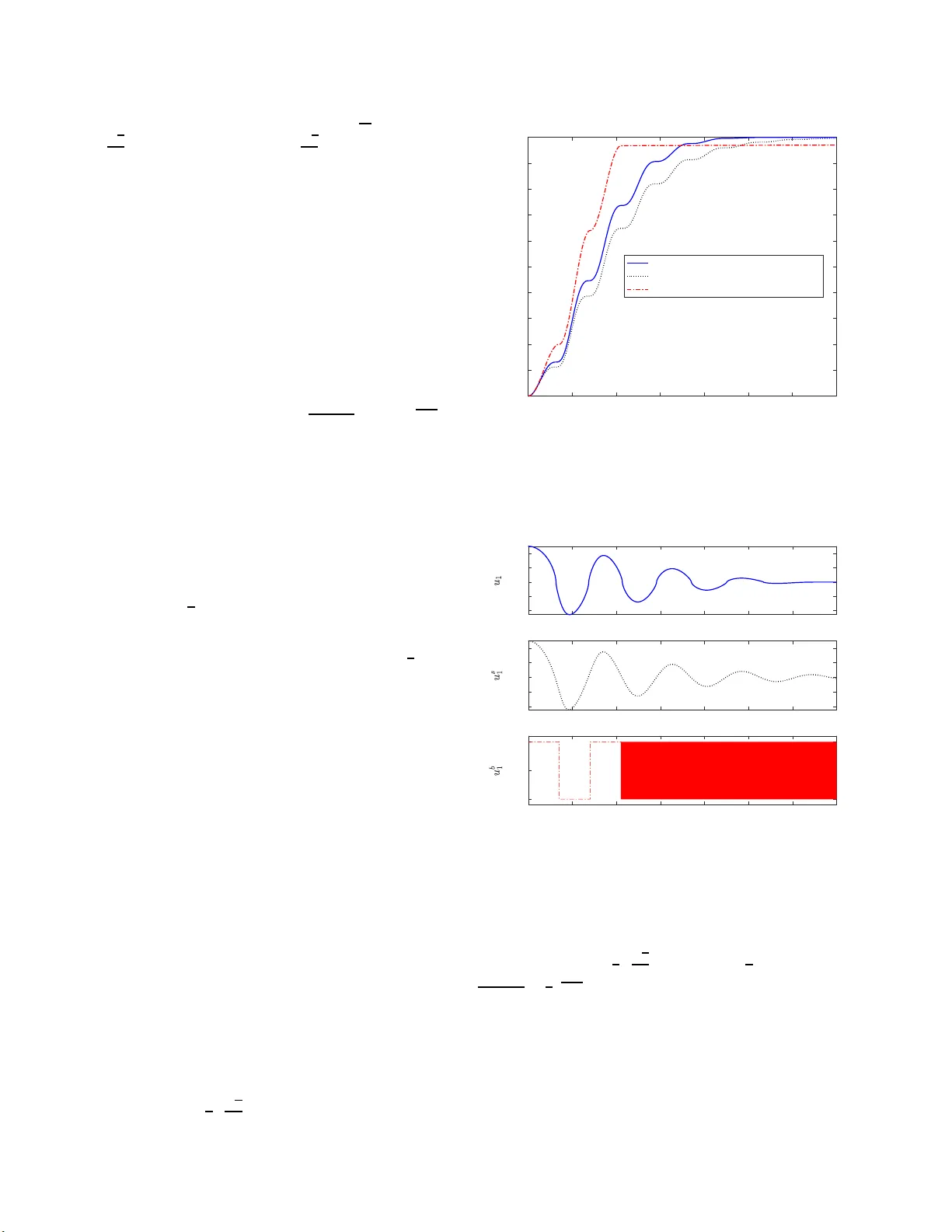
Finite-time stabilizatio n con trol of quan tum systems ⋆ Sen Kua ng a , Xi aoke Guan a , Dao yi Dong b a Dep art ment of Aut omation, University of Scienc e and T e chnolo gy of China, Hefei 230027, PR China b Scho ol of Engine ering and Inf ormation T e chnolo gy, University of New South Wales, Canb err a ACT 2600, Austr alia Abstract The finite-time control problem of quantum systems is inv estigated in this pap er. W e first define finite-t ime stability and present a fin ite-time Lyapunov stability criterion for finite-d imensional quantum systems in coherence vector rep resentation. Then, for tw o-lev el quantum systems, we design a contin uous non-smo oth control la w with a state-dep endent fractional p ow er and prov e the uniqu en ess of solutions of the system dyn amics with the control ler v ia th e concept of transversalit y . By combining the finite-time Lyapunov stabilit y criterion with the homogeneit y t h eory , the finite-time conv ergence of the system t o an eigenstate of its internal H amiltonian is prov ed. Numerical results on a spin-1/2 system demonstrate t he effectiveness of the prop osed fin ite-time stabilization control scheme. Key wor ds: quantum systems, finite- t ime stabilit y , contin uous non- smooth control, q uantum control, fi nite-time conv ergence 1 In tro duction Quantum co n trol has b een a fundamental tas k in the developmen t of qua n tum science and technology . Many classical control a nd optimization metho ds hav e b een applied to qua n tum systems, e.g., optimal control [1,2], Lyapuno v control [3 ,4,5,6,7], sliding mo de control [8,9], H ∞ control [10,11], fault-tolera nt c o ntrol and filtering [12,13], and learning control [14,15]. In q ua nt um co nt rol, a re lev ant ob jective is achieving finite-time co n trol, that is, a desir ed tar g et state is ex actly r e a ched under the ac- tion of control fields within a finite time. Since finite-time control ca n demonstra te hig h c o ntrol accur acy , fast con- vergence, a nd s trong ro bustness to v arious uncer tainties [16], it is of par ticular relev ance for the developmen t of high-precisio n information pro cess ing, quantum metro l- ogy , quantum navigation, quantum sensing a nd quan- tum ra dar. There hav e b een several existing appro aches that can b e used for finite-time control of quantum systems, e.g., π - ⋆ This work was sup p orted in part by the National Natural Science F ound ation of China under Grant 6187325 1, Gran t 6182830 3, and Grant 61773370, and in p art by the Australian Researc h Council’s Disco very Pro je cts F un ding Scheme Un- der Pro ject DP190101566. Email addr esses: skuang@ustc.edu.cn (Sen Kuang), zerogxk@ma il.ustc.edu.c n (Xiaoke Guan) , daoyidong@ gmail.com (D ao yi Dong). pulse metho ds [17], metho ds ba s ed on Lie gr oup decom- po sition [18,19], and optimal co n trol metho ds [2 0,21]. These metho ds can a chieve go o d p erfor mance fo r some problems but they also hav e their own weaknesses. F or example, π pulses generally are extremely sensitive to pulse areas. The Lie group decomp osition a pproach can be used to constructively obtain s imple co ntrol puls e s such as square-wav e pulses or Ga ussian wa v epack ets. How ev er, it may b e difficult to deco mpo se a des ired uni- tary op era tor in many pra ctical applications and to gen- eralize the approach to op en systems. Optimal control metho ds often suffer from complex n umerical or analy ti- cal computing [20]. F or instance, in time optimal control metho ds [21], the switching time of bang-bang control needs to b e exa ctly determined, which is o ften a difficult task. In this pap er, we aim to develop an effective finite- time control metho d that is exp ected to easily desig n and implement. In our finite-time control metho d, a non-smo oth control law will b e designed. Gener ally , non-smo o th co n trol ca n complete more complex co nt rol tasks than smo oth con- trol. F or example, to br eak symmetric top olog y of the state space and achiev e desir ed global stabilization, sev- eral switching control approaches base d on state spa ce partition were prop osed for op en qua n tum sy s tems un- der contin uous mea surement in [22], [23] and [24]. Con- sidering feedback delay , Ge et al. [2 5] des ig ned a time delay switching controller to comp ensate for the control- computation time. T o deal with the uncer tainties in the Preprint submitted to Automatica 27 May 2020 system Hamiltonian, tw o sliding mo de control schemes based o n unitary control and p er io dic pro jective mea- surements were pro po sed for qua ntum systems in [8] and [9]. Ref. [6] prop osed t wo switching Lyapunov control a p- proaches to achieve rapidly conv ergent control for tw o- level qua nt um systems. It sho uld b e po inted out that these control laws b elong to discontin uous non-smo o th control. In pra c tica l a pplications, they may ca use chat- tering and cannot induce finite-time conv ergence to the target state. Althoug h a co n tinuous non-smo oth con- trol law in saturation for m w as also designed for tw o- level sy s tems in [23], the finite-time convergence was not conside r ed. Ref. [26] in vestigated the finite-time sta- bilization problem of multip artite en tangled states for discrete-time Markovian dynamics by dissipa tive q ua n- tum circuits and pr esented several co nditio ns for finite- time stabiliza tion and robust finite-time stabilization. In classical control, there ha ve bee n several well- established methods for the design of contin uous non- smo oth finite-time controllers, which t ypically include the adding-a -p ow er-integrator technology [27,28], finite- time homogeneity metho ds [2 9], and contin uous nonsin- gular ter minal sliding mo de co nt rol [30,31]. Among these metho ds, the finite-time Lyapuno v stability theory and finite-time ho mogeneity theor y for m theoretica l bases for the analysis a nd synthesis of the finite-time control problem. Here we will pr esent a finite-time Lyapunov stability cr iterion for finite-dimensiona l closed qua n tum systems a nd design a contin uous non-s mo oth control law for tw o-level q uantu m s y stems to achiev e finite-time conv ergence to the tar get state. It is worth mentioning that the control law in this pa per is designed in a feed- back way and s hould b e implemen ted in an o pen- lo op wa y since measurement is not inv olved in the controller design, just like mos t existing work on Lyapunov con- trol o f quantum systems (also see [3]-[7]). Compare d with exis ting metho ds of finite-time control o f qua n tum systems, our metho d has the following adv antages: (i) it may avoid complicated numerical computing in design, (ii) it ma y avoid po ten tial c hattering due to contin u- it y , and (iii) it can be gener alized to high- dimensional or op en q uantu m systems. In view of the fact that the contin uous no n-smo oth control system may not satisfy the Lipschitz co nt inuit y condition at some p oints, we demonstrate the uniqueness of solutions of the system dynamics via the concept o f trans versality , which has bee n use d, e.g ., in [32]. Readers can r e fer to [33] and [34] for other metho ds to show the existence and uniqueness of s o lutions for general non- smo oth systems. The main co ntributions of this pap er ar e summarized as follows. First, finite-time stability a nd a finite-time Lyapuno v stability cr iter ion ar e presented for finite- dimensional quantum systems. Second, we prop ose a contin uous non-smo oth co nt rol law with a s ta te- depe ndent fractional power fo r t wo-lev el qua nt um sys- tems via the Lyapunov metho d, which enables the rapid finite-time conv ergence of the system. Third, we prov e the uniquene s s of solutions of the system dynamics with the des igned finite-time controller using the transversal- it y condition. Finally , the finite-time Lyapuno v stability criterion and the homogeneity theory a re simultane- ously used to prov e the finite-time stabilit y of the co n- trolled quantum system, i.e., the tar get state is reached within a finite time. This pa per is or ganized as follows. Section 2 intro duces the quantum co ntrol system and pres e nts the definition of finite-time stability for quantum systems and a Lya- punov cr iterion for finite-time stability . In Sec tio n 3 , we design a contin uous no n-smo oth controller for t wo-level quantum sys tems v ia the Lyapuno v metho d and prov e the uniqueness of solutions of the control system. The finite-time conv ergence of the system to the target sta te is proved in Section 4. Section 5 presents n umerical re- sults to demons trate the effectiveness of the prop o s ed finite-time control scheme. Conclus ions are pres ent ed in Section 6. Notation. L et R + be the set o f non- ne g ative real num- ber s, ∇ b e a vector differ en tial op erator , h , i denote an inner pro duct op era tion, and [ A, B ] denote the commu- tator b etw een A and B . The tw o s tate vectors | ψ 1 i and | ψ 2 i satisfying | ψ 1 i = e iφ | ψ 2 i , φ ∈ [0 , 2 π ) are said to b e equiv a lent , and the set of all s ta te vectors equiv alent to | ψ i forms the equiv alence cla s s of | ψ i . In physics, equiv- alent state vectors have the sa me observ ation mea ning, and therefor e can b e r egarded as the sa me state. 2 Finite-tim e s tability of quan tum systems 2.1 Basic c onc epts of finite-time stability F or an n -dimensional clos ed quantum system, its state can be represe nted by a unit column vector | ψ i in the Hilber t space defined on C n and its dynamics ob ey the Schr¨ odinger equatio n | ˙ ψ ( t ) i = − i ~ H | ψ ( t ) i = − i ~ H 0 + r X k =1 H k u k | ψ ( t ) i , (1 ) where H 0 and H k are the in ternal and control Ha milto- nians o f the system, resp ectively , ~ is the r educed Pla nck constant (set a s ~ = 1 in this pa per ), a nd u k is an exter - nal control field to b e designed. In coher ence v ector representation, the quantum s tate | ψ i c an b e written into | ψ ih ψ | = ξ 0 σ 0 + 1 2 n 2 − 1 X κ =1 ξ κ σ κ = I n n + 1 2 n 2 − 1 X κ =1 ξ κ σ κ , (2) where { σ κ } n 2 − 1 κ =0 is an orthog onal basis o f the n × n complex Hermitian matrix s pa ce, σ 0 = I n √ n , and 2 ξ 0 = 1 √ n . The r eal vector [ ξ 1 , . . . , ξ n 2 − 1 ] T , s = [ h ψ | σ 1 | ψ i , . . . , h ψ | σ n 2 − 1 | ψ i ] T ∈ R n 2 − 1 is called the co- herence vector of | ψ i in the ba sis { σ κ } n 2 − 1 κ =0 . The set of a ll coherence vectors for ms the Blo ch space B ( R n 2 − 1 ) [35]. F or simplicity , we only co nsider the ca se o f o ne c o nt rol field. In this case, quantum system (1) can b e wr itten a s [4] ˙ s ( t ) = ( A 0 + u 1 A 1 ) s ( t ) , (3) where the ( m, n )th elemen ts of A 0 and A 1 are A 0 ( m, n ) = tr( iH 0 [ σ m , σ n ]) , (4) A 1 ( m, n ) = tr( iH 1 [ σ m , σ n ]) . (5) Assume that the control law u 1 in (3) is a contin uous function of the state s . Thus, system (3) can be written as ˙ s ( t ) = f ( s ( t )) , s ( t ) ∈ B ( R n 2 − 1 ) (6) where f : B ( R n 2 − 1 ) → B ( R n 2 − 1 ) is a co n tinuous func- tion defined on B ( R n 2 − 1 ). T o illustrate the concept of finite-time sta bilit y , we as - sume that initia l time t = 0 and quantum system (6) has a unique solution in B ( R n 2 − 1 ) for any initial vec- tor s 0 ∈ B ( R n 2 − 1 ). W e denote this solution as s ( t ) or s ( t, s 0 ), ( t ≥ 0). No w, we give the definition of finite- time stability for quantum system (6). Definition 1 F or qu antum system (6), the tar get ve c- tor s f is said t o b e finite-time stable if for an arbitr ar- ily given initial ve ctor s 0 ∈ B ( R n 2 − 1 ) , ther e exists a c ont inuous function T ( s 0 ) : B ( R n 2 − 1 ) → [0 , ∞ ) such that the unique s olution s ( t, s 0 ) of s ystem (6) satisfies lim t → T ( s 0 ) s ( t, s 0 ) = s f and s ( t, s 0 ) = s f for t ≥ T ( s 0 ) . T ( s 0 ) is c al le d the settling time asso ciate d with s 0 . Here we consider an example to illustrate the definition of finite-time stability . Example 2 Consider the sc alar differ ential e quation ˙ y ( t ) = − k sign ( y ( t )) | y ( t ) | α , (7) wher e sign(0) = 0 , k > 0 , and α ∈ (0 , 1 ) . Sinc e the right-hand side of (7) is c ontinuous everywher e and the lo c al Lipschitz c onditio n is always satisfie d out- side the origin, system (7) has a u nique solut ion for any initial c ondition y 0 ∈ R . By dir e ct inte gr ation, the solu- tion of system ( 7) c an b e obtaine d as µ ( t, y 0 ) = sign( y 0 ) | y 0 | 1 − α − k (1 − α ) t 1 1 − α , t < | y 0 | 1 − α k (1 − α ) , y 0 6 = 0 0 , t ≥ | y 0 | 1 − α k (1 − α ) , y 0 6 = 0 0 , t ≥ 0 , y 0 = 0 . (8) It is known fr om (8) that t he settling-t ime function is T ( y 0 ) = 1 k (1 − α ) | y 0 | 1 − α . The Lyapunov function V ( y ) = y 2 c an b e u se d to pr ove that the origin of system (7) is glob al ly fin ite-time stable. H er e, we omit the pr o of for br evity. 2.2 Lyapunov t he or em for finite-time st ability W e first g ive a compar is on lemma [3 6]. Lemma 3 L et V b e a Lyapunov function define d on R + × B ( R n 2 − 1 ) and assume t hat ˙ V E ( t, m ) ≤ γ ( t, V ( t, m )) holds, wher e ( t, m ) ∈ R + × B ( R n 2 − 1 ) , E denotes the dif- fer ent ial e quation ˙ x = F ( t, x ) , ˙ V E ( t, m ) r epr esent s the time derivative of t he Lyapunov function V along the tr a- je ctories of E , and γ : R + × R → R is a c ontinuous func- tion. F urt her, assume that the initial value pr oblem ˙ m = γ ( t, m ) with m ( t 0 ) = m 0 has a unique solution m ( t, m 0 ) in the int erval [ t 0 , T ) , wher e 0 ≤ t 0 < T ≤ + ∞ . L et x ( t ) , t ∈ [ t 0 , T ) b e a solution of E with V ( t 0 , x ( t 0 )) ≤ m 0 . Then, V ( t, x ( t )) ≤ m ( t, m 0 ) holds for every t ∈ [ t 0 , T ) . Based o n L e mma 3, we have the following finite-time stability theor em for quantum system (6). Theorem 4 F or quantum system (6), supp ose that s f is the tar get ve ctor and ther e exist s a c ontinuously differ en- tiable function V : B ( R n 2 − 1 ) → R such that t he fol lo w- ing c onditions hold: (i) V is p ositive definite; (ii) F or s 0 ∈ B ( R n 2 − 1 ) , ther e exist two p ositive r e al num- b ers c > 0 and α ∈ (0 , 1) su ch that ˙ V ( s ( t, s 0 )) + c ( V ( s ( t, s 0 ))) α ≤ 0 . (9) Then, system ( 6) is fi nite-time st able, that is, it c onver ges to the t ar get ve ctor s f within a fi nite time. The set tling time fun ct ion T ( s 0 ) satisfies T ( s 0 ) ≤ 1 c (1 − α ) V ( s 0 ) 1 − α . (10) pro of. Considering (7) in Example 2 a nd le tting y ( t ) = V ( s ( t, s 0 )) and k = c , we hav e ˙ V ( s ( t, s 0 )) = − c ( V ( s ( t, s 0 ))) α . (11) F or t ∈ R + and s 0 ∈ B R n 2 − 1 , a pplying Lemma 3 to the differential inequality (9) a nd the sca lar differe n tial equation (11 ) yields V ( s ( t, s 0 )) ≤ µ ( t, V ( s 0 )) , (12) 3 where µ can b e wr itten as µ ( t, V ( s 0 )) = [ V ( s 0 ) 1 − α − c (1 − α ) t ] 1 1 − α , t < V ( s 0 ) 1 − α c (1 − α ) , s 0 6 = s f 0 , t ≥ V ( s 0 ) 1 − α c (1 − α ) , s 0 6 = s f 0 , t ≥ 0 , s 0 = s f . (13) Equation (1 3) means that the right-hand side o f (12) v anis hes when t ≥ 1 c (1 − α ) ( V ( s 0 )) 1 − α and therefore V ( s ( t, s 0 )) = 0, that is, s ( t, s 0 ) = s f . (14) Since s ( t, s 0 ) is contin uous, inf { t ∈ R + : s ( t, s 0 ) = s f } > 0 for s 0 ∈ B ( R n 2 − 1 ) \ s f and inf { t ∈ R + : s ( t, s 0 ) = s f } < ∞ for s 0 ∈ B ( R n 2 − 1 ). Le t T ( s 0 ) , inf { t ∈ R + : s ( t, s 0 ) = s f } . According to Definition 1, system (6) is finite-time stable to the target vector s f . F ro m (12 )-(14), it is clear that (1 0) holds. Theorem 4 is a Lyapunov criterion for the finite-time stability of quantum s ystem (6). The homoge neity the- ory also can be used to determine finite-time stability . Several results re lated to homogeneity are lis ted in the Appendix. W e will use Theo rem 4 a nd the homo gene- it y theory to prov e the finite-time stability of tw o-level quantum s ystems in Section 4. 3 Finite-tim e con troller design for tw o-lev el quan tum systems A tw o-level qua nt um system can act as a basic infor- mation unit in qua n tum informatio n pro cessing . In this section, for t wo-lev el quantum sy stems with only one control field, we desig n the control law u 1 in (1) via the Lyapuno v metho d to r ealize finite-time conv ergence of the sys tem to an e ig enstate | ψ f i of H 0 . W e assume that the internal and control Hamiltonia ns in this case are g iven as H 0 = " 1 0 0 − 1 # , H 1 = " 0 − i i 0 # . (15) Denote the e igenstates of H 0 as | 0 i = [1 , 0] T and | 1 i = [0 , 1] T and a ssume that the ta rget sta te is | ψ f i = | 1 i . W e use the following Lyapunov function [3 7] V = 1 − |h ψ f | ψ i| 2 . (16) Its first-o r der time deriv ativ e ca n b e c a lculated as ˙ V = − 2 u 1 |h ψ | ψ f i|ℑ e i ∠ h ψ | ψ f i h ψ f | H 1 | ψ i , (17) where we define ∠ h ψ | ψ f i = 0 when h ψ f | ψ i = 0. T o guarantee ˙ V ≤ 0, we desig n a cont inuous non-smo oth control law with a fra ctional p ow er as u 1 = K sig n ( φ α ( | ψ i )) | φ α ( | ψ i ) | α (18) with K > 0, φ α ( | ψ i ) = ℑ e i ∠ h ψ | ψ f i h ψ f | H 1 | ψ i , and α ∈ (0 , 1). W e apply the ho mo geneity cr iter ion for finite-time sta- bilit y (s e e L e mma 15 in the App endix) to prove that the controller in (18 ) ca n achieve the finite-time stabiliza - tion o f sy stem (1). T o this end, we ne e d to ca lculate the degree of homogeneity of the sys tem. B y expressing a complex n umber in its exp onential form, the co nt rolle d quantum state can b e wr itten as | ψ i = [ x 1 , x 2 ] T = r 1 e iφ a | 0 i + r 2 e iφ b | 1 i , (19) where r 1 , r 2 ∈ [0 , 1] and r 2 1 + r 2 2 = 1. The difference φ b − φ a , φ of the g lobal phase factors e iφ a and e iφ b is called the relative phase of | ψ i . W e also define the phase of x j to b e 0 whe n x j = 0 ( j = 1 , 2). With (19), (16)-(18 ) can b e written as V = 1 − |h ψ f | ψ i| 2 = r 2 1 , (20) ˙ V = − 2 K r 2 | r 1 cos φ | α +1 , (21) u 1 = K sig n ( r 1 cos φ ) | r 1 cos φ | α . (22) According to (21), ˙ V = 0 implies r 2 = 0 or r 1 = 0 or cos φ = 0. When r 2 = 0 and cos φ 6 = 0, the sy s tem is in an equiv a lence class of | 0 i = [1 , 0] T . In this cas e , it follows from (22) that u 1 6 = 0 a nd therefo re the system state is transferring tow ards the ta rget state | ψ f i . When r 1 = 0, the system is in the equiv alence cla ss of | ψ i = | ψ f i . In this case, it follows from (20)-(22) that V = 0, ˙ V = 0, and u 1 = 0. Considering the p o sitive definiteness of V and the neg ative definitenes s of ˙ V , we know that the system will b e sta bilized in the e q uiv alence class of the target state. F or co s φ = 0 and r 1 6 = 0, we deno te the quantum state sa tisfying these tw o conditio ns as | ψ q i and the cor resp onding moment as t q . Although u 1 ( t q ) = 0 holds in this cas e, the rela tive phase φ will co n tinue evolving under the int ernal Hamiltonian. This means that there exists t 1 > t q such that cos φ ( t ) 6 = 0 ( t q < t ≤ t 1 ). F ro m (22 ) we know u 1 ( t ) 6 = 0 ( t q < t ≤ t 1 ). Thu s, the s y stem state will keep evolving tow ards the target state | ψ f i and will not remain a t | ψ q i forever. That is, all moments t q form a zer o-measure set. Hence, the s tate | ψ q i a nd the moment t q do not change the stability pro per ty of the c o nt rolled sy stem. 4 z x y I T | ۧ 0 | ۧ 1 0 s Fig. 1. The Blo ch vector of a tw o-level quantum system. The system (1 ) with the controller (22) do es not satisfy the Lipschitz contin uit y co ndition at some p oints. Here, we show the existence a nd uniqueness of s olutions to tw o- level qua nt um sy s tems consider ing a sufficient condition [32]. Theorem 5 Under the action of the c ontr ol ler ( 22), t he two-level quantum system (1) with the Hamiltonians as shown in (15) has a unique c ont inu ously differ entiable solution for every initial s tate. pro of. The Blo ch vector of a tw o-level quantum s y stem can b e repres ent ed by s = (sin θ co s φ, sin θ sin φ, cos θ ) in the Blo ch spherica l co or dinate frame (se e Fig . 1 ). Ac- cordingly , the system s tate ca n b e written as | ψ ( θ , φ ) i = cos θ 2 , e iφ sin θ 2 T , (23) where θ ∈ [0 , π ] a nd φ ∈ [0 , 2 π ) [38]. The relative phase φ of | ψ i is the angle b etw een the pr o jection of s on the x − y plane and the p os itive x − axis, and θ is the a ngle betw een s and the pos itive z − axis. F or an initial state outside the s et O = {| ψ i : cos φ = 0 , r 1 6 = 0 } , the vector field of system (1) with the con- troller (22) is Lipschitz everywhere and there fo re system (1) has a unique s olution. In par ticular, whe n the ini- tial state satisfies r 1 = 0, the Lyapunov stability theo - rem guara nt ees that the system state always stays in the equiv a lence class o f | ψ f i , i.e., system (1) ha s a unique solution. Next, we discuss the case when the initial s ta te is in O . In this case, all quantum s ta tes s atisfying cos φ = 0 and r 1 6 = 0 form a longitude circle with φ = π 2 and 3 π 2 . F or each quantum state | ψ q i in O , ther e exists t 1 such that the rela tive phase φ changes from φ ( t q ) = π 2 + pπ to φ ( t ) 6 = π 2 + pπ ( p = 0 , 1) in ( t q , t 1 ]. In the Blo ch sphere, the system tra jectory intersects the lo ngitude circle with φ = π 2 and 3 π 2 in a non-overlap a nd non-tangent way in [ t q , t 1 ], i.e., the vector field of the tw o-level system (1) is tr ansversal to the no n- Lipschitz set O . Hence, the system (1) in this case has a unique solution for every initial co ndition in O [3 2]. Remark 6 The c onc ept of tr ansversality is involve d in the pr o of of The or em 5, which is a description on how two obje cts interse ct. F or two int erse ct ing curves, if they ar e not tangent , then they ar e said to b e tr ansversal e ach other. R e aders c an r efer to [39] for mor e gener al c onc epts and criteria for tr ansversality. 4 Analysis of finite-time stabili t y of t w o-level quan tum con trol s ystems F or tw o-level q uantum systems, w e have the fo llowing finite-time sta bility theor em. Theorem 7 Under the action of the c ontr ol ler (22), the system (1) with the H amiltonians in (15) is glob al ly finite-time st able, that is, the system wil l b e stabilize d in the e quivalenc e class of the tar get st ate | ψ f i = | 1 i within a finite time. pro of. With (19), s ystem (1) can be written as " ˙ r 1 e iφ a + i r 1 e iφ a ˙ φ a ˙ r 2 e iφ b + i r 2 e iφ b ˙ φ b # = − i " r 1 e iφ a − r 2 e iφ b # − i u 1 " − ir 2 e iφ b ir 1 e iφ a # , (24) which is equiv alen t to the following rela tion ˙ r 1 = − u 1 r 2 cos φ = − K r α 1 r 2 | co s φ | α +1 , r 1 ˙ φ a = − r 1 − u 1 r 2 sin φ = − r 1 − K r α 1 r 2 | co s φ | α sin φ, ˙ r 2 = − u 1 r 1 cos φ = K | r 1 cos φ | α +1 , r 2 ˙ φ b = r 2 − u 1 r 1 sin φ = r 2 − K r α +1 1 | co s φ | α sin φ. (25) Theorem 5 implies that system (2 5 ) also has a unique solution. Therefor e, | co s φ | α +1 in (2 5 ) can b e regar ded as a function of t , denoted as g ( t ). Thus, we hav e ( ˙ r 1 = − K r α 1 r 2 g ( t ) , ˙ r 2 = K r α +1 1 g ( t ) . (26) The ob jective is to s tabilize the state [ r 1 , r 2 ] T of sys- tem (2 6) to the target p oint [0 , 1] T from the initial p oint [ r 1 (0) , r 2 (0)] T . Since r 2 1 + r 2 2 = 1, we o nly need to con- sider whether the controlled v ar iable r 1 defined o n R + can b e sta bilized to the origin 0 from the initial p oint r 1 (0). E xpressing r 2 with r 1 , we hav e r 2 = 1 − r 2 1 1 2 = 1 − ∞ X j =1 C j 2 j 2 2 j × (2 j − 1) r 2 j 1 . (27) Substituting (27 ) into the first equa tion of (26) gives ˙ r 1 = − K r α 1 g ( t ) + ∞ X j =1 C j 2 j r 2 j 1 K r α 1 g ( t ) 2 2 j × (2 j − 1) . (28) 5 F or conv enience of analysis, w e wr ite (28) as ˙ r 1 = f ( r 1 ) = p 0 ( r 1 ) + ∞ X j =1 p j ( r 1 ) = ∞ X j =0 p j ( r 1 ) , (29) where p 0 ( r 1 ) = − K r α 1 g ( t ) and p j ( r 1 ) = C j 2 j K r α +2 j 1 g ( t ) 2 2 j × (2 j − 1) ( j ≥ 1 ). In what follows, we prove that system (29) is finite-time stable. The pro of can b e divided in to tw o steps. Step 1 The s ystem defined by ˙ r 1 = p 0 ( r 1 ) (30) is finite-time stable. Step 2 The s ystem (2 9) is globally finite-time sta ble. Pro of of Step 1. Accor ding to L e mma 15 in the Ap- pendix , to pr ove the finite-time s tability of s ystem (30), we o nly need to verify tha t s ystem (30) is asymptotically stable and has a neg ative degree of ho mogeneity . Asymptotic stability. F or the Lyapunov function V ( r 1 ) = r 2 1 , we calculate its Lie deriv ativ e along the tra jectory of system (30) and hav e L p 0 V ( r 1 ) = h∇ V ( r 1 ) , p 0 ( r 1 ) i = 2 r 1 p 0 ( r 1 ) = − 2 K r α +1 1 g ( t ) . (31) F ro m (3 1 ), the Ly apunov function V ( r 1 ) is non- increasing and L p 0 V ( r 1 ) is b ounded. The fa c t that L p 0 V ( r 1 ) is b ounded implies that L p 0 V ( r 1 ) is unifor mly contin uous, and therefo re the Barbalat’s lemma [36] guarantees that L p 0 V ( r 1 ) → 0 as t → ∞ . Consider - ing g ( t ) > 0, we have r 1 → 0, that is, system (30) is asymptotically stable. Ne gative de gr e e of homo geneity. According to Definition 12 in the App endix, when 0 < α < 1 a nd the dila tion is taken as δ 1 ε , the vector field p 0 ( r 1 ) sa tisfies p 0 ( εr 1 ) = ε α p 0 ( r 1 ) = ε 1+( α − 1) p 0 ( r 1 ) . (32) Therefore, the degree of homogeneity of the vector fie ld p 0 ( r 1 ) with r esp ect to the dilation δ 1 ε is k 0 = α − 1 < 0 . It follows from Lemma 15 in the App endix that the orig in of s y stem (30) is finite-time stable. Pro of of Step 2. F or j = 1 , 2 , 3 , . . . , we calculate the degree of homo geneity of the vector field p j ( r 1 ) in (29 ) with re s pec t to the dilation δ 1 ε and k j . W e hav e p j ( εr 1 ) = C j 2 j 2 2 j × (2 j − 1) K ε α +2 j r α +2 j 1 g ( t ) = ε 1+( α +2 j − 1) p j ( r 1 ) = ε 1+ k j p j ( r 1 ) . (33) That is, k j = α + 2 j − 1 ( j = 1 , 2 , 3 , . . . ). Note that the deg ree of homogeneity o f V ( r 1 ) with re- sp ect to the dilatio n δ 1 ε is l 1 = 2, h∇ V ( r 1 ) , p j ( r 1 ) i ( j = 0 , 1 , 2 , . . . ) is co nt inuous and its degre e of homo geneity with r esp ect to δ 1 ε is l 1 + k j . W e take V 1 = V ( r 1 ) a nd V 2 = h∇ V ( r 1 ) , p j ( r 1 ) i for Lemma 1 4 in the App endix. Since l 1 = 2 > 0 and l 2 = l 1 + k j = α + 2 j + 1 > 0, Lemma 14 implies h∇ V ( r 1 ) , p j ( r 1 ) i ≤ − c j V ( r 1 ) α +2 j + 1 2 , (34) where c j = − max { r 1 : V ( r 1 )=1 } h∇ V ( r 1 ) , p j ( r 1 ) i ∈ R ( j = 0 , 1 , 2 , . . . ). Thus, h∇ V ( r 1 ) , f ( r 1 ) i ≤ − c 0 V ( r 1 ) α +1 2 − · · · − c j V ( r 1 ) α +2 j + 1 2 − · · · = V ( r 1 ) α +1 2 − c 0 + U ( r 1 ) , (35) where U ( r 1 ) , − c 1 V ( r 1 ) 2 2 − · · · − c j V ( r 1 ) 2 j 2 − · · · . Since 2 j 2 > 0 for j ≥ 1, U ( r 1 ) is a contin uous function with U (0 ) = 0 . Now, we s how that (35) satisfies the co ndition in (9). Assume that there exists an o pen neighbor ho o d V of the origin such that U ( r 1 ) < c 0 2 holds for a ny r 1 ∈ V . Then, (35) can b e written a s h∇ V ( r 1 ) , f ( r 1 ) i < − c 0 2 V ( r 1 ) α +1 2 , (36) where c 0 > 0 and α +1 2 ∈ (0 , 1). Thus, the condition (9) in Theorem 4 is satisfied. In view of the p os itive definiteness of V ( r 1 ), Theorem 4 gua r antees that the or igin is a finite- time stable equilibrium po int of system (29). Next, we verify the existence of the o pen neighbor ho o d V , that is, there exist r 1 such tha t U ( r 1 ) < c 0 2 holds. C o n- sidering that c j = − max { r 1 : V ( r 1 )=1 } h∇ V ( r 1 ) , p j ( r 1 ) i ( j = 0 , 1 , 2 , . . . ) and r 1 = 1 holds whe n V ( r 1 ) = 1 , we calculate c 0 and c j ( j ≥ 1 ) as c 0 = −h∇ V ( r 1 ) , p 0 ( r 1 ) i = 2 K g ( t ) , (37) c j = −h∇ V ( r 1 ) , p j ( r 1 ) i = − 2 K C j 2 j g ( t ) 2 2 j × (2 j − 1) . (38) It follows from (38) that U ( r 1 ) = − c 1 V ( r 1 ) 2 2 − · · · − c j V ( r 1 ) 2 j 2 − · · · = 2 K g ( t ) h 1 2 V ( r 1 ) + · · · + C j 2 j V ( r 1 ) j 2 2 j × (2 j − 1) + · · · i = 2 K g ( t ) 1 − (1 − V ( r 1 )) 1 2 . (39) 6 Substituting (3 9 ) and (37) into U ( r 1 ) < c 0 2 , we have r 1 < √ 3 2 , tha t is , V = { r 1 : r 1 < √ 3 2 } . This shows the existence o f V in (36). F urthermo r e, since a ll moments t q corres p o nding to | ψ q i constitute a zero measur e s et and any other state different from | ψ q i s atisfies ˙ V < 0, r 1 can alwa ys conv erge into V w ithin a finite time for every initial state r 1 (0) / ∈ V . W e ca n conclude that the orig in o f s y stem (29 ) is a globa l finite-time sta ble equilibrium p oint. That is, r 1 can b e stabilized to the or igin within a finite time. E quiv ale ntly , the quantum state is stabilized to the equiv alence class of the targ e t state | ψ f i = | 1 i within a finite time. Remark 8 Ac c or ding to the pr o of of The or em 7, (36) al- ways holds for system (29). F r om The or em 4, the sett ling time function satisfies T ( r 1 (0)) < 4 c 1 (1 − α ) V ( r 1 (0)) 1 − α 2 when r 1 (0) ∈ V . When r 1 (0) / ∈ V , the c alculation of the sett ling time r elies on the system e quation (29), and ther efo r e it is not e asy to give a analytic al b ound for T ( r 1 (0)) . In addition, sinc e c 1 , V ( r 1 (0)) , and α ∈ (0 , 1) ar e b ounde d, T ( r 1 (0)) is also b ounde d although the b ound may vary with α . 5 Numerical exampl e s W e choose a spin- 1 2 system to present numerical results. Spin-1/2 systems hav e wide applications in e.g., quan- tum computation, quant um sens ing and quantum con- trol [4 0]. In sim ulation, w e set K = 0 . 5 and α = 2 3 for the control law in (2 2 ). W e also co nsider simulation re - sults under the standar d Lyapunov control law u s 1 [37] and the s tandard bang-bang Lyapunov control law u b 1 [6] for compar ison, where u s 1 and u b 1 are u s 1 = K ℑ e i ∠ h ψ | ψ f i h ψ f | H 1 | ψ i , (40) u b 1 = K sig n ℑ e i ∠ h ψ | ψ f i h ψ f | H 1 | ψ i . (41) W e choose the initial state a s | ψ (0) i = | 0 i / ∈ V and K = 0 . 5 for the standard Lyapunov control law u s 1 and the standar d bang- ba ng Lyapunov co nt rol law u b 1 . The simulation r e sults are shown in Fig. 2 and Fig. 3. According to Fig. 2 a nd simu lation data , the settling time asso c ia ted with the initial state | 0 i can b e obtained as t f ≈ 1 1 . 6270 a.u.. At t = 11 . 6 270 a.u., the popula - tions of the targ et state under u s 1 , u b 1 , a nd u 1 are 0.99 02, 0.9699 , and 1 .0 000, resp ectively . It ca n b e seen from Fig. 3 that the control law in this pap er is indeed con- tin uous and non-s mo o th while the standard Lyapunov control is smo oth and the s tandard bang-bang Lyapuno v control is discontin uous with chattering. W e further p erform simulation exp er imen ts fo r the ini- tial state | ψ (0 ) i = [ 1 2 , √ 3 2 ] T ∈ V . The simulation data 0 2 4 6 8 10 12 14 Time (a.u.) 0 0.1 0.2 0.3 0.4 0.5 0.6 0.7 0.8 0.9 1 Population continuous non-smooth control standard Lyapunov control standard bang-bang Lyapunov control Fig. 2. The p opulation evolution of the target state for | ψ (0) i = | 0 i un der t h e contin uous non-smo oth control u 1 , the standard Lyapunov control u s 1 , and th e standard bang-bang Lyapuno v control u b 1 . 0 2 4 6 8 10 12 14 -0.4 -0.2 0 0.2 0.4 0 2 4 6 8 10 12 14 -0.4 -0.2 0 0.2 0.4 0 2 4 6 8 10 12 14 Time (a.u.) -0.5 0 0.5 Fig. 3. The contin uous non-smo oth control u 1 , th e standard Lyapuno v control u s 1 , and the stand ard bang-b ang Lyapunov contro l u b 1 for | ψ (0) i = | 0 i . indicate that the settling time is t f ≈ 7 . 5 a.u.. According to Remark 8, the settling time asso ciated with the ini- tial state | ψ (0) i = [ 1 2 , √ 3 2 ] T satisfies T ( 1 2 ) ≈ 7 . 5 a . u . < 4 c 1 (1 − α ) V ( 1 2 ) 1 − α 2 = 9 . 52 a . u . , which is consistent with the theoretical result. Remark 9 F or the numeric al example in this se ct ion, it fol lows fr om [21] that the minimum tra nsfer time T O fr om | 0 i to | 1 i s atisfies 1 . 9505 < T O < 6 . 165 5 . In the minimum t ime c ontr ol scheme, the c ontr ol law is an opti- mal b ang-b ang c ontr ol and takes the maximal admissible 7 value either 0.5 or -0.5 at e ach m oment during the whole c ont r ol pr o c ess. While in the fin ite-time Lyapunov c on- tr ol scheme, t he c ontr ol law is a c ontinuous non-smo oth c ont r ol and only takes t he maximal admissible amplitude 0.5 at the initial moment. The settling time is longer than the minimum time T O . 6 Conclusion W e inv estigated the finite-time stability and presented a Lyapuno v stability criterio n for finite-dimensional quantum s ystems. A new contin uous non-smo oth con- trol law was pro po sed and the finite-time stabiliza tion tow ards an eigenstate of the in ternal Hamiltonian was achiev ed for tw o-level quantum systems. Ba sed on the transversality co ndition in the Blo c h space, we pr ov ed the uniqueness o f solutions of the system with the co n- tin uous non-smo o th controller. Using the finite-time Lyapuno v stability theory and the homog e ne ity the- orem, we a lso pr ov ed the finite-time sta bilit y of the control system. The effectiveness o f the pr op osed contin- uous non-smo oth control law was illus trated by numer- ical examples. F uture research includes optimizing the parameter α in the co nt roller to achieve an optimal pe r - formance, and extending the finite-time co nt rol scheme to high-dimensio nal quantum sy stems and sto chastic op en qua nt um sys tems with measurement feedba ck. App endix: H omogenei t y theory for fini te -time stability Several concepts and results related to homog eneity ar e listed her e, which can b e found in [29]. Definition 1 0 L et d = ( d 1 , d 2 , . . . , d n − 1 ) b e a set of p ositive r e al numb ers. F or a set of c o or dinates r = ( r 1 , r 2 , . . . , r n − 1 ) in R n − 1 , define the dilation δ d ε of r as the fol lowing c o or dinate ve ctor δ d ε ( r ) = ε d 1 r 1 , . . . , ε d n − 1 r n − 1 , ∀ ε > 0 (42) wher e d j is the weight of the c o or dinate r j . The dilation with d 1 = · · · = d n − 1 = 1 is c al le d a st andar d dilation. Definition 1 1 A function V : R n − 1 → R is said t o b e homo gene ous of de gr e e m ( m ∈ R ) with r esp e ct to δ d ε if V δ d ε ( r ) = ε m V ( r ) , ∀ r ∈ R n − 1 , ∀ ε > 0 . (43) Definition 1 2 A ve ct or field f ( r ) : R n − 1 → R n − 1 with f ( r ) = ( f 1 ( r ) , . . . , f n − 1 ( r )) T is said to b e homo gene ous of de gr e e k ( k ∈ R ) with r esp e ct to δ d ε if for e ach i = 1 , . . . , n − 1 , f j is homo gene ous of de gr e e k + d j , that is, f j δ d ε ( r ) = ε k + d j f j ( r ) , ∀ r ∈ R n − 1 , ∀ ε > 0 . (4 4) Lemma 13 Assu me t hat the fun ction f : R n − 1 → R n − 1 is homo gene ous of de gr e e k ( k ∈ R ) with r esp e ct to δ d ε and the origin is a lo c al ly asymptotic al ly s t able e qu ilibrium p oint. Then, when m > max {− k , 0 } , ther e exists a Lyapunov function V su ch that V and its time derivative ˙ V ar e homo gene ous of de gr e es m and m + k with r esp e ct to δ d ε , r esp e ctively. Lemma 14 L et V 1 and V 2 b e c ontinuous r e al-value d functions define d on R n − 1 and V 1 b e p ositive definit e. Supp ose that V 1 and V 2 ar e homo gene ous of de gr e es l 1 > 0 and l 2 > 0 with r esp e ct to δ d ε , r esp e ctively. Then, for every r ∈ R n − 1 , the fol lowing holds: min { z : V 1 ( z )=1 } V 2 ( z ) V 1 ( r ) l 2 l 1 ≤ V 2 ( r ) ≤ max { z : V 1 ( z )=1 } V 2 ( z ) V 1 ( r ) l 2 l 1 . (45) The following lemma shows the application of the ho - mogeneity theory to finite-time stability . Lemma 15 L et f ( r ) = ( f 1 ( r ) , . . . , f n − 1 ( r ) ) T : R n − 1 → R n − 1 b e a c ontinuous ve ctor fun ction and b e homo- gene ous of de gr e e k ( k ∈ R ) with r esp e ct to δ d ε , wher e d = ( d 1 , d 2 , . . . , d n − 1 ) is a set of p ositive r e al numb ers and ε > 0 . Then, t he origin is a finite- time s t able e qui- librium p oint if and only if it is an asymptotic al ly stable e qu ilibrium p oint and k < 0 . References [1] F. Dolde, V. Bergholm, Y. W ang, I. Jak obi, B. Na ydeno v, S. Pezzagna , J. Meijer, F. Jelezk o, P . Neumann, T. Sch ulte- Herbr ¨ uggen, et al. , “High-fidelity spin en tanglemen t usi ng optimal cont rol,” Natur e Communic ations , vol. 5, p. 3371, 2014. [2] G. Riviell o, R.- B. W u, Q . Sun, and H. Rabitz, “Searc hing for an optimal con trol in the presence of saddles on the quan tum-mec hanical observ able l andscap e,” Physic al R eview A , v ol. 95, p. 063418, Jun 2017. [3] C. Altafini, “F eedbac k stabilization of i sospectral cont rol systems on complex flag manifolds: application to quantum ensem bles,” IEEE T r ansactions on Automa tic Contr ol , v ol. 52, no. 11, pp. 2019–2028, 2007. [4] X. W ang and S. G. Schirmer, “Analysis of Ly apuno v metho d for cont rol of quantum states,” IEEE T r ansactions on Au tomatic c ontr ol , vol. 55, no. 10, pp. 2259–22 70, 2010. [5] S. Zhao, H. Li n, and Z. Xue, “Switc hing con trol of closed quan tum s ystems via the Ly apuno v method,” Au tomatic a , v ol. 48, no. 8, pp. 1833–18 38, 2012. [6] S. Kuang, D. Dong, and I. R . Pe tersen, “Rapid Ly apuno v con trol of finite-dimensional quan tum systems,” Automatic a , v ol. 81, pp. 164–175, 2017. [7] S. Kuang, D. Dong, and I. R. Petersen, “Lyapun ov control of quan tum s ystems based on energy-l evel connectivit y graphs,” IEEE T r ansactions on Contr ol Syst e ms T e chnolo g y , vol. 27, no. 6, pp. 2315–2329 , 2019. 8 [8] D. Dong and I. R. Pet ersen, “Sliding mo de con trol of quan tum systems,” New Journal of Physics , vol. 11, no. 10, p. 105033, 2009. [9] D. Dong and I. R. P etersen, “Sli ding mo de control of tw o- lev el quantum systems,” Autom atic a , vol. 48, no. 5, pp. 725– 735, 2012. [10] M. R. James, H. I. Nurdin, and I. R. Pe tersen, “ H ∞ con trol of li near quantum stochastic systems,” IEEE T r ansactions on A utomatic Contr ol , vol. 53, no. 8, pp. 1787–1803, 2008. [11] C. Xiang, I. R. Pete rsen, and D. Dong, “Coherent robust H ∞ con trol of linear quan tum s ystems with uncertainties in the Hamiltonian and coupling oper ators,” Automatic a , v ol. 81, pp. 8 – 21, 2017. [12] S. W ang and D. Dong, “F ault-tolerant con trol of linear quan tum sto c hastic systems,” IEEE T r ansactions on Au tomatic Contr ol , v ol. 62, pp. 2929–2935 , June 2017. [13] Q. Gao, D. Dong, and I. R. Petersen, “F ault toleran t quan tum filtering and fault detection f or quan tum systems,” Au tomatic a , vo l. 71, pp. 125 – 134, 2016. [14] D. Dong, X. Xing, H. Ma, C. Chen, Z. Liu, and H. Rabitz, “Learning-based quan tum robust con trol: algorithm, applications, and experi men ts,” IEEE T r ansactions on Cyb ernetics , to b e published. [15] M. Y. Niu, S. Boixo, V. N . Smelyanskiy , and H. Nev en, “Unive rsal quan tum con trol through deep reinf orcemen t learning,” npj Quantum Information , vol. 5, no. 1, p. 33, 2019. [16] S. P . B hat and D. S. Bernstein, “Finite-time stability of con tinu ous autonomous systems,” SIAM Journal on Contr ol and O ptimization , vol. 38, no. 3, pp. 751–766, 2000. [17] L. Allen and J. H. Eb erly , Optica l R esonanc e and Two-L evel Atom s . Wiley , 1987. [18] D. D’Alessandro, Intr o duction to Quantum Contr ol and Dynamics . CRC press, 2007. [19] S. G. Schirmer, “Quan tum cont rol usi ng Li e group decompositions,” in Pr o ce e dings of t he 40th IEEE Confer enc e on De cision and Contr ol , vol. 1, pp. 298–303, IEEE, 2001. [20] D. D’ Alessandro and M. Dahleh, “Optimal cont rol of t wo- lev el quant um systems,” IEEE T r ansactions on Autom atic Contr ol , vol. 46, no. 6, pp. 866–876, 2001. [21] U. Boscain and P . Mason, “Tim e minimal tra jectories for a spin 1/2 particle in a magnetic field,” Journal of Mathematic al Physics , vol. 47, no. 6, p. 062101, 2006. [22] M. Mirr ahimi and R. V an Handel, “Stabilizing feedbac k con trols for quantum systems,” SIAM Journal on Contr ol and O ptimization , vol. 46, no. 2, pp. 445–467, 2007. [23] S. S. Ge, T. L. V u, and C. C. H ang, “Non-smo oth Lyapuno v function-based global stabili zation f or quan tum fil ters,” Au tomatic a , vo l. 48, no. 6, pp. 1031–104 4, 2012. [24] Y. Liu, S. Kuang, and S. Cong, “Ly apuno v-based feedbac k preparation of GHZ entang lement of N - qubit systems,” IEEE T r ansactions on Cybernetics , vol. 47, no. 11, pp. 3827–3839, 2016. [25] S. S. Ge, T. L. V u, and T. H . Lee, “Quantu m measuremen t- based f eedbac k cont rol: a nonsmo oth time dela y control approac h,” SIAM Journal on Contr ol and Optimization , v ol. 50, no. 2, pp. 845–863 , 2012. [26] P . D. Johnson, F. Ti cozzi, and L. Viola, “Exact stabilization of en tangled states in finite time b y dissipative quan tum circuits,” Physic al R eview A , vol. 96, no. 1, p. 012308, 2017. [27] X. Huang, W. Lin, and B. Y ang, “Global finite-time stabilization of a class of uncertain nonlinear systems,” Au tomatic a , vo l. 41, no. 5, pp. 881–888, 2005. [28] J. F u, R. Ma, and T. Chai, “Adaptive finite-time s tabilization of a class of uncertain nonlinear systems via logic- based switc hings,” IEEE T r ansactions on A utomatic Contr ol , v ol. 62, no. 11, pp. 5998–6003, 2017. [29] S. P . Bhat and D. S. Bernstein, “Geometric homogeneit y wi th applications to finite-time stability ,” Mathematics of Contr ol, Signals and Syst ems , vol. 17, no. 2, pp. 101–127, 2005. [30] S. Y u, X. Y u, B. Shirinzadeh, and Z. M an, “Con tinuo us finite- time control for r obotic manipulators with terminal slidi ng mode,” Automatic a , vol. 41, no. 11, pp. 1957–196 4, 2005. [31] J. Y ang, S. Li, J. Su, and X. Y u, “Con tinuo us nonsingular terminal sli ding mo de con trol for systems wi th mismatched disturbances,” Automatic a , vol. 49, no. 7, pp. 2287–2291, 2013. [32] M. Kawski, “Stabilization of nonlinear s ystems in the pl ane,” Systems & Contr ol L ette rs , vol. 12, no. 2, pp. 169–175, 1989. [33] A. F. Fi lipp ov , Diffe r e ntial Equations with Disc ontinuous Rightha nd Sides: Contro l Systems , v ol. 18. Springer Science & Busi ness Media, 2013. [34] R. P . Agarwal and V. Lakshmik an tham, Uniqueness and Nonuniqueness Crit eria for Or dinary Differ ential Equations , v ol. 6. W orl d Scien tific Publishing C ompany , 1993. [35] G. Ki mura, “The Bl och v ector f or N - leve l systems,” Physics L etters A , vol. 314, no. 5-6, pp. 339–349, 2003. [36] H. K. Khalil, Nonline ar Systems . New Jersey: Prentice Hall, 2002. [37] S. Cong and S. Kuang, “Quant um cont rol strategy based on state distance,” A cta Autom atic a Sinic a , v ol. 33, no. 1, pp. 28–31, 2007. [38] G. F ano and S. Blinder, Twenty -First Century Quantum Me chanics: Hilb ert Sp ac e to Quantum Computers . Springer, 2017. [39] M. Golubitsky and V. Guill emin, Stable Mappings and Their Singularities , vol. 14. Springer Science & Business Media, 2012. [40] Y. W ang, D. Dong, A. Sone, I. R. Petersen, H. Y onez aw a, and P . Capp ellaro, “Quantum Hamiltonian identifiabilit y via a similari ty transformation approac h and beyond,” IEEE T r ansactions on Automatic Contr ol , to be published. 9
Original Paper
Loading high-quality paper...
Comments & Academic Discussion
Loading comments...
Leave a Comment