Towards a Robust WiFi-based Fall Detection with Adversarial Data Augmentation
Recent WiFi-based fall detection systems have drawn much attention due to their advantages over other sensory systems. Various implementations have achieved impressive progress in performance, thanks to machine learning and deep learning techniques. However, many of such high accuracy systems have low reliability as they fail to achieve robustness in unseen environments. To address that, this paper investigates a method of generalization through adversarial data augmentation. Our results show a slight improvement in deep learning-systems in unseen domains, though the performance is not significant.
💡 Research Summary
The paper addresses the problem of poor generalization of Wi‑Fi‑based fall‑detection systems when deployed in environments that differ from those used for training. While many recent works have achieved high accuracy on the same indoor setting and with the same participants, their performance drops dramatically in unseen domains due to the sensitivity of channel state information (CSI) to layout, objects, and human presence. To improve robustness without requiring data from every possible target domain, the authors adopt an adversarial data‑augmentation (ADA) strategy originally proposed for domain‑generalization tasks.
ADA treats the unknown target distribution as lying within a Wasserstein distance ρ from the source distribution in the semantic space. It repeatedly generates worst‑case synthetic samples that maximize the loss while staying within the ρ‑ball, then trains the model on both original and adversarially perturbed data. By varying ρ and training separate models for each value, an ensemble of models is obtained; at test time the most suitable model is selected.
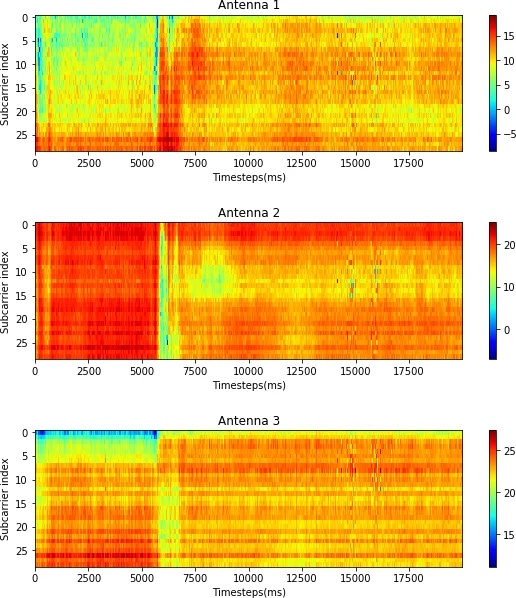
The experimental pipeline starts with raw CSI recordings collected at 1000 Hz. The authors concatenate signals from two antennas, forming 10‑second windows (10 000 × 60) and then down‑sample to 500 × 60 to reduce memory usage while preserving discriminative patterns. A simple six‑layer convolutional neural network (CNN‑ADA) processes these matrices: two convolutional layers (64 and 128 filters, 5 × 5 kernels) each followed by max‑pooling, two fully‑connected layers, and a softmax classifier for binary fall vs. non‑fall decisions.
The method is evaluated on the publicly available FallDeFi dataset, which contains CSI data from multiple subjects and rooms. Training and testing are deliberately split across different rooms and subjects to simulate unseen domains. Results show that adding ADA yields modest improvements: accuracy, precision, and recall each increase by roughly 1–2 percentage points compared with the baseline CNN trained without augmentation. The gain, while statistically measurable, is not large enough to claim a breakthrough in robustness.
The authors discuss several limitations. First, the choice of the Wasserstein radius ρ is heuristic; an automated way to select or adapt ρ could improve performance. Second, only amplitude information is used, whereas phase data—known to correlate with human motion—remains underexploited. Third, the ensemble approach adds inference overhead because the system must evaluate multiple models to pick the best one. Finally, the synthetic perturbations generated by ADA may not fully capture the complex, non‑linear variations introduced by real‑world changes such as furniture rearrangement or multi‑person interference.
Future work is suggested in three directions: (1) integrating meta‑learning or multi‑source domain adaptation to learn a more universal representation, (2) designing richer feature extractors that jointly process amplitude and phase, possibly using hybrid signal‑processing and deep‑learning pipelines, and (3) developing lightweight, real‑time capable architectures that retain the benefits of adversarial augmentation without the computational cost of model ensembles.
In summary, the study demonstrates that adversarial data augmentation can slightly enhance the cross‑domain performance of Wi‑Fi‑based fall detection, but substantial gains in reliability will likely require more sophisticated augmentation strategies, multimodal CSI exploitation, and architecture optimizations.
Comments & Academic Discussion
Loading comments...
Leave a Comment