On Norm-Based Estimations for Domains of Attraction in Nonlinear Time-Delay Systems
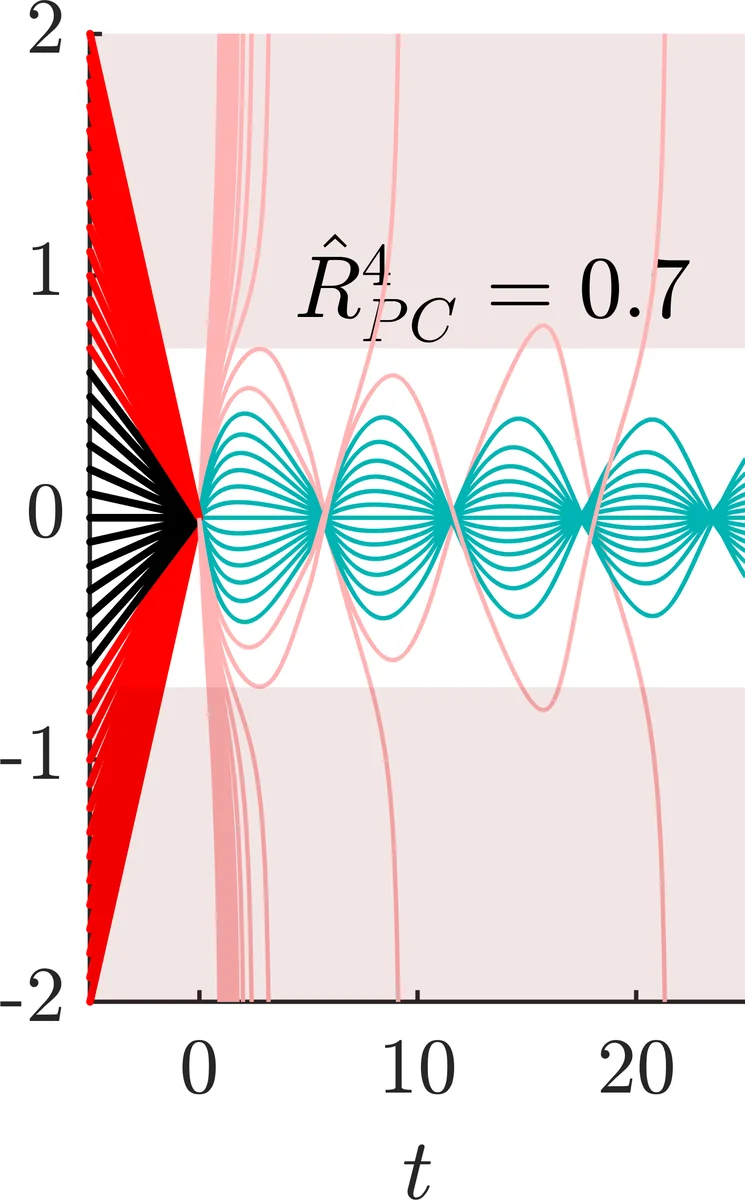
For nonlinear time-delay systems, domains of attraction are rarely studied despite their importance for technological applications. The present paper provides methodological hints for the determination of an upper bound on the radius of attraction by numerical means. Thereby, the respective Banach space for initial functions has to be selected and primary initial functions have to be chosen. The latter are used in time-forward simulations to determine a first upper bound on the radius of attraction. Thereafter, this upper bound is refined by secondary initial functions, which result a posteriori from the preceding simulations. Additionally, a bifurcation analysis should be undertaken. This analysis results in a possible improvement of the previous estimation. An example of a time-delayed swing equation demonstrates the various aspects.
💡 Research Summary
The paper addresses the problem of estimating the domain of attraction (DOA) and its radius for equilibria of nonlinear autonomous retarded functional differential equations (RFDEs) with a single discrete delay. While stability analysis of time‑delay systems is well‑developed for linear models, quantitative information about the size of the basin of attraction for nonlinear systems is rarely available, despite its importance for engineering design and safety assessment.
The authors first formalize the setting: the state of a delay system is a function defined on the interval
Comments & Academic Discussion
Loading comments...
Leave a Comment