Two Disjoint 5-Holes in Point Sets
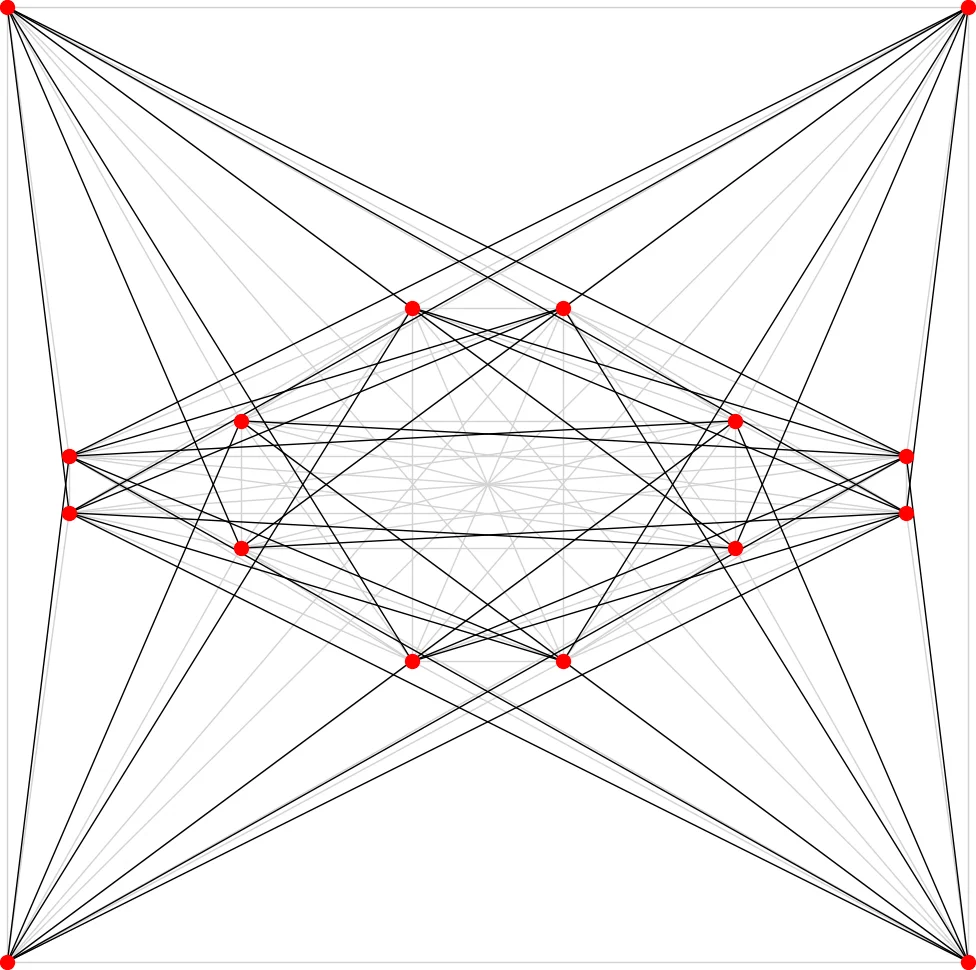
Given a set of points $S \subseteq \mathbb{R}^2$, a subset $X \subseteq S$ with $|X|=k$ is called $k$-gon if all points of $X$ lie on the boundary of the convex hull of $X$, and $k$-hole if, in addition, no point of $S \setminus X$ lies in the convex hull of $X$. We use computer assistance to show that every set of 17 points in general position admits two disjoint 5-holes, that is, holes with disjoint respective convex hulls. This answers a question of Hosono and Urabe (2001). We also provide new bounds for three and more pairwise disjoint holes. In a recent article, Hosono and Urabe (2018) present new results on interior-disjoint holes – a variant, which also has been investigated in the last two decades. Using our program, we show that every set of 15 points contains two interior-disjoint 5-holes. Moreover, our program can be used to verify that every set of 17 points contains a 6-gon within significantly smaller computation time than the original program by Szekeres and Peters (2006). Another independent verification of this result was done by Mari'c (2019).
💡 Research Summary
The paper addresses a long‑standing open problem in combinatorial geometry concerning the existence of multiple disjoint empty convex polygons (k‑holes) in planar point sets. A k‑hole is a set of k points that form the vertices of a convex polygon with no other points of the set inside its convex hull; a k‑gon merely requires the points to lie on the convex hull boundary. While Erdős and Szekeres proved that any sufficiently large set contains a k‑gon, the analogous question for k‑holes is much harder. Harborth showed that every 10‑point set contains a 5‑hole, and Horton constructed arbitrarily large point sets without 7‑holes, leaving the case k≤6 as the main focus.
The authors concentrate on the function h(k₁,…,k_l), the smallest n such that every n‑point set in general position contains pairwise disjoint k_i‑holes for i=1,…,l. Prior work had determined h(k₁,k₂) for all k₁,k₂≤5 except for h(5,5), which was known only to satisfy 17 ≤ h(5,5) ≤ 19. The paper resolves this gap by proving the exact value h(5,5)=17. The proof is computer‑assisted and relies on a novel encoding of point configurations using only triple orientations (the sign of the determinant of three points). This combinatorial representation eliminates the need for explicit coordinates and reduces the problem to a Boolean satisfiability (SAT) instance.
The SAT model encodes the non‑existence of two disjoint 5‑holes in a 17‑point set. Variables represent the orientation of each ordered triple of points; clauses enforce the geometric constraints that define a 5‑hole (cyclic order, emptiness) and that the convex hulls of two candidate holes are disjoint (an A‑B‑separation condition). The authors feed this model to modern SAT solvers (Glucose 4.0 and PicoSAT). The solvers refute the instance within about two hours on a single 3 GHz CPU, thereby establishing that no 17‑point set can avoid two disjoint 5‑holes. The unsatisfiability proof is independently verified using DRAT‑trim, ensuring full rigor.
Beyond the main theorem, the paper derives several corollaries and extensions:
-
Interior‑disjoint 5‑holes: By a slight modification of the SAT encoding, the authors show that every 15‑point set contains two interior‑disjoint 5‑holes (their convex hulls may intersect but no hole lies inside the other). This answers a question raised by Hosono and Urabe (2018).
-
6‑gons: Using the same framework, they confirm that every 17‑point set contains a 6‑gon, reproducing the result of Szekeres and Peters (2006) with dramatically reduced computation time.
-
Multi‑parameter bounds: The exact value h(5,5)=17 yields new exact and upper bounds for three‑parameter functions such as h(2,5,5)=17, h(3,5,5)≤19, h(4,5,5)≤23, and h(5,5,5)∈
Comments & Academic Discussion
Loading comments...
Leave a Comment