Dissipative models of swell propagation across the Pacific
Ocean swell plays an important role in the transport of energy across the ocean, yet its evolution is still not well understood. In the late 1960s, the nonlinear Schr{ö}dinger (NLS) equation was derived as a model for the propagation of ocean swell over large distances. More recently, a number of dissipative generalizations of the NLS equation based on a simple dissipation assumption have been proposed. These models have been shown to accurately model wave evolution in the laboratory setting, but their validity in modeling ocean swell has not previously been examined. We study the efficacy of the NLS equation and four of its generalizations in modeling the evolution of swell in the ocean. The dissipative generalizations perform significantly better than conservative models and are overall reasonable models for swell amplitudes, indicating dissipation is an important physical effect in ocean swell evolution. The nonlinear models did not out-perform their linearizations, indicating linear models may be sufficient in modeling ocean swell evolution.
💡 Research Summary
The paper investigates the ability of the classic one‑dimensional cubic nonlinear Schrödinger (NLS) equation and several of its dissipative extensions to model the evolution of ocean swell as it travels across the Pacific Ocean. The authors begin by reviewing the historical development of the NLS model, originally derived in the late 1960s as a weak‑nonlinearity, narrow‑band approximation for slowly modulated gravity‑wave trains. They note that while the NLS and its higher‑order conservative counterpart, the Dysthe equation, have been successful in laboratory experiments for modest wave steepness (ε < 0.1), they neglect the many dissipative processes that affect real ocean swell—viscous damping, wave breaking, geometric spreading, air‑sea stress, etc.
To address this gap, four dissipative generalizations are examined: (i) the dissipative NLS (dNLS) which adds a constant linear damping term i δ u, (ii) the viscous Dysthe (vDysthe) which augments the Dysthe equation with a term proportional to δ u_ξ, (iii) the dissipative Gramstad‑Trulsen (dGT) model that includes both the vDysthe‑type linear damping and a higher‑order term –10 i ε² δ u_ξξ, giving a quadratic dependence of the damping on wavenumber, and (iv) the original conservative Dysthe equation for reference. The authors discuss the conservation properties of each model: NLS conserves both mass M and momentum P, Dysthe conserves M but not necessarily P, dNLS conserves the spectral mean ω_m but not M or P, vDysthe conserves neither, and dGT predicts a monotonic decrease of ω_m for any non‑trivial wave train.
A central physical phenomenon examined is frequency downshift (FD), defined as a systematic reduction of the carrier frequency either in the spectral peak ω_p or the spectral mean ω_m. Laboratory studies have shown FD even in the absence of wind or breaking, suggesting intrinsic mechanisms that can be captured by appropriate PDE models. The authors therefore test whether the five models can reproduce FD observed in real ocean data.
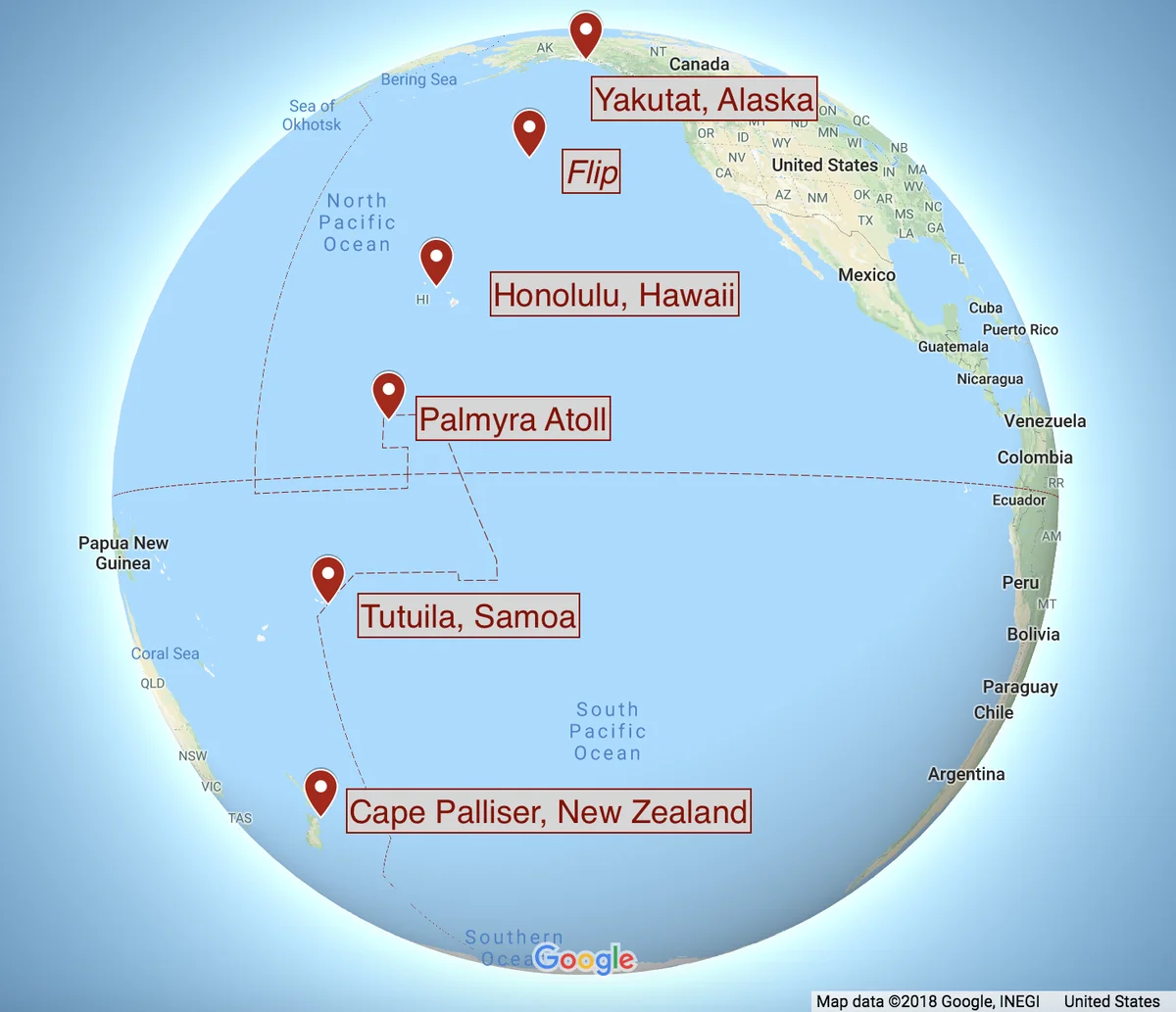
The empirical dataset comes from the classic 1966 Snodgrass‑Munk Pacific swell campaign. Six stations were deployed along a great‑circle track, but only four (Tutuila, Palmyra, Honolulu, Yakutat) provided usable power‑density spectra for three selected swells (August 1.9, August 13.7, July 23.2). The original measurements lacked phase information, so the authors reconstructed time‑series realizations by digitizing the spectra, converting dB to linear energy density, discretizing into frequency bins of width Δf = 1/L (L = 3 h), assigning random phases, and performing an inverse discrete Fourier transform. This procedure yields initial conditions for the PDE simulations that respect the observed narrow‑band character (half‑width‑half‑maximum ratios HWHM / ω₀ ≈ 0.02–0.05).
Numerical integration of each model over the nondimensional propagation distance corresponding to the observed station separations reveals clear trends. The conservative NLS and Dysthe models dramatically under‑predict amplitude decay and fail to generate the observed FD; their solutions retain almost constant energy and spectral shape over the long distances. The dNLS model improves amplitude decay but, because its damping is frequency‑independent, it preserves the spectral mean and cannot reproduce FD. The vDysthe model captures both amplitude loss and some FD, yet it suffers from a non‑physical exponential growth of side‑bands far from the carrier when the linear damping term dominates, reflecting a known limitation of its linear‑in‑k damping assumption. The dGT model, by contrast, matches the measured amplitude attenuation and reproduces the observed downshift of both ω_p and ω_m across all three swells, without exhibiting the spurious side‑band growth.
A secondary finding concerns the role of nonlinearity. All four swell cases have steepness ε < 0.1, placing them within the weak‑nonlinear regime. The authors observe that the linearized versions of the dissipative models (i.e., dropping the cubic term) produce virtually identical predictions for amplitude and frequency evolution, indicating that nonlinear self‑modulation is negligible for these oceanic swells. Consequently, a simple linear dissipative model may be sufficient for operational forecasting of swell amplitude and spectral shift over basin scales.
The paper concludes that (1) incorporating dissipation is essential for realistic modeling of Pacific swell; (2) among the tested dissipative extensions, the dGT equation offers the most robust and physically consistent representation of both amplitude decay and frequency downshift; and (3) nonlinear effects, while mathematically elegant, do not substantially improve predictions for the low‑steepness swells examined. Limitations include the sparse spatial sampling (only four gauges), the absence of phase data, and the one‑dimensional reduction of a fundamentally two‑dimensional propagation problem. Nevertheless, this work provides the first systematic validation of dissipative NLS‑type models against historic ocean swell observations, bridging the gap between laboratory‑scale experiments and real‑world oceanography.
Comments & Academic Discussion
Loading comments...
Leave a Comment