Conformally Mapped Polynomial Chaos Expansions for Maxwell's Source Problem with Random Input Data
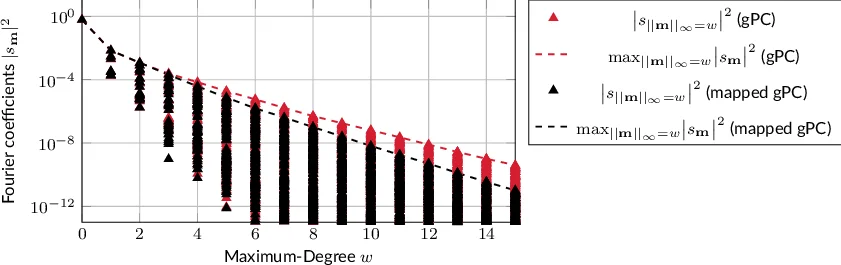
Generalized Polynomial Chaos (gPC) expansions are well established for forward uncertainty propagation in many application areas. Although the associated computational effort may be reduced in comparison to Monte Carlo techniques, for instance, further convergence acceleration may be important to tackle problems with high parametric sensitivities. In this work, we propose the use of conformal maps to construct a transformed gPC basis, in order to enhance the convergence order. The proposed basis still features orthogonality properties and hence, facilitates the computation of many statistical properties such as sensitivities and moments. The corresponding surrogate models are computed by pseudo-spectral projection using mapped quadrature rules, which leads to an improved cost accuracy ratio. We apply the methodology to Maxwell’s source problem with random input data. In particular, numerical results for a parametric finite element model of an optical grating coupler are given.
💡 Research Summary
This paper presents a novel method for accelerating uncertainty quantification in computational electromagnetics by combining Generalized Polynomial Chaos (gPC) expansions with conformal mapping techniques. The work is motivated by forward uncertainty propagation problems, such as those arising in the design of nanoscale optical and plasmonic components, where geometric and material parameters are subject to random variations. While gPC expansions are a standard tool for this task, offering spectral convergence for smooth, analytic quantities of interest (QoIs), their convergence rate is intrinsically limited by the region of analyticity of the QoI in the complex plane, typically characterized by a Bernstein ellipse.
The core innovation of this work is the construction of a new orthogonal basis designed to enhance this convergence rate. The authors propose applying a conformal map (g), specifically a “sausage mapping” which is a polynomial approximation of the inverse sine function, to the input parameter space. This transformation aims to map a standard Bernstein ellipse into a straighter, strip-like region in the complex plane. If the original QoI function Q(y) is analytic in such a strip, its transformed counterpart h(s)=Q(g(s)) will be analytic within a larger Bernstein ellipse. Since the convergence rate of polynomial approximation is directly tied to the size of this ellipse, a faster convergence is achieved for approximating h(s).
The new basis functions are defined as Φ_m(y) = (Ψ̃_m ∘ g^(-1))(y), where Ψ̃_m are polynomials orthonormal with respect to the transformed probability density ˜ρ(s) = ρ(g(s)) * g’(s). A critical property is that this constructed basis {Φ_m} remains orthonormal under the original input probability measure ρ. This preserves all advantageous statistical properties of standard gPC, allowing for direct computation of moments and sensitivity indices (e.g., Sobol indices) from the expansion coefficients.
To compute these coefficients via pseudo-spectral projection, the authors develop a “mapped quadrature” rule. The integral for the coefficients is evaluated by applying a change of variables (y=g(s)) and then using standard Gaussian quadrature tailored to the transformed density ˜ρ. The quadrature nodes are then mapped back to the original parameter space via g, ensuring that the expensive underlying model (e.g., a finite element solver) is only ever evaluated at real-valued inputs, avoiding the need for complex extensions.
The methodology is applied to Maxwell’s source problem for a periodic structure excited by a plane wave, a scenario relevant for modeling optical grating couplers. The QoI is the fundamental reflection coefficient, and uncertainties are introduced in the geometry of material interfaces. Numerical results first demonstrate the principle on an analytic RLC circuit model, then on a full 3D parametric finite element model of a metal-insulator-metal plasmonic grating coupler. The results clearly show that the conformally mapped gPC approach achieves a given level of accuracy with significantly fewer solver evaluations compared to the standard gPC method. This demonstrates a substantially improved cost-accuracy ratio, making high-fidelity uncertainty quantification for computationally expensive electromagnetic models more feasible. The paper concludes that the integration of conformal maps provides a powerful and practical tool for convergence acceleration in polynomial chaos-based surrogate modeling for problems with high parametric sensitivity.
Comments & Academic Discussion
Loading comments...
Leave a Comment