Partition bound is quadratically tight for product distributions
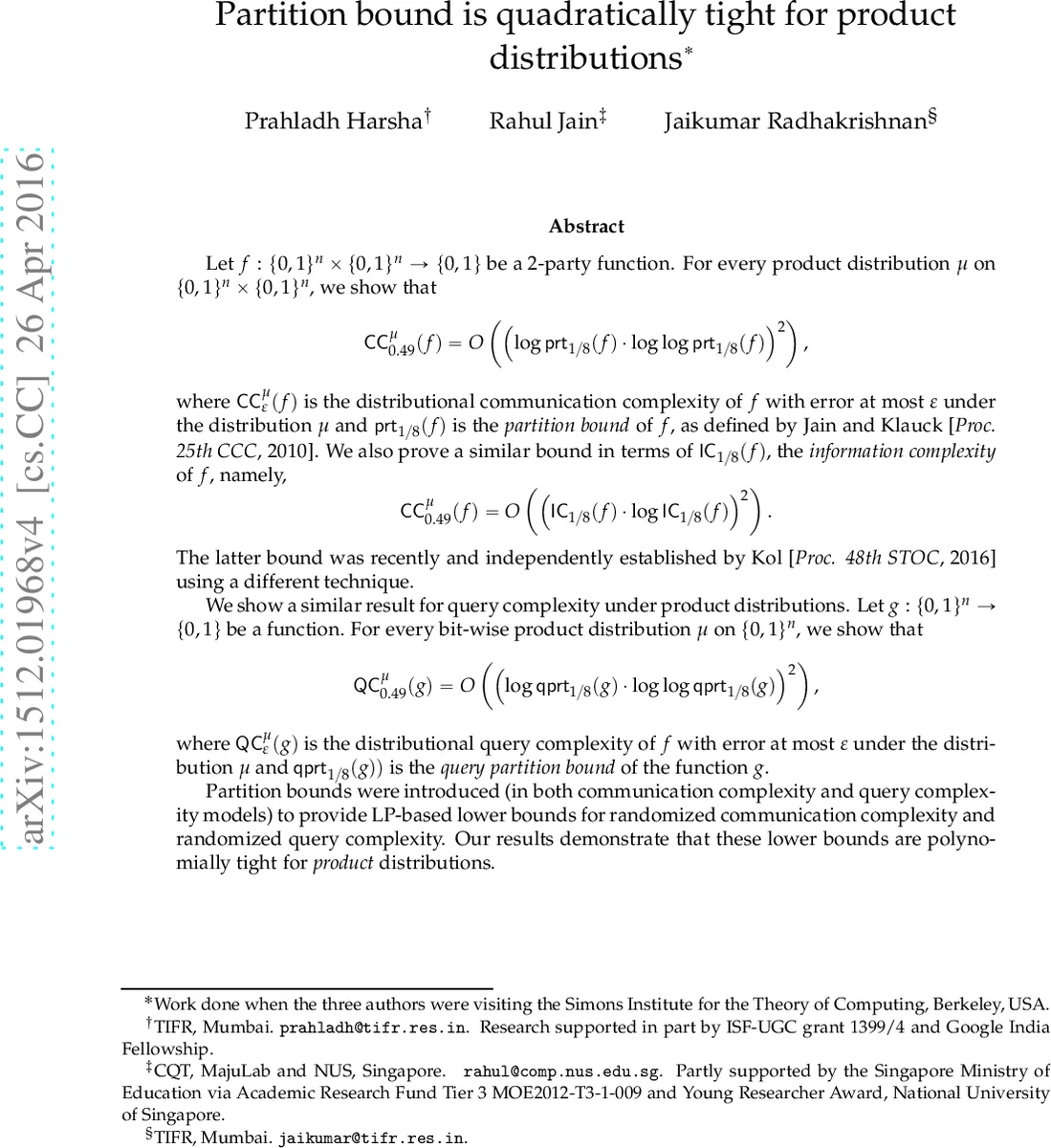
Let $f : {0,1}^n \times {0,1}^n \rightarrow {0,1}$ be a 2-party function. For every product distribution $\mu$ on ${0,1}^n \times {0,1}^n$, we show that $$\mathsf{CC}^\mu_{0.49}(f) = O\left(\left(\log \mathsf{prt}{1/8}(f) \cdot \log \log \mathsf{prt}{1/8}(f)\right)^2\right),$$ where $\mathsf{CC}^\mu_\varepsilon(f)$ is the distributional communication complexity of $f$ with error at most $\varepsilon$ under the distribution $\mu$ and $\mathsf{prt}{1/8}(f)$ is the {\em partition bound} of $f$, as defined by Jain and Klauck [{\em Proc. 25th CCC}, 2010]. We also prove a similar bound in terms of $\mathsf{IC}{1/8}(f)$, the {\em information complexity} of $f$, namely, $$\mathsf{CC}^\mu_{0.49}(f) = O\left(\left(\mathsf{IC}{1/8}(f) \cdot \log \mathsf{IC}{1/8}(f)\right)^2\right).$$ The latter bound was recently and independently established by Kol [{\em Proc. 48th STOC}, 2016] using a different technique. We show a similar result for query complexity under product distributions. Let $g : {0,1}^n \rightarrow {0,1}$ be a function. For every bit-wise product distribution $\mu$ on ${0,1}^n$, we show that $$\mathsf{QC}^\mu_{0.49}(g) = O\left(\left( \log \mathsf{qprt}{1/8}(g) \cdot \log \log\mathsf{qprt}{1/8}(g) \right)^2 \right),$$ where $\mathsf{QC}^\mu_{\varepsilon}(g)$ is the distributional query complexity of $f$ with error at most $\varepsilon$ under the distribution $\mu$ and $\mathsf{qprt}_{1/8}(g))$ is the {\em query partition bound} of the function $g$. Partition bounds were introduced (in both communication complexity and query complexity models) to provide LP-based lower bounds for randomized communication complexity and randomized query complexity. Our results demonstrate that these lower bounds are polynomially tight for {\em product} distributions.
💡 Research Summary
The paper investigates the tightness of the partition bound—a linear‑programming based lower bound introduced by Jain and Klauck—for two‑party communication complexity and query complexity when inputs are drawn from product (independent) distributions. The authors prove that, for any Boolean function f : {0,1}ⁿ × {0,1}ⁿ → {0,1} and any product distribution μ, the distributional communication complexity with error at most 0.49 satisfies
CC⁽μ⁾₀.₄₉(f) = O!\Big(\big(\log prt₁⁄₈(f)·\log \log prt₁⁄₈(f)\big)²\Big).
Here prt₁⁄₈(f) denotes the partition bound with error 1/8. An analogous bound holds in terms of the (worst‑case) information complexity IC₁⁄₈(f):
CC⁽μ⁾₀.₄₉(f) = O!\Big(\big(IC₁⁄₈(f)·\log IC₁⁄₈(f)\big)²\Big).
The second inequality matches a recent independent result of Kol (STOC 2016), who obtained a bound of the form O(IC⁽μ⁾·polylog IC⁽μ⁾) for each product distribution μ. The present work, however, expresses the bound using the global information complexity IC₁⁄₈(f), which is the maximum of IC⁽μ⁾₁⁄₈(f) over all μ.
The proof proceeds by relating the partition bound to the smooth‑rectangle bound, a relaxation that can be expressed as a linear program. The authors show that for product distributions the smooth‑rectangle bound can be made arbitrarily small by reducing the error parameter δ, and that it is upper‑bounded (up to logarithmic factors) by both the partition bound and the information complexity. The key technical step is a recursive construction of a communication protocol tree with few leaves. Starting from an optimal LP solution for the smooth‑rectangle bound, they locate a large “biased rectangle”—a region where the output is heavily skewed toward one value. The input space is then partitioned into three parts: the biased rectangle, a sub‑problem where the smooth‑rectangle value drops by a constant factor, and a region whose μ‑mass shrinks significantly. By iterating this decomposition, they obtain a protocol whose number of leaves is O(log srec·log log srec), where srec denotes the smooth‑rectangle bound. Since the communication cost of a protocol is at most the logarithm of its number of leaves, the final bound becomes quadratic in the logarithm of the partition bound (with an extra log log factor).
The paper also extends the analysis to query complexity. For any Boolean function g : {0,1}ⁿ → {0,1} and any bit‑wise product distribution μ, the distributional query complexity with error 0.49 satisfies
QC⁽μ⁾₀.₄₉(g) = O!\Big(\big(\log qprt₁⁄₈(g)·\log \log qprt₁⁄₈(g)\big)²\Big),
where qprt denotes the query partition bound. The proof mirrors the communication‑complexity argument but uses the Nisan‑Wigderson approach to construct a decision tree with a bounded number of leaves, again leveraging the product structure of μ.
Overall, the results demonstrate that for product distributions the partition bound (and consequently the information complexity) is quadratically tight up to logarithmic factors. This establishes that LP‑based lower bounds are not merely asymptotic barriers but provide near‑optimal estimates for a broad class of distributions. The work leaves open the challenge of extending such tightness results to non‑product (correlated) distributions, where exponential separations between information complexity and communication complexity are known.
Comments & Academic Discussion
Loading comments...
Leave a Comment