Low-signal limit of X-ray single particle imaging
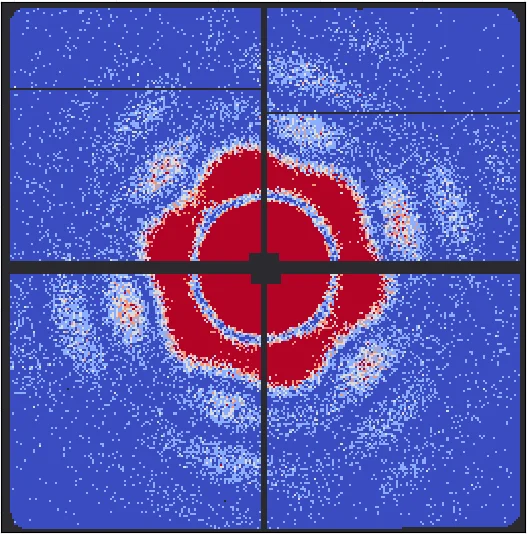
An outstanding question in X-ray single particle imaging experiments has been the feasibility of imaging sub 10-nm-sized biomolecules under realistic experimental conditions where very few photons are expected to be measured in a single snapshot and instrument background may be significant relative to particle scattering. While analyses of simulated data have shown that the determination of an average image should be feasible using Bayesian methods such as the EMC algorithm, this has yet to be demonstrated using experimental data containing realistic non-isotropic instrument background, sample variability and other experimental factors. In this work, we show that the orientation and phase retrieval steps work at photon counts diluted to the signal levels one expects from smaller molecules or with weaker pulses, using data from experimental measurements of 60-nm PR772 viruses. Even when the signal is reduced to a fraction as little as 1/256, the virus electron density determined using ab initio phasing is of almost the same quality as the high-signal data. However, we are still limited by the total number of patterns collected, which may soon be mitigated by the advent of high repetition-rate sources like the European XFEL and LCLS-II.
💡 Research Summary
This paper presents a groundbreaking experimental demonstration of the resilience of X-ray single particle imaging (SPI) techniques at extremely low signal levels, moving beyond previous simulation-based predictions. The central question addressed is whether practical experimental hurdles—such as significant non-isotropic instrument background and sample heterogeneity—pose a fundamental barrier to imaging small biomolecules (<10 nm) with X-ray free-electron lasers (XFELs), where each diffraction snapshot contains very few photons.
The study uses experimental data from 60-nm PR772 viruses, collected at the Linac Coherent Light Source (LCLS). The authors employed a established two-step reconstruction pipeline: 1) Orientation determination and 3D intensity merging using the EMC algorithm (implemented in Dragonfly), which assigns orientations and scale factors to each of the 14,772 diffraction patterns; and 2) Iterative phase retrieval using a novel background-aware algorithm. This phasing algorithm uniquely models a spherically symmetric instrument background component separately from the particle’s diffraction signal and employs a support constraint based on a fixed number of voxels, successfully reconstructing the virus’s electron density to 8.5 nm resolution.
The core experiment involved diluting this original high-signal dataset by randomly keeping only a fraction of the photons in each pattern. Dilution factors ranged from 1/2 down to 1/256, with the latter resulting in patterns containing an average of only about 136 photons per frame—a level comparable to what might be expected from much smaller particles like single proteins or from using much weaker X-ray pulses.
Remarkably, the quality of the final 3D electron density reconstruction, as quantified by metrics like the Fourier Shell Correlation (FSC) and Phase Retrieval Transfer Function (PRTF), remained almost unchanged even at the lowest signal level (1/256 dilution). This proves that the algorithmic pipeline—particularly the orientation recovery (EMC) and the modified phasing routine—is robust against the fundamental Poisson noise statistics associated with very low photon counts and can handle realistic experimental background.
The findings have two major implications. First, they suggest that imaging sub-10-nm biomolecules with current XFEL parameters is algorithmically feasible, provided a proportionate reduction in instrument background can be achieved. Second, they indicate that useful data could be obtained from particles of this size using the much weaker but high-repetition-rate pulses expected from upcoming sources like LCLS-II.
The paper concludes by identifying the primary current limitation not as signal per pattern, but as the total number of patterns collected. Achieving higher resolution requires significantly more patterns to improve statistics. The advent of high-repetition-rate XFEL sources (e.g., European XFEL, LCLS-II), capable of producing hundreds of thousands to millions of patterns per experiment, is highlighted as the key development that will soon overcome this bottleneck and potentially enable SPI to reach near-atomic resolution.
Comments & Academic Discussion
Loading comments...
Leave a Comment