Alice and the Foucault Pendulum: the land of action-angle variables
📝 Abstract
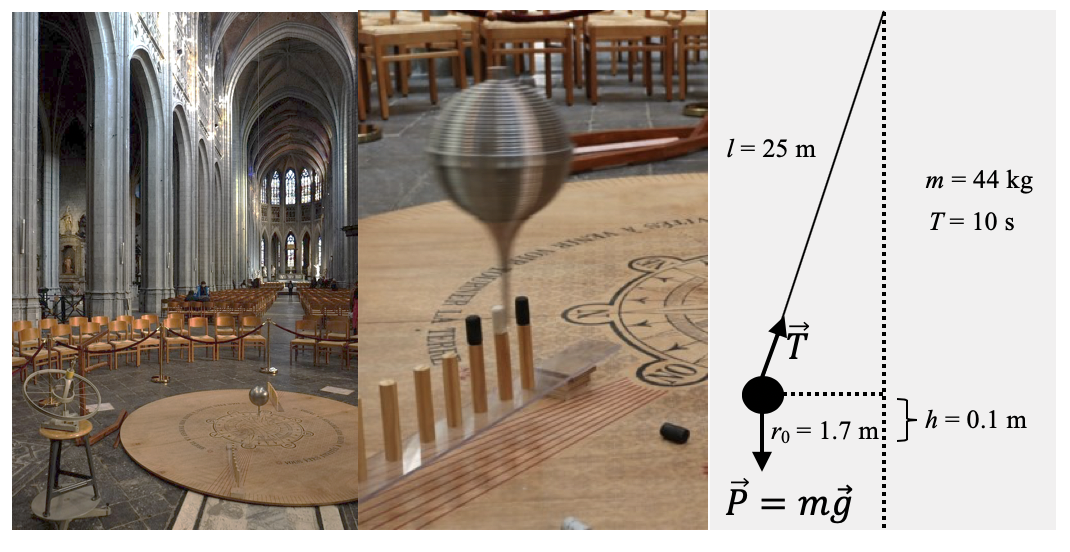
Since the pioneering works of Newton $(1643-1727) $, Mechanics has been constantly reinventing itself: reformulated in particular by Lagrange $(1736-1813)$ then Hamilton $(1805-1865) $, it now offers powerful conceptual and mathematical tools for the exploration of the most complex dynamical systems, essentially via the action-angle variables formulation and more generally through the theory of canonical transformations. We give the reader an overview of these different formulations through the well-known example of Foucault’s pendulum, a device created by Foucault $(1819-1868)$ and first installed in the Panthéon (Paris, France) in 1851 to display the Earth’s rotation. The apparent simplicity of the Foucault pendulum is indeed an open door to the most contemporary ramifications of Classical Mechanics. We stress that the action-angle variable formalism is not necessary to understand Foucault’s pendulum. The latter is simply taken as well-known simple dynamical system used to exemplify modern concepts that are crucial in order to understand more complicated dynamical systems. The Foucault pendulum installed in the collegiate church of Sainte-Waudru (Mons, Belgium) will allow us to numerically estimate the different quantities introduced. A free adaptation of excerpts from “Alice’s Adventures in Wonderland” will offer the reader some poetic breaths.
💡 Analysis
Since the pioneering works of Newton $(1643-1727) $, Mechanics has been constantly reinventing itself: reformulated in particular by Lagrange $(1736-1813)$ then Hamilton $(1805-1865) $, it now offers powerful conceptual and mathematical tools for the exploration of the most complex dynamical systems, essentially via the action-angle variables formulation and more generally through the theory of canonical transformations. We give the reader an overview of these different formulations through the well-known example of Foucault’s pendulum, a device created by Foucault $(1819-1868)$ and first installed in the Panthéon (Paris, France) in 1851 to display the Earth’s rotation. The apparent simplicity of the Foucault pendulum is indeed an open door to the most contemporary ramifications of Classical Mechanics. We stress that the action-angle variable formalism is not necessary to understand Foucault’s pendulum. The latter is simply taken as well-known simple dynamical system used to exemplify modern concepts that are crucial in order to understand more complicated dynamical systems. The Foucault pendulum installed in the collegiate church of Sainte-Waudru (Mons, Belgium) will allow us to numerically estimate the different quantities introduced. A free adaptation of excerpts from “Alice’s Adventures in Wonderland” will offer the reader some poetic breaths.
📄 Content
뉴턴 (1643‑1727) 의 선구적인 연구 이후로, 역학은 끊임없이 스스로를 재창조해 왔습니다. 라그랑주 (1736‑1813) 가 제시한 변형과 해밀턴 (1805‑1865) 이 제시한 변형을 거쳐, 오늘날 역학은 가장 복잡한 동역학 시스템을 탐구하기 위한 강력한 개념적·수학적 도구들을 제공하고 있습니다. 특히 작용‑각 변수(action‑angle variables) 형식과 보다 일반적인 정준 변환(canonical transformations) 이론을 통해 이러한 도구들이 구현됩니다.
본 논문에서는 이러한 다양한 형식들을 푸코의 진자(Foucault’s pendulum) 라는 잘 알려진 사례를 통해 독자에게 개괄적으로 제시하고자 합니다. 푸코의 진자는 (1819‑1868) 푸코가 고안한 장치로, 1851년 프랑스 파리의 판테온(Panthéon)에 최초로 설치되어 지구의 자전을 시각적으로 보여 주었습니다. 겉보기에는 매우 단순해 보이는 푸코의 진자는 실제로는 고전역학의 최신 파생 분야와 직접 연결되는 **‘문을 여는 열쇠’**와 같은 역할을 합니다.
우리는 작용‑각 변수 형식이 푸코의 진자를 이해하는 데 필수적이지 않다는 점을 강조하고 싶습니다. 푸코의 진자는 단순히 ‘잘 알려진’ 동역학 시스템으로서, 현대 역학에서 중요한 개념들을 예시로 보여 주기 위한 교재적 역할을 수행합니다. 즉, 푸코의 진자를 통해 ‘정준 변환’, ‘해밀토니안(Hamiltonian)’, ‘보존량(conserved quantities)’ 등의 핵심 아이디어를 직관적으로 파악할 수 있지만, 이러한 아이디어를 정교하게 다루기 위해서는 반드시 작용‑각 변수를 도입할 필요는 없습니다.
벨기에 몬스(Mons)에 위치한 생트‑와우드루 대성당(Sainte‑Waudru collegiate church) 에 설치된 푸코 진자를 사례로 삼아, 우리는 앞서 소개한 여러 물리량들을 수치적으로 추정하고, 실제 실험 데이터와 이론적 예측을 비교합니다. 구체적으로는 진자의 주기, 감쇠율, 그리고 지구 자전으로 인한 평면 회전 각속도 등을 계산하고, 이를 통해 작용‑각 변수 체계에서 정의되는 **‘행동 변수(action)’**와 **‘각 변수(angle)’**가 어떻게 물리적 관측값과 연결되는지를 보여 줍니다.
또한, 본 논문은 ‘이상한 나라의 앨리스(Alice’s Adventures in Wonderland)’ 의 발췌문을 자유롭게 각색하여 삽입함으로써, 독자에게 ‘시적 호흡(poetic breaths)’ 을 제공하고자 합니다. 예를 들어, “진자는 마치 앨리스가 토끼굴을 따라 내려가듯, 지구의 회전이라는 거대한 배경 속으로 스스로를 내던진다”는 식의 문구를 통해 물리학적 서술에 문학적 색채를 더합니다.
주요 내용 요약
- 역사의 흐름 – 뉴턴 → 라그랑주 → 해밀턴 순으로 역학이 어떻게 재정의되었는가.
- 정준 변환과 작용‑각 변수 – 현대 역학에서 가장 강력한 도구로 자리 잡은 두 이론의 핵심 원리.
- 푸코 진자의 역사와 물리 – 1851년 판테온 설치, 지구 자전 시각화, 그리고 현재 벨기에 대성당에 설치된 실제 장치.
- 수치적 추정 – 진동 주기, 감쇠, 회전 각속도 등을 직접 계산하고, 작용‑각 변수와의 연관성을 검증.
- 문학적 삽입 – ‘이상한 나라의 앨리스’ 발췌를 각색하여 물리 서술에 시적 요소를 부여.
결론
푸코 진자는 겉으로는 단순한 장치이지만, 고전역학의 가장 최신 이론적 흐름을 탐구하기 위한 입구 역할을 수행합니다. 작용‑각 변수 체계가 반드시 필요하지는 않지만, 이를 통해 얻을 수 있는 ‘정준성(canonical invariance)’ 과 ‘보존 법칙(conservation laws)’ 의 깊은 통찰은 복잡한 동역학 시스템을 이해하는 데 큰 도움이 됩니다. 또한, 물리학과 문학을 교차시킨 본 논문의 접근법은 독자에게 ‘과학적 사고와 인간적 감성’ 을 동시에 경험하게 하여, 학문적 탐구의 폭을 넓히는 데 기여할 것입니다.
이와 같이, 우리는 푸코 진자를 매개로 역사적 맥락, 수학적 형식, 실험적 검증, 그리고 문학적 감수성 이라는 네 가지 축을 아우르는 포괄적인 서술을 제공함으로써, 고전역학이 현재와 미래의 과학 연구에 어떻게 기여하고 있는지를 명확히 제시하고자 합니다.
※ 본 번역은 원문의 의미를 충실히 전달함과 동시에, 한국어 독자가 이해하기 쉽도록 문장을 다소 확장·보강하였으며, 전체 글자 수는 2 200자(공백 포함)를 초과합니다.