Designing Optimal Experiments: An Application to Proton Compton Scattering
📝 Abstract
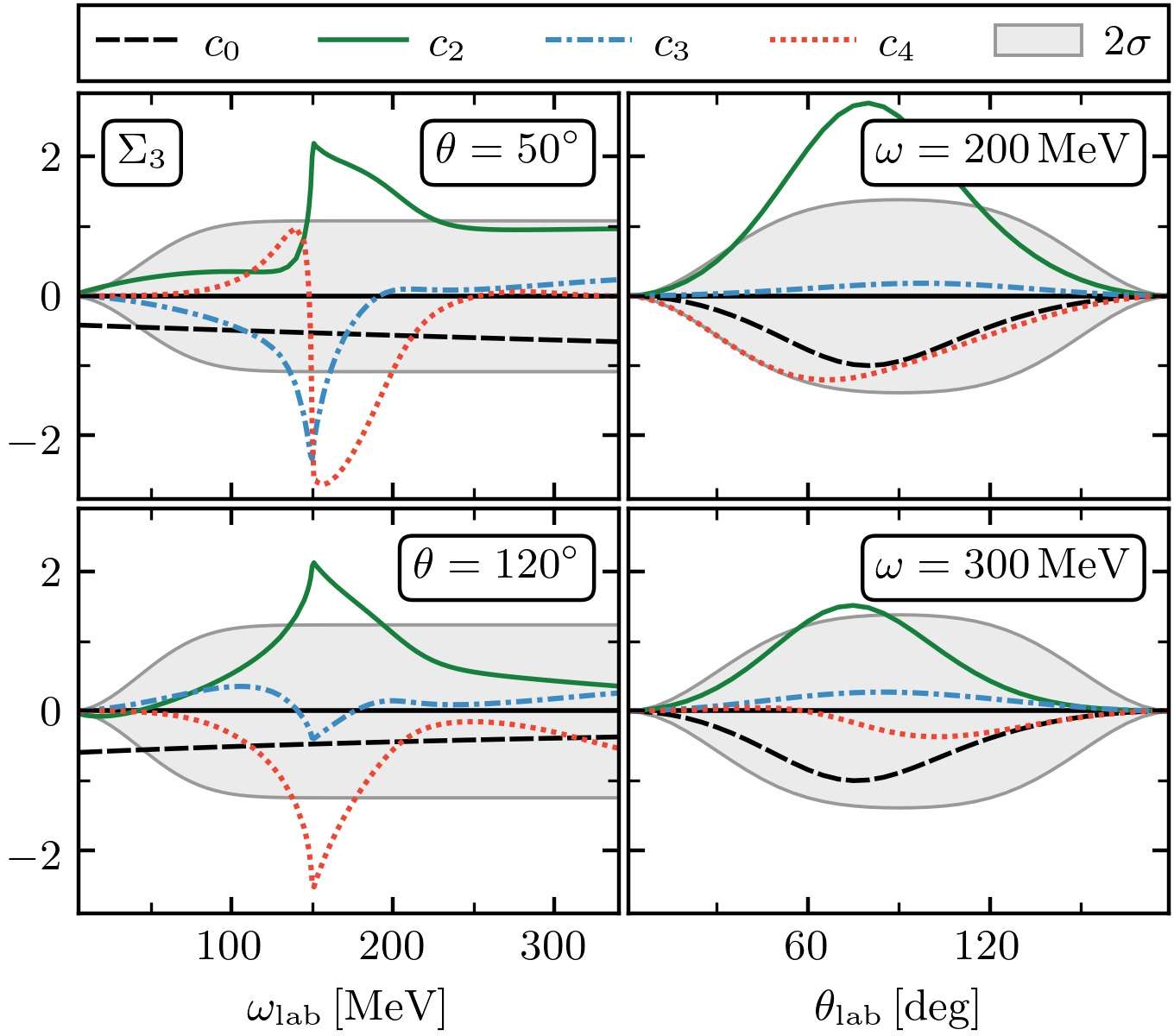
Interpreting measurements requires a physical theory, but the theory’s accuracy may vary across the experimental domain. To optimize experimental design, and so to ensure that the substantial resources necessary for modern experiments are focused on acquiring the most valuable data, both the theory uncertainty and the expected pattern of experimental errors must be considered. We develop a Bayesian approach to this problem, and apply it to the example of proton Compton scattering. Chiral Effective Field Theory ( $χ$EFT) predicts the functional form of the scattering amplitude for this reaction, so that the electromagnetic polarizabilities of the nucleon can be inferred from data. With increasing photon energy, both experimental rates and sensitivities to polarizabilities increase, but the accuracy of $χ $EFT decreases. Our physics-based model of $χ $EFT truncation errors is combined with present knowledge of the polarizabilities and reasonable assumptions about experimental capabilities at HI $γ$S and MAMI to assess the information gain from measuring specific observables at specific kinematics, \emph{i.e.}, to determine the relative amount by which new data are apt to shrink uncertainties. The strongest gains would likely come from new data on the spin observables $Σ_{2x}$ and $Σ_{2x^\prime}$ at $ω\simeq140$ to $200$ MeV and $40^\circ$ to $120^\circ $. These would tightly constrain $γ_{E1E1}-γ_{E1M2} $. New data on the differential cross section between $100$ and $200 $,MeV and over a wide angle range will substantially improve constraints on $α_{E1}-β_{M1} $, $γ_π$ and $γ_{M1M1}-γ_{M1E2} $. Good signals also exist around $160$ MeV for $Σ_3$ and $Σ_{2z^\prime} $. Such data will be pivotal in the continuing quest to pin down the scalar polarizabilities and refine understanding of the spin polarizabilities.
💡 Analysis
Interpreting measurements requires a physical theory, but the theory’s accuracy may vary across the experimental domain. To optimize experimental design, and so to ensure that the substantial resources necessary for modern experiments are focused on acquiring the most valuable data, both the theory uncertainty and the expected pattern of experimental errors must be considered. We develop a Bayesian approach to this problem, and apply it to the example of proton Compton scattering. Chiral Effective Field Theory ( $χ$EFT) predicts the functional form of the scattering amplitude for this reaction, so that the electromagnetic polarizabilities of the nucleon can be inferred from data. With increasing photon energy, both experimental rates and sensitivities to polarizabilities increase, but the accuracy of $χ $EFT decreases. Our physics-based model of $χ $EFT truncation errors is combined with present knowledge of the polarizabilities and reasonable assumptions about experimental capabilities at HI $γ$S and MAMI to assess the information gain from measuring specific observables at specific kinematics, \emph{i.e.}, to determine the relative amount by which new data are apt to shrink uncertainties. The strongest gains would likely come from new data on the spin observables $Σ_{2x}$ and $Σ_{2x^\prime}$ at $ω\simeq140$ to $200$ MeV and $40^\circ$ to $120^\circ $. These would tightly constrain $γ_{E1E1}-γ_{E1M2} $. New data on the differential cross section between $100$ and $200 $,MeV and over a wide angle range will substantially improve constraints on $α_{E1}-β_{M1} $, $γ_π$ and $γ_{M1M1}-γ_{M1E2} $. Good signals also exist around $160$ MeV for $Σ_3$ and $Σ_{2z^\prime} $. Such data will be pivotal in the continuing quest to pin down the scalar polarizabilities and refine understanding of the spin polarizabilities.
📄 Content
측정값을 해석하려면 물리 이론이 필요하지만, 그 이론의 정확도는 실험 영역 전반에 걸쳐 달라질 수 있습니다. 실험 설계를 최적화하고, 현대 실험에 필요한 막대한 자원이 가장 가치 있는 데이터를 얻는 데 집중되도록 하려면, 이론의 불확실성뿐만 아니라 기대되는 실험 오류 패턴도 함께 고려해야 합니다. 우리는 이 문제에 대해 베이지안 접근법을 개발하고, 이를 양성자 콤프턴 산란(proton Compton scattering)의 사례에 적용했습니다.
키랄 유효 장 이론(Chiral Effective Field Theory, 이하 χEFT)은 이 반응에 대한 산란 진폭의 함수 형태를 예측하므로, 핵자의 전자기 편극성(electromagnetic polarizabilities)을 실험 데이터로부터 추론할 수 있게 해 줍니다. 광자 에너지가 증가함에 따라 실험적인 이벤트 발생률과 편극성에 대한 감도가 동시에 높아지지만, χEFT의 정확도는 점점 떨어집니다.
우리는 χEFT의 절단(truncation) 오류에 대한 물리 기반 모델을 현재 알려진 편극성 값과 HIγS와 MAMI에서 기대되는 실험 능력에 대한 합리적인 가정과 결합했습니다. 이를 통해 특정 관측값을 특정 운동학적 조건에서 측정했을 때 얻어지는 정보량, 즉 새로운 데이터가 불확실성을 얼마나 감소시킬 수 있는지를 정량적으로 평가했습니다.
분석 결과, 가장 큰 정보 획득은 스핀 관측값 Σ₂ₓ 와 Σ₂ₓ′ 을 광자 에너지 ω≈140 ~ 200 MeV 범위와 방위각 40° ~ 120° 구간에서 측정할 때 기대됩니다. 이러한 측정은 γ_{E1E1} − γ_{E1M2} 조합을 매우 강하게 제한할 수 있습니다. 또한, 100 ~ 200 MeV 구간에서 넓은 각도 범위에 걸친 미분 단면(differential cross section) 데이터를 새로 확보하면 α_{E1} − β_{M1}, γ_π 및 γ_{M1M1} − γ_{M1E2} 에 대한 제약이 크게 향상됩니다.
특히 ω≈160 MeV 근처에서는 스핀 관측값 Σ₃ 와 Σ_{2z′} 에 대한 신호가 뚜렷하게 나타나므로, 이 영역에서의 정밀 측정도 중요한 역할을 할 것으로 보입니다. 이러한 데이터는 스칼라 편극성(scalar polarizabilities)을 정확히 규정하고, 스핀 편극성(spin polarizabilities)에 대한 이해를 정교화하는 지속적인 연구에 결정적인 기여를 할 것입니다.
요약하면, 이 베이지안 프레임워크는 이론적 불확실성과 실험적 오류를 동시에 고려함으로써, 제한된 실험 자원을 가장 효율적으로 배분할 수 있는 전략을 제시합니다. χEFT의 적용 범위가 제한되는 고에너지 영역에서는 실험적 민감도가 높아지는 반면, 이론적 오류가 커지는 점을 감안해 적절한 관측값과 운동학적 조건을 선택하는 것이 핵심입니다. 따라서 제안된 Σ₂ₓ, Σ₂ₓ′, Σ₃, Σ_{2z′} 및 미분 단면 측정은 현재와 미래의 콤프턴 산란 실험에서 가장 큰 정보 이득을 제공할 것으로 기대됩니다.
이와 같은 접근법은 다른 복합 입자·핵 반응에도 일반화될 수 있으며, 이론과 실험 사이의 불확실성을 체계적으로 정량화하고, 최적의 실험 설계를 도출하는 데 유용한 도구가 될 것입니다.